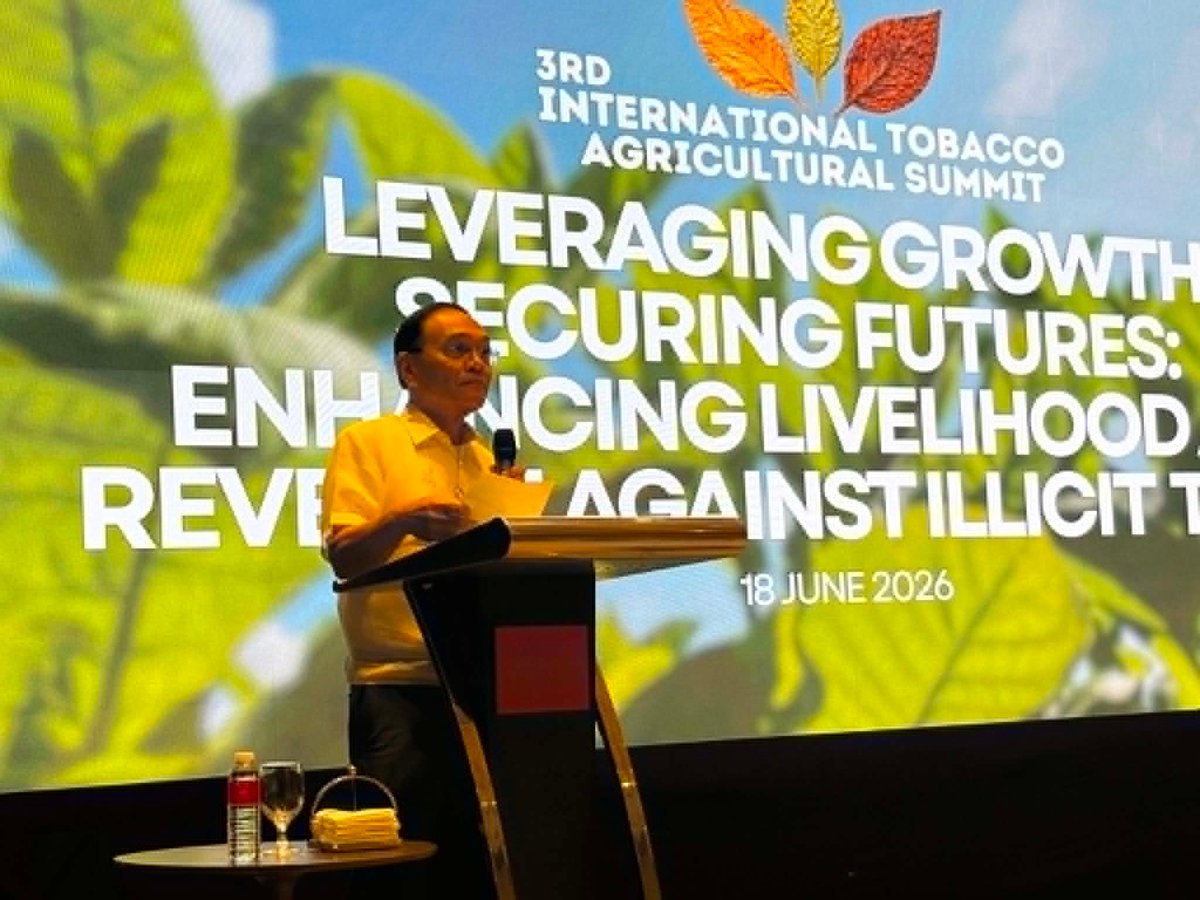
During the Third International Tobacco Summit, government officials highlighted the need to move beyond seizures and arrests by targeting criminal networks, strengthening prosecutions, and protecting legitimate tobacco stakeholders from unfair competition.
Agriculture Undersecretary for Operations and Agri-Fisheries Mechanization Roger V. Navarro said illegal manufacturing and marketing of tobacco products reduce government income while placing legal farmers at a disadvantage.
“The Philippine government’s recent estimates place the reduction in revenues at around P50 billion annually. That is how much revenue is being lost. That is also the scale of the illegal tobacco trade. This is why we really need to stop it.”
Navarro also emphasized the importance of enforcement agencies in sustaining the tobacco sector, citing the role of the Philippine Coast Guard (PCG) and the Philippine National Police (PNP) in disrupting illegal activities.
Meanwhile, the PNP reported significant gains in its anti-illicit tobacco operations. From 1 January to 16 June, 2026, authorities conducted 8,986 operations nationwide, resulting in the arrest of 2,560 individuals and the filing of cases before the courts.
The estimated value of confiscated smuggled cigarettes and equipment during the period reached P8.63 billion, according to former Police Brigadier General Rogelio P. Penones, former Regional Director of the PNP Police Regional Office.
Among the areas and units that recorded major seizures were Police Regional Office 13 (Caraga) with P3.38 billion, Police Regional Office 7 (Central Visayas) with P1.27 billion, and the Criminal Investigation and Detection Group (CIDG) with P1.04 billion worth of confiscated goods.
Penones stressed that enforcement should focus not only on removing illegal products from circulation but also on dismantling the criminal groups behind the trade.
“Our approach now goes beyond the perception of illegal goods and the arrest of warriors. We deliberately target the criminal ecosystem, identifying syndicates, mapping,” he said.
He added that successful operations must result in strong evidence-based cases that lead to prosecution and conviction through proper investigation, evidence preservation, and coordination with prosecutors.
The Bureau of Customs (BOC) also reported billions of pesos in seizures linked to illicit tobacco activities. Deputy Commissioner Emmanuel Licup said the agency confiscated more than P5.6 billion worth of illicit cigarettes and tobacco products and approximately P1.6 billion worth of illegal vape products this year.
Licup said investigations have pointed to areas such as Manila and Cebu, while authorities continue to determine the full scope of the illegal trade network. He noted that the problem involves both imported illicit products and local illegal manufacturing operations.
“Our investigation points to Manila and Cebu. We cannot yet conclude where they are exactly coming from, but I am sure it is not only one source. I realized that many of the illicit manufacturing operations we have apprehended are not purely imported. I initially thought these were all imported products, but these also come from those provinces.”
The Department of Justice (DOJ), meanwhile, highlighted the role of stronger legal mechanisms in addressing economic sabotage. Prosecutor General Richard Anthony Fadullon cited the Anti-Agricultural Economic Sabotage Act or Republic Act No. 12022, signed in September 2024, as a key measure against smuggling, profiteering, and cartel activities.
Fadullon said the law aims to protect farmers, fisherfolk, and consumers from criminal groups that manipulate agricultural products, while ensuring accountability for those involved in economic sabotage.
As the Philippines takes a larger role in regional cooperation, officials said stronger coordination with neighboring countries will be necessary to address cross-border smuggling networks. National Tobacco Administration (NTA) Administrator Belinda Sanchez emphasized the need for intelligence sharing, technology-based monitoring, and cooperation among customs, regulatory, and law enforcement agencies.
She said enforcement success should not only be measured by the number of raids conducted or products seized, but by the ability to protect legitimate livelihoods, preserve government revenues, and ensure that those benefiting from illicit trade are held accountable.