
Cayetano bloc petitions SC: Leadership revamp triggered by 3 June 'rump session' void from the start
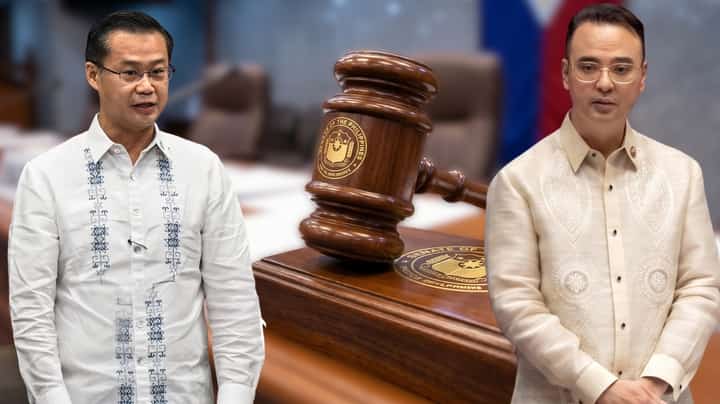
SENATE Pro Tempore Sherwin Gatchalian (left) and Senate President Alan Peter Cayetano (right) are locked in a standoff over control of the Senate, with both sides disputing each other’s headcount.
PHOTOGRAPH BY DAILY TRIBUNE IMAGE AND AGENCE FRANCE-PRESSE
The faction led by Senator Alan Cayetano finally brought the chamber’s weeks-long leadership row before the Supreme Court on Tuesday, asking the body to nullify the 3 June “rump session” that allowed Senator Win Gatchalian and allies to take over the Senate.
The filing came one day before the Senate convenes for a special session, an avenue seen as a way to break the Senate impasse amid growing speculation that some senators allied with Cayetano may switch sides and join the rival faction backing Gatchalian.
The omission of Senators Joel Villanueva and Mark Villar—both allied with Cayetano’s bloc—as petitioners further intensified the rumor. Although Villar’s office pointed to his current stay abroad as the reason for his not signing the document.
Aside from Cayetano, the petitioners comprised Senators Loren Legarda, Pia Cayetano, Jinggoy Estrada, Bong Go, Rodante Marcoleta, Imee Marcos, Robin Padilla, Camille Villar, and lawyer Jose Luis Montales, who was also removed as Senate secretary as a result of the revamp.
The petitioners urged the SC to reverse the 3 June session, which they derided as unconstitutional “mob rule” for justifying the leadership change despite lacking a quorum.
“To allow unconstitutional, illegal, and questionable actions that flowed from such [a] null and void rump session would surrender constitutional fiat to the whims and caprices of 12 people who have hijacked a co-equal branch of government. With all due respect, this should not be allowed,” a portion of the 87-page filing reads.
The session was called to order on that day after 12 senators showed up at the session hall, despite the absence of the Cayetano bloc, who had boycotted the session since 1 June.
Earlier, Cayetano and allies explained that the three-day boycott was in protest of what they derided as “selective prosecution,” which led to Estrada's arrest on plunder charges tied to the flood control scandal on 1 June.
The surprise appearance of Senator Chiz Escudero, formerly allied with Cayetano, broke the impasse on 3 June and allowed senators supportive of Gatchalian to declare all positions vacant and installed him as the Senate president pro tempore.
Gatchalian effectively replaced Legarda and has since acknowledged that his position as acting Senate leader has yet to be fully legalized, unless a senator from Cayetano’s camp switches allegiance and gives them the constitutionally mandated 13-vote threshold.
3 June revamp ‘no effect’
Cayetano and his allies’ petition argued that what transpired on 3 June was “unconstitutional, null, and void ab initio (from the start), and therefore “no legal effect” to the previous standing of the Senate.
“It necessarily follows that any outcome, output, and/or result flowing or resulting therefrom is inexistent and illegal,” the petition reads.
As a result, Cayetano and Legarda sought to restore their former top positions and reinstate their allies in their respective posts and committee chairmanships.
Gatchalian and allies have justified the legality of the 12-member quorum, citing previous Senate precedents, particularly the landmark 1949 Supreme Court case (Avelino v. Cuenco), which allowed the adjustment of the base number of senators when certain members are legally beyond the Senate's coercive reach.
Because of this, they repeatedly insisted that the simple majority has been reduced to 12 because their base has dropped from 24 to 22 due to the arrest of Senator Jinggoy Estrada and the continued hiding of Senator Bato dela Rosa, both under Cayetano’s bloc.
Cayetano’s bloc strongly rejected this, asserting that it goes against Section 16(2), Article VI of the Constitution, which mandates that at least 13 lawmakers should constitute a quorum to conduct business and elect new leaders.
A lack of quorum, they argued, would compel the Senate to adjourn and require the attendance of their absent colleagues.
“To allow unconstitutional, illegal, and questionable actions that flowed from such [a] null and void rump session would surrender constitutional fiat to the whims and caprices of 12 people who have hijacked a co-equal branch of government. With all due respect, this should not be allowed,” a portion of the 87-page filing reads.
SC ‘unlikely’ to meddle
Former Integrated Bar of the Philippines president Domingo Cayosa averred that only one senator breaking allegiance from Cayetano’s camp could break the standoff without the need for SC intervention.
Without it, however, the deadlock will persist, as the high court is unlikely to meddle in the business of a coequal branch.
Cayosa cited the petition filed by a high school teacher, Barry Tayam, as one of the glaring examples of the high court’s reluctance to interfere with a highly political issue.
Tayam’s petition was junked by the SC last week on the grounds of lacking legal standing and because he failed to show that he suffered a direct injury or imminent harm from the acts being challenged.
Cayosa said the SC did not rule on the merits of the case; therefore, the same was not a definitive decision, and demonstrated the SC’s restraint.
Despite the revamp still being contested by the Cayetano bloc, Malacañang has already recognized Gatchalian as the acting Senate leader.