
THEATER REVIEW: 'Master Class' is emotionally flat
Even so, one cannot deny the sheer discipline behind the production. Carrying 'Master Class' requires endurance, concentration, and commitment, all of which Lauchengco-Yulo possesses. The evening is never careless or unserious, no. If anything, its problem lies in over-control rather than lack of effort.


I caught the evening performance on 23 May at the RCBC Theater. There is no doubt that Menchu Lauchengco-Yulo is a beautiful, competent theater actress, whom the local theater industry often relies on for English-language productions. Onstage, clear English pronunciation and diction are essential for believability, clarity, and emotional connection between the text, the character, and the audience.
And so, in Philippine Opera Company’s staging of Terrence McNally’s straight play Master Class, it is not surprising that Lauchengco-Yulo was cast as Maria Callas, one of the most famous Greek-American opera singers of the 20th century. Callas was, in many ways, a mythic figure, famously linked to Aristotle Onassis.
While one has to admire Lauchengco-Yulo — dressed in monochrome corporate black, wearing a blazer and tailored trousers, her hair in that iconic half-ponytail — and while one must acknowledge the sheer difficulty of carrying such long stretches of dialogue, the production itself is emotionally flat.
McNally’s text is written almost like a 1990s American sitcom. The language, especially in the first act, is prosaic. As such, much of the entertainment value relies heavily on comedic timing and delivery.
Intended to function like a classroom, with the audience as participants, the play is inspired by Callas’ real-life Juilliard master classes in 1970s New York. Sure, on the surface, the play may appear to be simply about vocal training and artistic instruction. Underneath, however, it wrestles with the question: “What does greatness cost a person?”
Through painful memories and monologues, the audience is meant to understand Callas’ insecurities, heartbreak, obsession with artistic perfection, and fading fame.
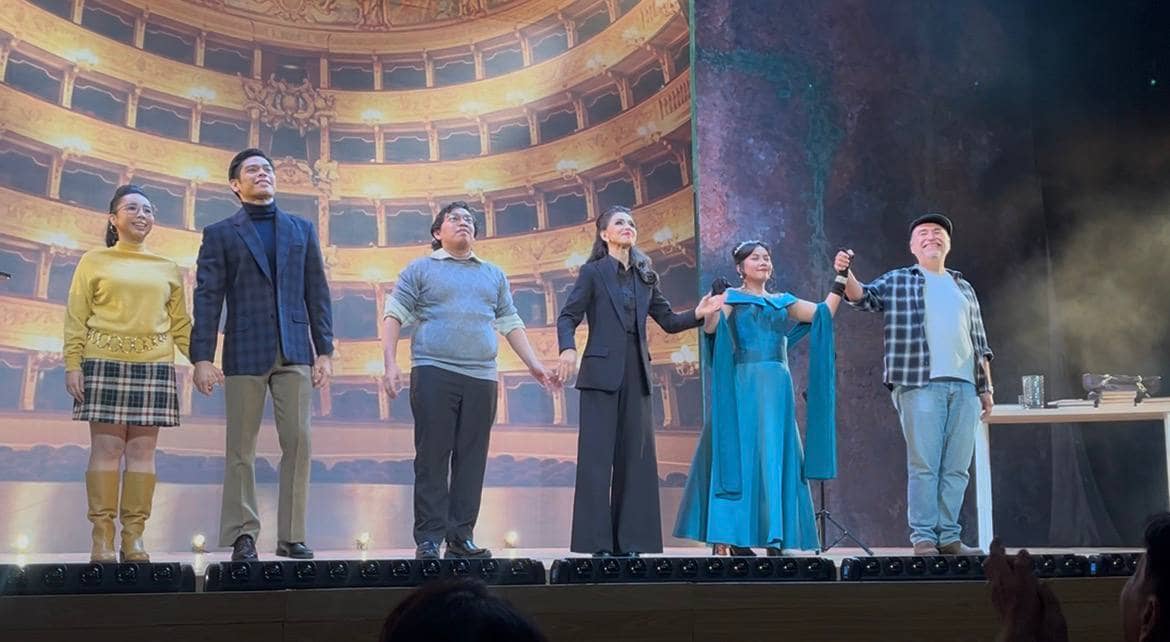
Curtain call, 23 May evening show.
Stephanie Mayo
In Jaime del Mundo’s staging, the set remains simple, much like the original Broadway production, with a piano positioned on the left side and Callas’ desk on the right. Yet it never quite resembles a lecture hall. The stage is backed by towering wooden panels resembling unraveling ribbons. Sculptural, elegant. And cold.
Now, Lauchengco-Yulo’s performance is disciplined and committed. The issue is her rapid-fire delivery, which becomes exhausting rather than revealing. Lines are fired off almost mechanically, with barely enough breathing room for thought, silence, hesitation, or emotional transition.
The effect is not that of watching a human being think and feel in real time, but of watching a highly skilled recitation — complete with the stylized “poh poh poh” and “tuh tuh tuh” vocal mannerisms associated with Callas, but without enough emotional elasticity underneath them.
The staging further amplifies this problem. Del Mundo’s decision to keep Callas largely confined around a stool does the performance few favors. Combined with Lauchengco-Yulo’s limited vocal modulation and stage pacing, the physical stillness creates an oddly static experience.
There is no doubt that she is devoted to the role, but Del Mundo and Lauchengco-Yulo keep the performance trapped within speed and only a few vocal pitches, sacrificing the volatility, grandeur, and fragility of Callas.
I later watched old Master Class excerpts on YouTube featuring Faye Dunaway, Patti LuPone, and Zoe Caldwell, with Caldwell delivering, in my opinion, the strongest interpretation of Callas. Dunaway captured the sitcom rhythms perfectly, but Caldwell truly felt like a strict teacher standing before an audience, carrying within her all the history of pain, memory, loss, and loneliness.
Not because Caldwell is foreign — and no, it would be unfair to directly compare actors working under different directors and performance approaches — but because great performance transcends geography and race. Caldwell appears relaxed and emotionally inhabited, whereas Lauchengco-Yulo often seems perpetually tense and jumpy. Caldwell understands the power of pauses, emotional stillness, and precise body language.
Again, Master Class gets much of its humor from the rhythm and structure of an American sitcom rather than from an intellectually layered character study. As a result, the laughter depends heavily on pitch-perfect timing, tonal variation, and delivery. But Lauchengco-Yulo’s performance seldom finds the exact comedic pitch needed to elevate the material. The jokes are delivered, but they rarely breathe long enough to bloom organically into laughter.
The supporting cast, some of them first-time theater actors, also weakens the immersion. Of course, it is difficult to cast performers who can both sing opera and act convincingly. But that challenge belongs to the production, not the audience.
While the performers all possess admirable vocal ability, a couple of them lack the diction, stage credibility and naturalism necessary for immersion and believability. And when a performer visibly struggles to deliver lines because they are fundamentally opera singers rather than actors, the theatrical world begins to collapse, and the audience becomes increasingly aware of performance rather than character.
Most disappointingly, I never truly felt transported into a master class. I never felt the intimidating magnetism of a teacher, much less the towering presence of Maria Callas herself. The production communicated the feeling of an ordinary, even tedious, day inside a classroom that I wished to quit, rarely Callas’ soul. Instead of being invited into the inner life of an artistic titan, I often felt as though I was watching actors demonstrate a concept from a distance.
Even so, one cannot deny the sheer discipline behind the production. Carrying Master Class requires endurance, concentration, and commitment, all of which Lauchengco-Yulo possesses. The evening is never careless or unserious, no. If anything, its problem lies in over-control rather than lack of effort.
Playdates: 22 May to 1 June, Carlos P. Romulo Auditorium, RCBC Plaza