
In the forest of PBF 2026, stories found their readers
The fourth Philippine Book Festival drew nearly 39,000 readers who wandered through a vibrant literary landscape — meeting authors, uncovering new voices, and rediscovering the power of Filipino storytelling.


Like a rainforest teeming with life, the Megatrade Hall of SM Megamall transformed into a dense, vibrant ecosystem of stories from 12 to 15 March — layered, interconnected and alive with movement. Paths formed not of soil but of curiosity, as readers wandered from one booth to another, discovering voices, genres and ideas that seemed to grow naturally from the ground beneath them.
By the time the fourth Philippine Book Festival (PBF) concluded, the numbers told part of the story: nearly 39,000 visitors, more than 100 publishers, and retail sales surpassing the previous year. But like any forest, its true richness could not be measured in figures alone. It was in the encounters — in the unexpected clearings, the quiet undergrowth of small presses, and the towering presence of literary figures — that the festival revealed its depth.
Organized by the National Book Development Board (NBDB), the PBF has grown steadily since 2023 into one of the country’s major cultural events and the only one devoted entirely to Filipino-authored and published works in a bid to strengthen the country’s local publishing industry and promote Filipino stories and voices. This year’s edition arrived with renewed momentum, coming fresh from the Philippines’ milestone role as Guest of Honour at the Frankfurt Book Fair 2025 — an international spotlight that has further energized interest in Filipino literature at home and abroad.
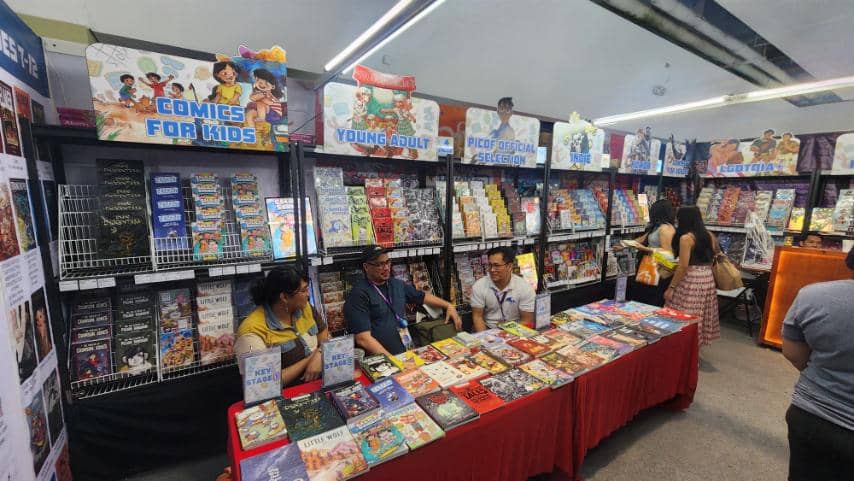
THE booth of Komiket at the festival where komiks and graphic novels are given attention.
This year, it embraced its theme, “Gubat ng Karunungan” (Rainforest of Knowledge) to reflect the richness and diversity of Philippine literature, and to project a space where each book, each reader, and each creator formed part of a living literary habitat. This theme came alive with key visuals created by artist and designer Joffrey “Pepot” Atienza from the province of Quezon.
“Living on the edge of the Mount Banahaw rainforest for over ten years, the theme ‘Gubat ng Karunungan’ felt deeply personal. My contribution to this year’s Philippine Book Festival is inspired by my daily walks with my cats and dogs through dry creeks and the lush biodiversity of my backyard. I wanted to share the magic of the Philippine wilderness that I’m lucky enough to call home,” he explained.
He added; “I wanted to visualize a single word: Enchantment. My work captures the symphony of the forest…colorful birds in the canopy, insects etched with complex patterns, and the misunderstood, shy grace of reptiles. It follows shrews and wild chickens scouring the rich ground and peers at tiny fish in the shallows. It culminates in the majesty of the trees, the heavy scent of night-blooming flowers, and the mesmerizing glow of a thousand fireflies dancing in the dark.”
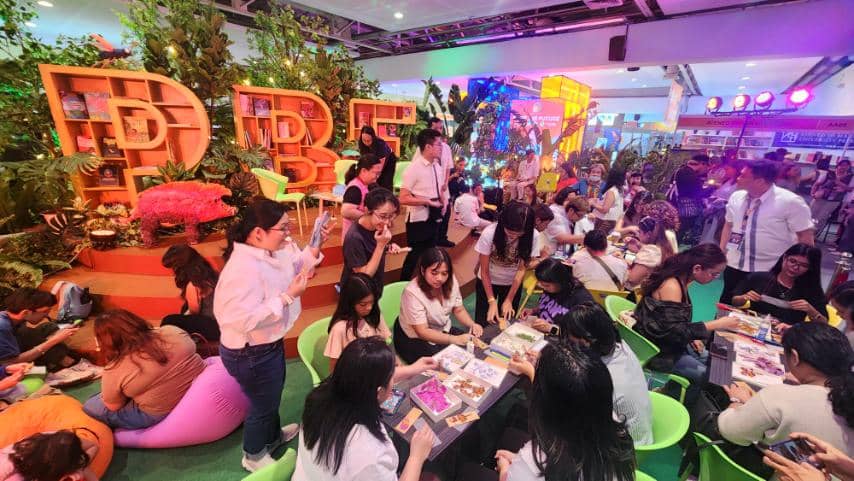
KIDS and parents participating at the diverse array of workshops.
Opening the forest
The Philippine Book Festival 2026 opened with a ceremony on 12 March that set the tone for a gathering rooted in both celebration and purpose. Led by NBDB executive director Charisse Aquino-Tugade and graced by Department of Education Secretary Edgardo “Sonny” Angara and National Commission for Culture and the Arts chairman Eric B. Zerrudo, the program brought together publishers, authors, illustrators, educators, and readers under one roof, signaling the festival’s growing importance not only as a literary event but as a national platform for culture and education.
As Aquino-Tugade reflected, the festival is envisioned as “not just a market… but a place people come back to because it gives them something they did not know they were looking for,” framing the PBF as a shared cultural space that continues to grow with its community.
A highlight of the program was a multilingual reading of Mindanawon poet Gerald Galindez’s “Kung Ang Libro Ay Dagat” by Zerrudo, Ilocano author Faye Flores-Melegrito and Galindez, delivered in Hiligaynon, Ilokano and Maguindanao, underscoring the richness of Philippine languages and storytelling traditions.
Entering the forest
To step into the PBF was to enter a carefully imagined terrain. The four realms — Aral Aklat, which focused on textbooks and educational materials; Booktopia, dedicated to Filipino fiction and nonfiction; Kid Lit, designed for young readers and interactive storytelling; and Komiks, celebrating Filipino comics and graphic narratives — functioned like distinct ecological zones within the forest. Each had its own character, its own species of stories, yet all were sustained by the same roots: Filipino experience and imagination.
Around them, the festival’s activation spaces pulsed like natural clearings. Lugar Lagdaan became a gathering ground where readers met authors; Bahay Ilustrador, a workshop area where ideas took visual form; the Fiesta Stage, where performances and events echoed; and Umpukan, a quiet corner for conversations to flow.
At the center was the Gubat ng Karunungan, a forest-inspired space designed as an enclave for reading as well as for talks, workshops, and classes.
Where paths cross
In any forest, paths cross unexpectedly. At the PBF, these crossings took the form of long lines and brief, meaningful exchanges. Readers queued patiently at Lugar Lagdaan, waiting to meet writers whose works had shaped their inner landscapes.
National Artist for films and broadcast arts Ricky Lee, historian Ambeth Ocampo, National Artist for Literature Virgilio S. Almario, and fictionist Jose “Butch” Dalisay stood like old-growth trees — steady presences in Philippine literature — while newer voices and popular authors such as Jonaxx drew their own devoted followings.
In Bahay Ilustrador, the act of creation unfolded in real time. Visitors entered as observers and left as participants, carrying with them sketches and ideas — seeds, perhaps, for future stories.
These were the moments when the forest felt most alive: when stories were not only read but exchanged, affirmed, and set into motion once again.
A forest open to all
This year, the forest widened its borders. For the first time, opening day was fully accessible to the general public — a gesture that allowed new readers to step into the ecosystem.
As Aquino-Tugade reflected, the festival is becoming a “third place” — “not home, not work or school, but somewhere in between… a space with no entry requirement other than showing up.”
The presence of both seasoned book evaluators and first-time visitors enriched the space. “Both of them belong here,” Aquino-Tugade said, “and the festival is richer for having to hold both at once.”
Echoes through the canopy
The forest did not remain still. It resonated. On the Fiesta Stage, performances rippled like sound through the canopy — from theatrical adaptations to spoken word and music.
One moment might carry the energy of a Gloc-9 performance; another, the quiet gravity of a poet sharing deeply personal work. These echoes reminded audiences that literature is not confined to the printed page — it moves, it performs, it breathes.
One of the major events of the festival, the 43rd National Book Awards stood as a moment of recognition — like sunlight breaking through the leaves — illuminating the works that continue to shape Philippine literature.
Roots that reach classrooms
Beneath the visible canopy of the festival lay its deeper roots — its role in education. Hundreds of Department of Education evaluators moved through the forest with purpose, selecting titles that would eventually reach classrooms across the country.
Here, the metaphor of the rainforest becomes especially apt. What grows in one place nourishes many others. The books chosen at the PBF will find their way into schools, shaping how future generations read, think, and understand their world.
As Aquino-Tugade noted, transformation often begins with environment: “A Filipino reader who has never thought of themselves as a reader is more likely to become one in a space that feels alive… than in one that simply stocks titles.”
Reaching beyond the forest
Even as it deepens locally, the Philippine Book Festival is beginning to extend outward. International observers, including representatives from the Frankfurt Book Fair, have taken notice, signaling that Filipino literature is finding its place in a broader global ecosystem.
Institutional partnerships, such as the planned commemorative stamp, further affirm the festival’s growing cultural significance — markers that this forest is no longer isolated, but part of a larger landscape.
A living ecosystem
At its closing, the PBF reported at least a seven percent growth in retail sales. Yet like any thriving rainforest, its success lies not only in measurable output, but in its ability to sustain life — to nurture connections, to encourage growth, and to renew itself year after year.
“We have been asking ourselves… whether the PBF can be that for Filipino books,” Aquino-Tugade said. “Not just a market… but a place people come back to because it gives them something they did not know they were looking for.”
In the end, the answer could be found in the movement of the crowd, in the weight of books carried home, in the conversations that lingered long after the halls had emptied. In this forest of stories, something took root. And from it, readers — and the stories that will one day belong to them — continue to grow.