
#BasyangPH hits Bohol, triggers heavy rain and strong winds

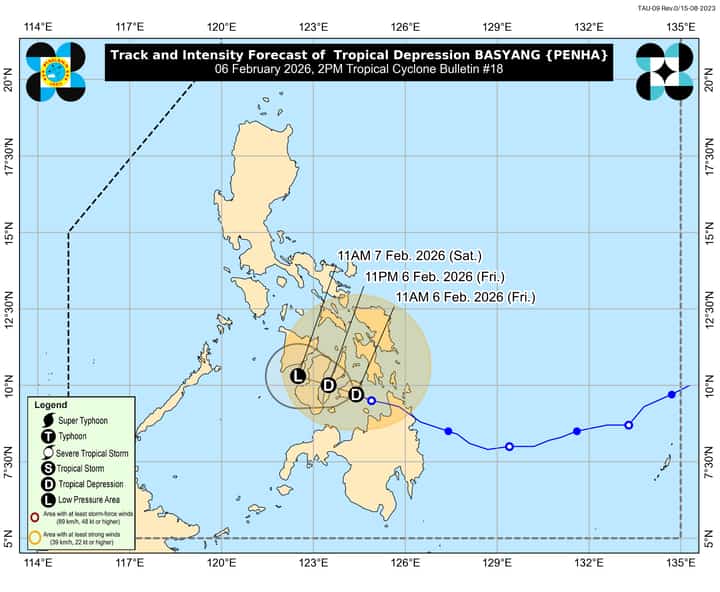
Tropical Depression Basyang made landfall over Bohol on Friday afternoon, 6 February. The weather system continues to bring heavy rainfall, strong winds, and rough seas across large parts of the country.
PAGASA warned that heavy rains remain a major concern, especially in areas already saturated by previous weather systems.
While all storm surge warnings have been lifted, strong to gale-force winds may still be experienced in many areas due to both Basyang and the enhanced Northeast Monsoon.
Wind Signal Nos. 1 and 2 remain in effect in affected provinces, with possible minor to moderate wind impacts.
Rough to moderate seas are expected over several coastal waters, with wave heights reaching up to 4.0 meters in parts of the Visayas, Bicol Region, and Northern Mindanao.
Mariners of small seacrafts, including motorbancas, are strongly advised not to venture out to sea, especially in areas experiencing rough conditions.
As of 2:00 p.m., the center of Basyang was located near Bilar, Bohol, moving west-northwestward at 20 kilometers per hour.
The system has maximum sustained winds of 55 km/h and gusts of up to 75 km/h. PAGASA said Basyang may make landfall over southern Cebu and Negros Oriental before weakening into a low-pressure area by Saturday, 7 February.
Residents in affected areas are advised to remain alert, monitor official advisories, and take necessary precautions against flooding, landslides, and strong winds.