




Remittances rise by 2.6% in March
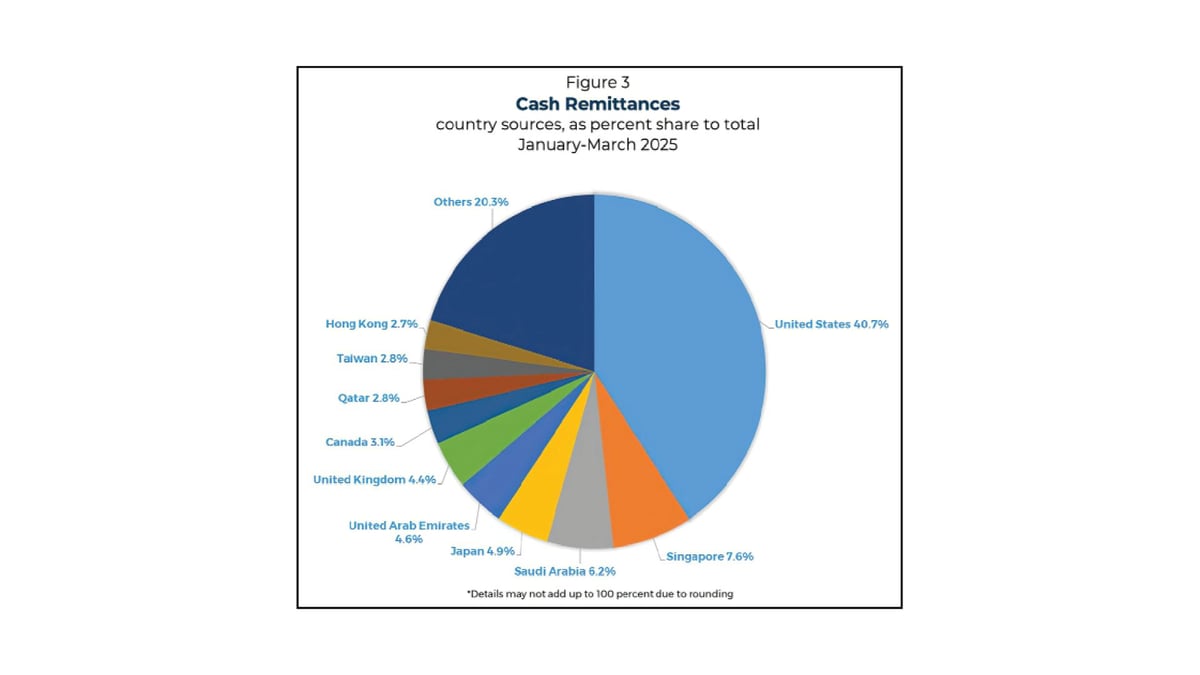
The United States accounted for the largest share of total cash remittances in the first quarter, followed by Singapore and Saudi Arabia.
Graph courtesy of BSP
The United States accounted for the largest share of total cash remittances in the first quarter, followed by Singapore and Saudi Arabia.
Graph courtesy of BSP
In March, overseas Filipino remittances increased by 2.6 percent to $3.13 billion as the US dollar weakened compared to the peso.
The Bangko Sentral ng Pilipinas reported an increase from the $3.05 billion recorded in March 2024.
Thus, in the first three months of this year, remittances reached $9.4 billion, up 2.7 percent from the same period in 2024.
From the total, cash remittances sent through banks in March rose by 2.6 percent to $2.81 billion year-on-year.
Cumulatively, these remittances grew to $8.44 billion by 2.7 percent from the $8.22 billion registered last year.
The United States remained the top source of cash remittances in the first three months, with a 40.7 percent share. Singapore placed second, representing 6.2 percent, followed by Saudi Arabia, which accounted for 6.2 percent.
The figures came after the US dollar weakened from $1 per P58.50 in February to $1 per P57.19 in March, according to data from the Bankers Association of the Philippines.
Strong dollar a bane
Rizal Commercial Banking Corp. chief economist Michael Ricafort said an opposite condition of a stronger US dollar would mean fewer remittances as the currency converts to fewer pesos.
However, despite the year-on-year growth in March remittances, Ricafort shared that the latest figure was among the lowest in 10 months amid the global economic uncertainty due to Trump’s tariffs.
“Trump’s threats of higher tariffs and other America-first policies could also slow down global trade, investments, and some jobs for overseas Filipinos,” the economist said.
Still, Ricafort expects remittances to be resilient, as families of overseas Filipinos back home will require more funds for their children’s schooling, which starts on 16 June.
He added that the domestic economy continues to grow mainly due to household consumption of various goods and services.
“The country’s consumer spending accounts for nearly 75 percent of the economy. Families of overseas Filipino workers have been an important market for many products and services in the economy, including big-ticket items such as homes, vehicles, and investments,” Ricafort said.
Housing is probably the biggest issue affecting people the world over.
Malacañang on Monday called for a more thorough investigation into the questioned flood control projects in Taguig…
The defense on Monday backed the move by senator-judges to exclude a prosecution witness who testified on the firearms…
