
AI reshapes 5G Networks
Carriers can now monetize experience, not just traffic.
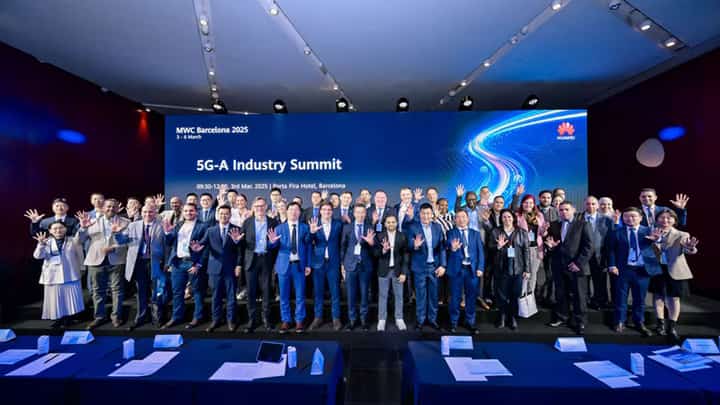
At MWC Barcelona 2025, Huawei’s president of ICT Sales & Service Li Peng painted a bold vision for the future of telecommunications: a world where 5G-Advanced and AI work in seamless harmony to unlock the full potential of mobile networks.
Li predicted that this convergence would drive double-digit growth in both data usage and average revenue per user, reshaping how carriers monetize and optimize their networks.
“We’re rapidly entering a fully intelligent world,” Li stated. “By embracing and evolving 5G, we can unlock the infinite potential of mobile networks. Huawei is ready to work with carriers and industry partners worldwide to accelerate this transformation.”
Huawei sees AI not just as an enabler, but a game-changer in human-machine interaction, network optimization, and content delivery.
The rise of AI-powered voice assistants, cloud phones and real-time applications demands lower latency and faster speeds, pushing networks to evolve from 5G NSA to 5G SA and ultimately 5G-A.
Technologies like Control and User Plane Separation and Guaranteed Bit Rate will be essential in reducing latency and ensuring a seamless user experience.
AI is also revolutionizing content creation and distribution, with AI-Generated Content enabling rapid production of immersive 2D and 3D videos.
This shift will skyrocket network traffic, requiring carriers to expand spectrum, increase capacity, and enhance both uplink and downlink bandwidth.
Beyond infrastructure, Huawei emphasized AI-driven network operations and monetization. Carriers can leverage AI for predictive maintenance, traffic optimization, and personalized services, creating new revenue streams beyond traditional data plans.
Some early adopters have already launched VIP services, AI-driven call enhancements, and B2B2C solutions via Open APIs, significantly boosting industry revenue.
With over 200 cities worldwide scaling up 5G-A deployment, Li’s message was clear: the AI-powered, fully connected future is here, and those who move fast will reap the rewards.