
Sulu Sultan Phugdalun Kiram II to pursue $25 billion claim vs Malaysia before UN

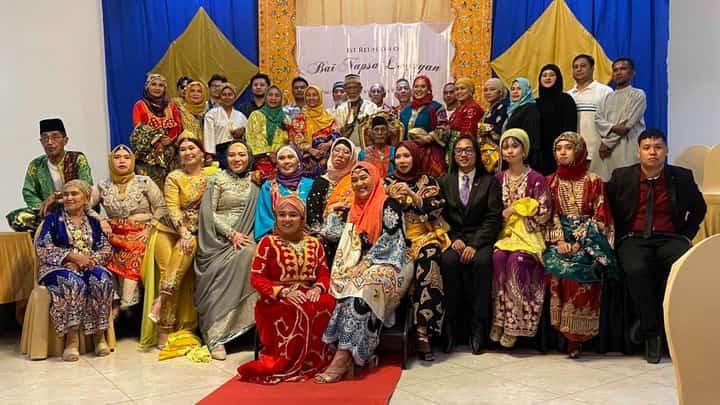
Sultan Phugdalun (center) and British High Court identified heirs of the ancestral territorial proprietary rights of Sabah (North Borneo).
Photo courtesy of Sultanate of Sulu
Sultan Phugdalun Kiram II, the 35th Sultan of Sulu, will officially seek the endorsement of the U.S. government through Secretary of State Marco Rubio to support a 2004 petition to the United Nations (UN). The petition seeks $25 billion in damages from Malaysia for the illegal annexation of Sabah, despite the existing Carpenter-Kiram Treaty of 1915, which placed Mindanao, Sulu, and Sabah under American protection.
Abraham Idjirani, convenor of the Mindanao and Sulu Unification Movement (MSUM), told the Daily Tribune on Wednesday that after the death of Jamalul Kiram III on 20 October 2013, Sultan Phugdalun Kiram II was officially installed as the 35th Sultan on 6 February 2016, at the Sulu Capitol in Patikul, Sulu.
Sultan Phugdalun Kiram II led the direct heirs, who were named based on a 1939 decision by the Session Court of North Borneo. The ruling identified nine direct descendants of the Sultanate of Sulu as having proprietary rights over the disputed territory of Sabah.
In an 11 October 1939 judgment, British Session Court Chief Justice Macaskie recognized the proprietary rights of the rightful heirs of Sultan Kiram and appointed Datu Punjaman Kiram as the administrator of the North Borneo (Sabah) estate.
The court also named eight other heirs, including Datu Ismael Kiram, Dayang Dayang Sitting Kiram, Dayang Dayang Sitting Mariam Kiram, Dayang Dayang Putli Kiram, Princess Tarhata Kiram, Princess Sakinur-in Kiram, Dayang Dayang Piandao Kiram, and Mora Napsa.
After assuming the throne, Sultan Phugdalun Kiram II led a delegation to China to meet ancestral relatives and commemorate the 600th death anniversary of Sultan Pahara, who died and was buried in Dezhou City, Shandong Province, in 1405. His visit marked the historical alliance between the Ming Dynasty and the Eastern Kingdom of Sulu.
Following his visit to China, Sultan Phugdalun Kiram II paid a courtesy call to President Rodrigo Duterte.
Before Sultan Jamalul Kiram III died on October 20, 2013, he reiterated his father’s decree that the Sultanate of Sulu must continue pursuing its claim over Sabah, which was "illegally annexed" by Malaysia, despite the existing Carpenter-Kiram Treaty of 1915.
One of Sultan Jamalul Kiram III’s decrees was that Sabah is the patrimony of the people of Mindanao and Sulu and was "not for sale" to the Malaysian government.
"Sultan Jamalul reiterated his father’s dying wish that Sabah is not for the Sultan alone but for the patrimony of the people," Idjirani said.
After his death, Jamalul Kiram III was airlifted to Sulu and buried in the ancestral graveyard in Maimbung town, where most of the principal and rightful heirs of the Sultanate were also buried.
Idjirani said Kiram III issued a decree to his two brothers, Esmail and Agbimuddin, calling for unity within the family and a continued pursuit of the Sabah claim.
"The Sultanate of Sulu will officially request U.S. Secretary of State Marco Rubio to endorse the 2004 petition to the United Nations," Idjirani said. The petition seeks $25 billion in damages from Malaysia for the exploitation of Sabah’s natural resources after it was annexed by the British and later incorporated into the Malaysian Federation despite the Carpenter-Kiram Treaty, which assured U.S. protection over the Sultanate’s ancestral territorial rights.
The request for U.S. endorsement follows a response from the International Court of Justice (ICJ), which stated that the Sultanate’s petition would need endorsement from the U.S., China, or the Philippines before being referred to the United Nations General Assembly (UNGA) for deliberation.
"The Sultanate will officially send the request and supporting documents," Idjirani said.
Philippe Couverous, ICJ registrar, in a 20 October 2024 reply to the Sultanate of Sulu, a copy of which was obtained by the Daily Tribune, stated that Articles 34 and 35 of the ICJ Statute require the endorsement of a UN member nation for the petition to be deliberated in the General Assembly.
He said the reply of the ICJ specifically mentioned the need of an endorsement of a UN member for deliberation in the general assembly.
"This is to inform you that the provisions contained in Articles 35 and 34 of the Statute of the International Court of Justice, the Sultanate of Sulu and North Borneo or the Bangsa Suluk Nation just need one nation to endorse its 2004 Petition for deliberations in the UN General Assembly.” Couverous said.
The 2004 petition submitted by the Sultanate of Sulu to then-UN Secretary-General Kofi Annan adhered to the principle of peaceful settlement and demanded the repossession of North Borneo (Sabah) from Malaysia, alongside a $25 billion claim for the exploitation of natural resources since its "illegal occupation" in 1963.
However, Idjirani said that while the Sultanate of Sulu lacked international recognition as a sovereign entity, the present ruling family—or the Bangsa Suluk Nation—would seek assistance from the U.S. government under President Donald Trump to endorse the petition. This, he said, aligns with the U.S.'s commitment under the 1915 Kiram-Carpenter Agreement.
"The filing of the 2004 petition with the UN was to advance the vital interests, well-being, and general welfare of its people, both within and outside its ancestral lands, including the inhabitants of Sabah," Idjirani said.
He explained that Malaysia merely inherited the British leasehold rights obtained by the British North Borneo Company in 1878. Upon the establishment of the Malaysian Federation in 1963, the late Senator Arturo Tolentino argued at the UN that these rights were not those of a sovereign nation but merely leasehold rights.
Idjirani said the Sultanate of Sulu would seek U.S. President Donald Trump’s endorsement of its 2004 petition to the International Court of Justice (ICJ), demanding $25 billion in damages from Malaysia for its unauthorized exploitation of Sabah’s resources.
The $25 billion claim is based on an estimate of the resources exploited from Sabah since its annexation in 1963 up to the present day.
"Since the Philippine government has already opted out of the Sabah case, our only hope is for the U.S. or China to endorse our petition," Idjirani concluded.