
DoJ, BARMM leaders bolster legal services, amnesty push
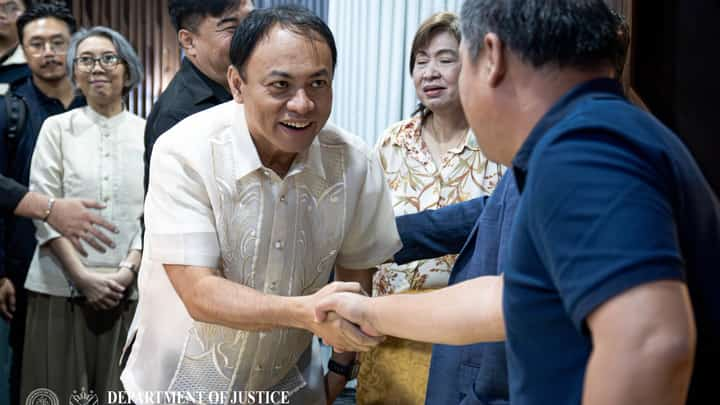
DEPARTMENT of Justice Secretary Fredderick Vida (left) meets with leaders of the Bangsamoro Autonomous Region in Muslim Mindanao and local officials in General Santos City to strengthen coordination in delivering justice services across the region.
Photograph Courtesy of DOJ
The Department of Justice (DoJ) convened a high-level dialogue with leaders of the Bangsamoro Autonomous Region in Muslim Mindanao (BARMM) and local government officials in General Santos City to expand grassroots access to justice and strengthen inter-agency law enforcement coordination.
Held at the Greenleaf Hotel, the forum was led by Justice Secretary Fredderick A. Vida, Undersecretaries Garney Candelaria and Francis John Tejano, and National Bureau of Investigation (NBI) director Melvin Matibag.
They were joined by House Senior Deputy Speaker Ferdinand Hernandez, BARMM Chief Minister Abdulraof Macacua, and local officials from Regions 9, 10, 11 and 13.
In his opening remarks, Vida reaffirmed the department’s mandate to deliver accessible legal services to underserved areas and urged local chief executives to remain steadfast in upholding the rule of law.
Matibag pledged the NBI’s full support in streamlining investigative and law enforcement services across Mindanao.
When a provincial governor requested an NBI clearance office in a geographically isolated area to ease travel burdens for residents, Matibag committed to establishing the facility.
Macacua welcomed the national government’s backing, noting that stronger institutional support is critical as BARMM builds on its recent parliamentary elections to reinforce regional governance structures.
He stressed that improving access to justice directly addresses historical grievances that have fueled local conflict and insurgency.
“The reason why the number of rebels grew in the past was because people had nowhere to turn for justice, so they joined the rebels,” Macacua said, underscoring the need to provide communities with credible avenues for legal redress.
During the closed-door session, BARMM Ministry of the Interior and Local Government official Jordan Bayam called for expanded justice infrastructure in remote areas, specifically proposing the appointment of a special provincial prosecutor for BARMM’s Special Geographic Area, which comprises eight municipalities.
Participants also discussed sustaining government amnesty programs for surrendering former members of the New People’s Army seeking community reintegration, as well as harmonizing investigative procedures to tackle illegal drugs and regional security challenges.