
FLiRT variant KP.2 already in Phl — DOH

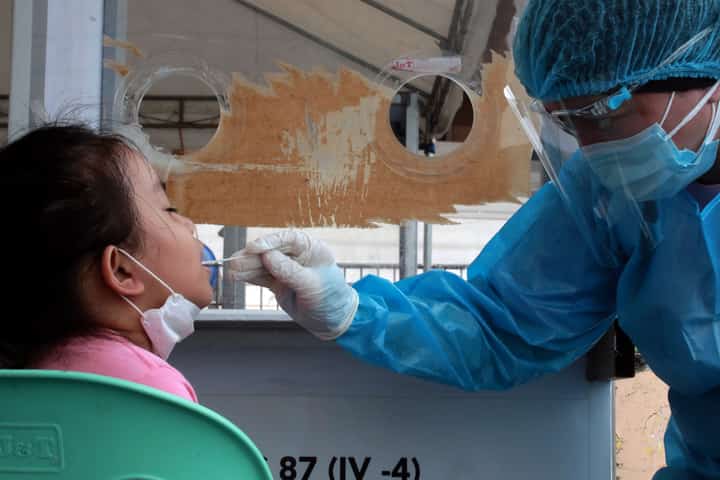
COVID tests are still being conducted in the Philippines, although the virus that originated in Wuhan, China in 2019 is already being treated by many like the common cold. | Daily Tribune file photo
The Department of Health (DOH) on Tuesday said FLiRT variant KP.2 is already in the Philippines.
Citing the recent sequencing data by the Philippine Genome Center, the DOH confirmed the identification of 30 cases of JN.1, two cases of JN.1.18, and two cases of KP.2.2.
"Their detection (along with the slow increase in the number of new cases and the plateau in number of occupied COVID-19 beds) aligns with the international observation that the new variants under monitoring continue to be clinically mild and manageable," Domingo told reporters in a Viber message.
There are four variants under monitoring (VUM): JN.1.7, JN.1.18, KP.2, and KP.3.
All of these are descendants of JN.1. Variants KP.2 and KP.3 are the proper names of what is informally known as "FLiRT" variants.
FLiRT is a nickname coined by some researchers to describe amino acid changes in the Covid-19 virus' spike protein, specifically from phenylalanine (F) to leucine (L) at position 456, and from arginine (R) to threonine (T) at position 346.
WHO observed that "there are currently no reported laboratory or epidemiological reports indicating any association between VOIs/VUMs and increased disease severity."
Domingo noted that there is still no evidence that the KP.2 and KP.3 variants are causing severe to critical COVID-19, both locally and internationally.
Further assessment continues to determine transmissibility and capacity to evade immune response.
Covid-19 cases in Phl
As of 27 May, data showed that Philippine regions remain to be at low risk for Covid-19.
Only 14 percent or 174/1,235 of dedicated COVID-19 ICU beds were occupied.
Only 15 percent or 1,601/10,910 of total Covid-19 beds were occupied. Severe and critical COVID-19 cases admitted in various hospitals total to only 185 or 10 percent of total admissions, based on hospital reports in the DOH Data Collect application.
The average number of daily reported cases for the week of 21 to 27 May is 319.
This is higher than the previous week's figure (202), but is still less than half compared to around 500 per day at the start of this year, and also compared to around 1,750 per day in the middle of May 2023.
The average number of daily reported severe, critical, and ICU COVID-19 admissions as of 27 May is much less than its level in the middle of May 2023.
Out of the new cases reported for the said week, 22 had severe or critical disease.
Twenty deaths were recorded, of which five occurred in the recent two weeks, 14 to 27 May.
Domingo also assured that the DOH remains to be in close coordination with international health authorities.
He also urged the public to comply with the minimum health standards.
"The voluntary use of face masks should be done properly, along with standard precautions like hand washing, avoiding crowds, and choosing good airflow," Domingo said.
"Good respiratory hygiene (covering coughs), washing hands, choosing less crowds, and ensuring good airflow and ventilation are tried and tested ways to prevent ILIs and other acute respiratory illnesses, including COVID-19. It is also best for those who feel ill to stay at home for the meantime, or to properly wear a mask should there be a need to go out."
The Health official added that the DOH still sees no need for travel restrictions as these may impair the flow of other essential health goods and services.