
China spaceship carries first foreign astronaut
Pakistani astronaut Muhammad Zeeshan Ali will experiment on photosynthetic cyanobacteria.
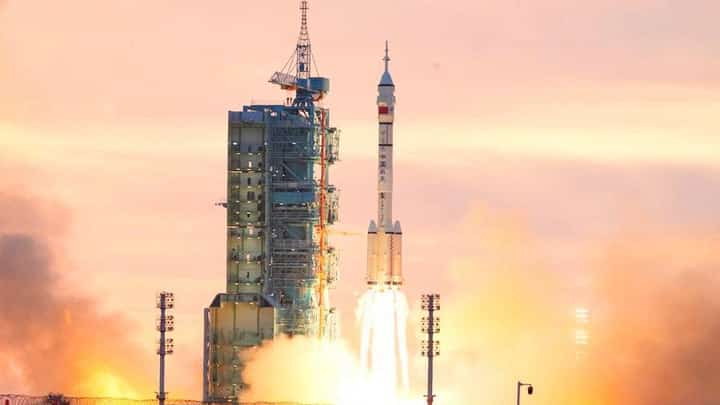
THE Shenzhou-24 crewed spaceship, takes off on a Long March-2F carrier rocket, from the Jiuquan Satellite Launch Center in northwest China, on 25 November 2026.
Photograph courtesy of WANG JIANGBO/XINHUA
China’s Shenzhou-24 spacecraft on Wednesday blasted off to space carrying two taikonauts and a Pakistani astronaut to the Tiangong space station.
The Chinese mission marked the first time a foreign astronaut was taken aboard China’s spacecraft and the space station.
The Shenzhou-24 mission’s commander and spacecraft pilot was Tang Hongbo with flight engineer Wu Yi and payload specialist Muhammad Zeeshan Ali of Pakistan.
Zhang Jingbo, spokesperson for the China Manned Space Agency (CMSA), described the joint flight as a landmark achievement in bilateral cooperation as the two countries mark the 75th anniversary of diplomatic relations this year, Xinhua reports.
The Long March-2F carrier rocket blasted off at 8:18 a.m. (Beijing Time) from the Jiuquan Satellite Launch Center in northwest China, and separated from Shenzhou-24 about 10 minutes after liftoff. The spacecraft then entered its designated orbit, prompting the CMSA to declare the launch “a complete success.”
The spacecraft completed a fast, automated rendezvous and docking with the front port of Tianhe, the space station’s core module, in about 3.5 hours, and the Shenzhou-23 crew aboard Tiangong opened the hatch at 2:35 p.m., welcoming the new arrivals, according to Xinhua.
After completing a short-term joint flight, Ali will return to Earth aboard the Shenzhou-23 spacecraft alongside two Shenzhou-23 crew members. The other two Shenzhou-24 astronauts will stay in orbit for roughly six months along with Shenzhou-23 astronaut Zhu Yangzhu, who has already spent six months in orbit and will remain aboard Tiangong to complete a year-long stay experiment.
Space experiments
More than 90 scientific experiments and technology tests are planned for the Shenzhou-24 mission, covering space life sciences, space material science, microgravity fluid physics and combustion science, fundamental physics, space medicine and new space technologies, according to the CMSA.
Four China-Pakistan cooperative projects in the fields of biotechnology and materials also will be conducted, with Ali experimenting on photosynthetic cyanobacteria.