
Agri group puzzles why pork meat prices soaring
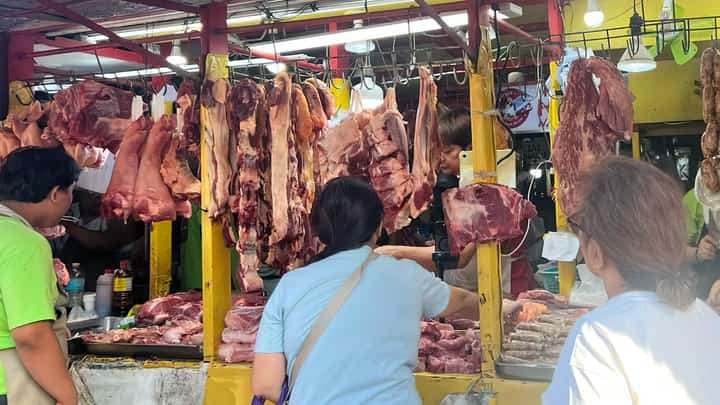
FEWER customers buy meat products at Pritil Market, Tondo, Manila, due to high prices of pork and beef, even if farmgate prices continue to plummet, a brunt being shouldered by local meat producers.
Photograph by Raffy Ayeng for DAILY TRIBUNE
The Samahang Industriya ng Agrikultura (SINAG) is asking why pork prices continue to rise in wet markets, even though supplies are not short and farm-gate prices have been plummeting in recent weeks.
In Pritil Market in Tondo, Manila, prices of pork loin as of Sunday range from P380 to P420 per kilo, while other parts (kasim, knuckles, ribs) start from P300 to P380 per kilo.
In Mega QMart in Quezon City, the price of kasim is now P300 per kilo from P280 last week, while pork loin is also P400 per kilo from P380 last week.
Pork retailers at the said wet markets expect that prices will further rise towards Christmas.
“What can we do? We will just endure it. We have to eat as pork meat remains a staple in our meals,” said Glenda Nuevaespana, a housewife buying pork loin in Pritil Market on Sunday.
In a Facebook post, a netizen featured a meat shop in Novaliches, Quezon City, where they can sell their pork meat starting at P200 per kilo, which SINAG says is feasible as farm gate prices of pork meat are currently at P140 to P160 per kilo.
“The government, particularly the Department of Agriculture, should intensify their monitoring. The margins of farmgate to retail of middlemen are soaring. There is indeed an absence of regulation from farmgate to retail in wet markets,” said Jay Cainglet, executive director of SINAG in a radio interview on Sunday.
He added that supply is also ample, as imported meat continues to flood in, now more than 1 million kilos as of October scattered in wet markets and groceries, rising from 900 thousand kilos in the same period last year.
“Consumers should not bear the brunt because the supply is sufficient, or oversupply. Prices should go down. However, local producers are now suffering from these low farmgate prices,” Cainglet stressed.
Agriculture Secretary Francisco Tiu Laurel Jr. earlier convened hog industry stakeholders and proposed a 10-percentage-point increase in 2027, raising tariffs from the current 15 percent in-quota and 25 percent out-quota rates to 25 percent and 35 percent, respectively.
The rates would then return to 30 percent in-quota and 40 percent out-quota in 2028, Tiu Laurel said.
The proposed phased approach comes as local hog production and pork inventories recover, but prices received by farmers move in the opposite direction.
“Our local hog production increased by six percent in the first semester of 2026, while pork imports and inventories have reached high levels,” Tiu Laurel said.
Farmgate prices fell from P215 per kilogram in June 2025 to P150 per kilogram in August 2026, according to the DA, squeezing raisers’ margins and making it harder for them to repopulate farms.