
An ordinance on pet ‘kapon’ in Quezon City
“Isn’t it worth it to give some tax benefits to private veterinary clinics who would be able to help the City reduce the number of animals that would end up as strays if they are not fixed?”
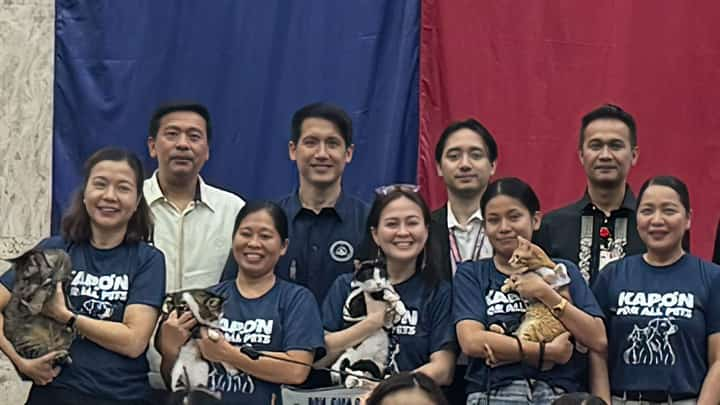
ANIMAL welfare advocates with principal authors of the ordinance standing From (left) Philippine Animal Welfare Society (PAWS) executive director Anna Cabrera; behind her in white barong Councilor Joseph Juico, Councilor Vito Generoso, QC Vice Mayor Gian Sotto and Dr. Henry Barbero, OIC of the QC Veterinary Office. Joining them are PAWS volunteers Ilyn Romez with cat Maggie; Ampon Alaga’s Martha Subido Herrera with rescued cat Zorro; PAWS volunteer Gian Villamayor with rescued cat and PAWS director Cristina Martinez.
PHOTOGRAPH COURTESY OF PHILIPPINE ANIMAL WELFARE SOCIETY
Animal welfare groups have long campaigned for more spay-neuter instead of just vaccinations for dogs and cats. With companion animals being capable of giving birth three to four times a year and an average litter size of three puppies or kittens with every birth, it is easy to see how having sexually-intact pets and the non-accessibility or non-affordability of spay-neuter procedures can give rise to a situation where there may not be enough homes for them all.
Spay-neuter are surgical procedures done by a licensed veterinarian to remove the reproductive organs of a female (spay) or male (castration) cat or dog. These are done while the animals are under general anesthesia and this is promoted by those who care about the welfare of companion animals because those who rescue strays are all too familiar with the fate that meets animals that are not adopted into homes. They are run over, they have no one to care for them when they are sick and social media is, in fact, filled with calls for help for injured stray animals or those that are about to be euthanized in pounds because they are unclaimed.
Who can cope with their dogs or cats giving birth multiple times in a year? It is a never-ending cycle of giving away puppies or kittens to people who will end up just dumping them when the going gets tough.
A QC ordinance to the rescue
QC Councilors Vito Sotto Generoso and Joseph Juico presented during public hearings how much the City’s expenditures are in terms of the upkeep of pound animals and providing rabies shots for both humans (post exposure shots) and animals (annual rabies vaccinations).
Initially labeled as Proposed Ordinance No. PO23CC-123 — “An Ordinance Providing Tax Incentives to Veterinary Clinics Performing Spay-Neuter Surgery” — it was approved last 8 October, 2026 and was largely based on The Philippine Animal Welfare Society (PAWS)’s draft submission.
Finally, the ordinance entitled “Ordinance Providing Tax Incentives to Veterinary Clinics Performing Spay-Neuter Surgery” was approved last 8 October.
Why a text credit is big
QC councilors Generoso and Juico presented during public hearings how much the City’s expenditures are in terms of the upkeep of pound animals and providing rabies shots for both humans (post exposure shots) and animals (annual rabies vaccinations).
“Isn’t it worth it to give some tax benefits to private veterinary clinics who would be able to help the City reduce the number of animals that would end up as strays if they are not fixed?” Juico said in one public hearing.
Any reduction in taxes is something that LGUs will naturally oppose because taxes are the lifeblood of the government. But somehow, two legislators in QC have successfully made an argument for giving tax incentives to private veterinary clinics in their jurisdiction to be given tax credits in exchange for free kapon services for the low-income QCitizens who are pet owners.
Some clinics, in fact, have already been giving free spay-neuter to indigents even without tax incentives. Among them, according to Philippine Animal Welfare Society (PAWS), is Vets in Practice and Modern Pet.
Generoso, the primary author of the measure, received cheers and applause from animal advocates attending the session. Generoso pointed out that this (the ordinance) was a “very important measure to protect not only our pets and our young people in the community” referring to the reduction in rabies risks and bite incidences as a result of increased accessibility of indigents to spay-neuter for their pets.
There are about 80 private veterinary clinics in Quezon City and if even half of that number give five free spay-neuter every month, that is an additional 200 animals neutered!
It is no wonder that PAWS and other animal advocates applauded this ordinance. Three puspins were present as animal representatives showing why the measure is important. Renji, an orange puspin was rescued and bottlefed as a kitten, Maggie and Diet were, likewise, stray cats who were once malnourished and sickly and trying to fend for themselves. PAWS volunteers brought them to the Session Hall to personally thank the legislators.
Kapon-Ampon’s Martha Herrera was also present at the hearing with her rescued cat, Zorro.
“It is every animal advocate’s dream to hear the speeches of QC legislators agreeing with what we have been campaigning for all these years,” Martha said.