
Managing purse when world was crumbling
Raising interest rates is a tool for demand-driven price pressures, not for the supply-side shocks now at work: oil, food and weather.
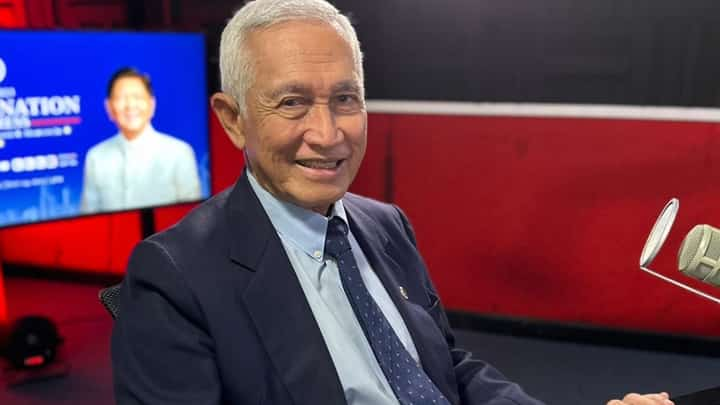
MAN for all business seasons His successor, Finance Secretary Carlos Dominguez III, gave the highest accolade to former Finance Secretary Gary Teves, saying he had led the Department of Finance ‘when the world was crumbling.’
Photograph courtesy of Presidential Broadcast Service
Margarito “Gary” Teves has weathered a financial crisis before. Now, seeing similar warning signs in the books, he is spelling out what he believes must be done to avert another economic storm.
When then Finance Secretary Carlos Dominguez III explained why Teves was suited for a government post, he offered a memorable assessment: Teves had led the Department of Finance (DoF) “when the world was crumbling.”
Dominguez was referring to 2008 and 2009, when the global financial crisis tested economies around the world. Teves steered the country through that turbulent period. More than a decade later, he sees a different set of pressures building on the Philippine economy — and has little reason to be reassured.
Teves was born in 1943 in Dipolog, Zamboanga, and his career spans politics, banking, and the Cabinet.
From 1987 to 1998, he represented Negros Oriental’s Third District in the House of Representatives, serving the maximum three terms. That legislative stint gave him a working knowledge of how budgets are made and bargained over, which proved useful later.
He then moved to the Land Bank of the Philippines, serving as president and CEO from 2000 to 2005. Under him, the state-owned lender grew into one of the country’s largest banks. His tenure there led to the biggest job of his career.
In July 2005, President Gloria Macapagal-Arroyo’s economic team resigned en masse amid that year’s political turmoil. Teves was appointed Finance Secretary to steady a department that was under heavy pressure. He stayed until June 2010, one of the longer tenures in recent decades.
VAT years amid crisis
His most consequential act came early. The 2005 expanded value-added tax law, which raised the VAT rate to 12 percent and broadened the base, was the centerpiece of efforts to shrink a deficit that had been dragging down the country’s credit standing. It was politically costly and fiscally decisive. The additional revenues helped stabilize public finances just as the global economy was about to turn.
When the crisis hit in 2008, the Philippines weathered it better than many of its neighbors. In 2009, the London-based magazine The Banker named Teves Asia’s best finance minister.
Teves has long counted the late Finance Secretary Jesus Estanislao among his mentors, a connection that reflects a school of thought that favors fiscal discipline and institutional credibility over quick fixes.
After leaving government, Teves stayed in public discussions as a commentator and a trustee of the Foundation for Economic Freedom.
Familiar warning sign
Today’s picture, as Teves lays it out, is grim. In an interview on online program Straight Talk, he outlined the problems facing the economy: inflation that rose to 7.2 percent in September, the weakest second-quarter growth in years, a ballooning deficit, and a debt-to-GDP ratio of about 66 percent.
He is blunt on how to read the inflation numbers. In his view, raising interest rates is a tool for demand-driven price pressures, not for the supply-side shocks now at work: oil, food and weather.
Higher rates could still hurt, because businesses delay investment and consumers put off big purchases, but they would do little to fix the underlying cause. The right response, he said, lies with the national government: raise farm productivity, diversify raw material supplies, and build the roads, cold storage, and warehouses that keep goods moving.
On debt, Teves said the public should watch the ratio to gross domestic product (GDP) rather than the headline peso figure.
Borrowing, he noted, is not dangerous in itself if the money goes to productive uses. His concern is that in recent years it did not. He points to corruption, misallocation and a lack of transparency, and he notes that the current ratio exceeds even the pandemic peak and sits above the 60 percent level generally treated as manageable.
Interest payments, at around 15 percent of the proposed national budget, crowd out classrooms, clinics and food programs.
‘Make every peso count’
Teves keeps returning to one principle: make every peso count. He applies it to the 2027 budget with open disappointment.
By his estimate, the House added about P145 billion for items such as unconditional ayuda or cash subsidies and local pet projects, while cutting about P66 billion from growth-enhancing programs including foreign-assisted projects, school and health facilities, and agricultural food hubs.
He wanted the Senate to restore the cuts by reallocating the additions, and to put the remaining balance into the Pantawid Pamilyang Pilipino Program (4Ps), PhilHealth, school-based feeding and the Anti-Red Tape Authority.
He argued that the 4Ps, which ties cash aid to school attendance and health check-ups, lifts families out of poverty more sustainably than no-strings handouts.
On the flood control scandal, he wanted speed and integrity together: a faster, time-bound review of procurement rules, a lifetime ban for contractors tied to corruption or ghost projects, and civil society groups to help monitor projects.
Limits to possible
Teves, who oversaw the 2005 VAT overhaul, does not advocate new taxes now. He considers it too late in the administration’s term to pass them, especially with the President’s approval ratings low. He prefers modernizing VAT administration to cut leakage, halting congressional VAT exemptions that erode the base, and using the Ease of Paying Taxes Law more.
In July 2005, President Gloria Macapagal-Arroyo’s economic team resigned en masse amid that year’s political turmoil. Teves was appointed Finance Secretary to steady a department that was under heavy pressure.
Cutting the VAT rate to 10 percent, he warns, would cost roughly P330 billion a year, which taxes, borrowing, or spending cuts would have to cover.
On the peso, he says the BSP should not defend a particular level but guard against extreme swings. He cites oil prices, geopolitical uncertainty, and the country’s import dependence as the forces behind the weakness.
On credit ratings, he considers the government’s “A” goal out of reach for this administration, and said the sensible aim is to keep the current rating while laying the groundwork for the next one. He does not think chasing the rating distorts policy, because showing creditors that the government manages its money responsibly is the route to it.
Asked what he would do in his first 90 days if he were handed the DoF portfolio today, Teves answers in the language of discipline.
He would simplify tax payments and shift to digital transactions, which he says reduces both friction and corruption. He would redirect spending from unproductive items to programs that support growth. He would send officials to the provinces to verify, in person, what line agencies report on food production, schools, health and infrastructure.
It is a modest playbook, free of grand gestures, built on the conviction that public finance is a matter of trust. For someone who once steered the economy through a global crisis, that lesson may carry over.