
Welcome to ‘United States of Makati’: Where the city is the amenity


Have you been to the United States of Makati lately?
Are you an OFW in Makati? And how well do you speak Makatinese?
Social media has recently been having fun with the idea of Makati as its own country. Office workers call themselves “OFWs”— “Onsite Filipino Workers” or, on particularly exhausting days, “Overworked Filipino Workers”—as they navigate their daily commutes into the city.
The joke comes with its own geography and currency. Workers earn “Makati dollars,” long-time employees claim “Makaticitizenship,” and Glorietta has been dubbed the fictional country’s airport.
It works because Makati really can feel like a world of its own.
More than a business district
Makati’s transformation was never simply about building skyscrapers. Over the decades, Ayala Land helped shape an urban environment where commercial, residential, retail, hospitality, cultural and recreational spaces could exist within one connected district.
Ayala Land, Inc. is one of the Philippines’ largest property developers, with a long-standing approach centered on master-planned communities, sustainable development, and creating long-term value for residents, investors, and stakeholders. Its story is closely tied to Makati itself, beginning with the development of Hacienda Makati—once an expansive, largely undeveloped property that would eventually become the country’s leading financial and central business district.
Developments that satisfy your residential, recreational, and commercial needs, stretching our impact from individuals and households to communities and society.
Since Ayala Land’s establishment in 1988 and its listing on the Manila and Makati Stock Exchanges in 1991, the company has grown into one of the country’s leading real estate developers. Yet perhaps one of its most enduring legacies remains visible in the way Makati functions as a city.
That distinction matters.
A successful property destination is not defined only by what happens inside a building. Its value is also shaped by what surrounds it: how accessible it is, what people can do nearby, how walkable it feels, and whether the district remains active beyond office hours.
In Makati, the city itself becomes part of the amenity.
An office worker can step out of a tower and find cafés, restaurants, retail destinations, hotels, galleries, and open spaces within reach. Residents can access much of the same ecosystem without having to travel far, while visitors can move seamlessly between business, leisure, dining, shopping and entertainment.
This interconnected environment is what gives a master-planned district its lasting appeal. The buildings may provide the individual spaces, but the network between them creates the larger experience—and ultimately, the value of the place.
This is the power of mixed-use development.

Leading listed property developer.
Value of the spaces between
Perhaps the most important part of Makati’s property story is not always found inside its buildings. It is in the spaces between them.
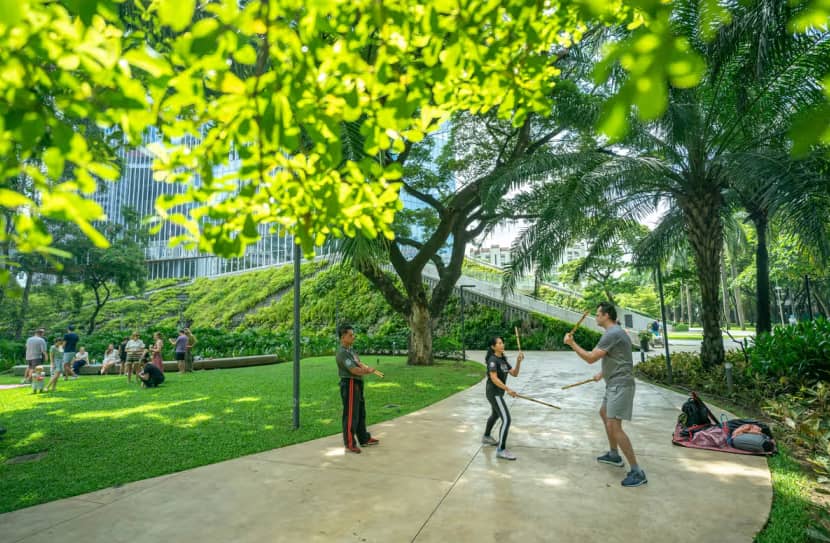
Landscaped streets, pedestrian areas, parks, plazas and gathering spaces give the CBD a sense of place. They transform a collection of properties into a neighborhood.
During the workweek, these spaces accommodate thousands of employees moving between offices, restaurants, shops, and transport connections.
On weekends, they take on another personality.
The Salcedo and Legazpi weekend markets bring people outdoors for food, local products, and leisurely mornings. Car-free Sundays turn portions of the city into spaces for runners, cyclists, and pedestrians. Cafés become meeting places, galleries become cultural destinations and restaurants extend the life of the district well into the evening.
These experiences contribute to what makes an address desirable.
From work address to lifestyle address
For property buyers, residents, and investors, Makati’s appeal goes beyond proximity to offices.
It is about access to a lifestyle.
A residential property in a well-established mixed-use district offers more than a home. It places residents close to employment centers, retail, dining, entertainment, culture, transportation and recreation.
For businesses, the same ecosystem creates a premium environment for employees, clients, and visitors.
This interconnectedness creates lasting value. The more people a district attracts, the more activity it generates; the more activity it generates, the more attractive it becomes to businesses, retailers, residents and investors.
That is what turns a business district into a city ecosystem.
Experience Makati beyond the office
The best way to appreciate Makati may be to experience it without a work agenda.
Start with gallery hopping, then make your way to the Salcedo or Legazpi weekend markets. Spend the afternoon café hopping or exploring the city’s dining destinations. Go for a run during car-free Sundays and experience streets usually dominated by traffic from a different perspective.
As evening arrives, the skyline becomes part of the experience.
The towers light up, restaurants and bars come alive and the CBD takes on a different energy. With hotels, dining, shopping, and entertainment concentrated within the district, even a staycation can feel like a quick urban escape.
City as the amenity
The “United States of Makati” may have started as a social media joke, but it captures something real about the city’s evolution.
Makati’s appeal is not simply its skyscrapers. It is the relationship between them—the offices, residences, retail destinations, hotels, cultural spaces, streets, parks and public areas that make the district work as a whole.
This is where Ayala Land’s long-term approach to placemaking becomes especially significant. It becomes a lifestyle.