
Bill Gates pushes AI tax, ‘Human Reserved’ jobs

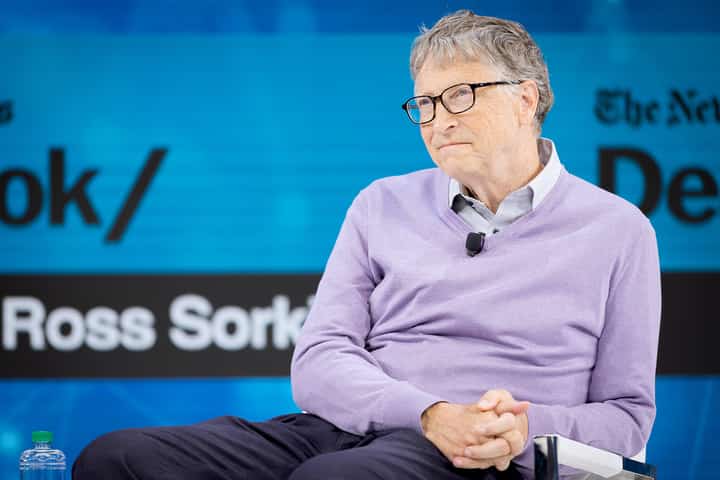
Tax the bots Bill Gates wants governments to tax AI and robots, protect some jobs for humans and use the proceeds to cushion workers displaced by automation.
Michael Cohen/Agence France-Presse
Microsoft co-founder Bill Gates is calling on governments to tax artificial intelligence (AI) and robots while setting aside some jobs exclusively for humans as automation threatens to reshape the global workforce.
In an essay published 26 August, Gates warned that AI could permanently eliminate jobs across white- and blue-collar industries, with entry- and mid-level workers particularly vulnerable.
“Many jobs will disappear forever,” Gates wrote.
He said jobs in sales, customer support, software engineering and paralegal work could be among the first affected, while AI could eventually take over tasks such as evaluating loan applications, analyzing data and triaging patients.
Robotics could extend the disruption to construction, hospitality and other physical work, with Gates predicting increasingly capable machines could begin competing with humans on some tasks before the end of the decade.
To soften the impact, Gates proposed creating a category of work he calls “Human Reserved,” where governments and societies deliberately choose to keep humans in certain roles even when machines become capable of performing them.
He pointed to caregiving as one example, arguing that some interactions should remain human even if robots eventually become technically capable of handling them. Education and mental health care could use a hybrid approach, with humans remaining in charge while using AI as a tool.
Gates also revived his proposal to tax automation.
“I believe we should tax AI tokens and robots,” he said.
Companies can generally deduct the cost of machines as business expenses, while hiring workers generates payroll and income tax revenue. Gates argued that this creates a financial incentive to replace people with machines.
Revenue from an AI or robot tax could be used to retrain displaced workers and strengthen social safety nets as automation reduces employment and government tax collections, he said.
Gates first publicly backed a robot tax in 2017, saying governments could use the proceeds to help workers displaced by automation.
Beyond employment, Gates warned that increasingly capable AI could make fraud, disinformation, cyberattacks and biological threats easier to carry out. He also raised concerns about AI companions and their potential effects on children’s social development and critical-thinking skills.
At the same time, he rejected an entirely pessimistic view of the technology, pointing to potential gains in health care, agriculture, education, scientific research and clean energy.
Gates said governments should establish new national bodies capable of coordinating AI policy across labor, security, education, taxation, health and other sectors.
He also called for an international framework to address risks that cross national borders, saying countries hosting leading AI developers and controlling important parts of the technology supply chain should begin establishing shared rules. Cooperation between the United States and China would also be necessary, he said.
Gates argued that governments need to act before widespread displacement forces them to respond in crisis mode, saying institutions currently in place were not designed for a technology advancing and spreading at AI’s pace.