
BSP chief sees Q4 growth recovery
‘As of the end of the second quarter of this year, we are only at a shortfall of about 7 percent year on year in terms of public spending.’
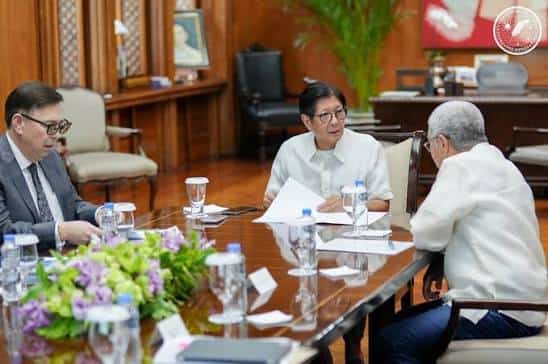
PRESIDENT Ferdinand Marcos Jr. (left) and Bangko Sentral ng Pilipinas Governor Eli Remolona Jr. are both optimistic that the country's growth is on track and will be felt towards the fourth quarter of the year, and with the full rebound in 2027.
photograph courtesy of PCO
Economic growth should begin to recover by the end of the year before returning fully to track in 2027 as the government continues to ramp up infrastructure spending, Bangko Sentral ng Pilipinas Governor Eli Remolona Jr. said.
“I believe the government has been working strenuously to accelerate infrastructure spending, and we expect that growth will recover by the fourth quarter of 2026,” he said following the BSP’s third consecutive rate hike this year.
“The fundamentals for growth are still in place. Once growth gets going, it will get going. So, we think growth will, more or less, fully recover by next year,” he added.
Gross domestic product (GDP) growth sank to its lowest quarterly level since 2009, excluding the pandemic recession, in the second quarter, as the infrastructure spending slowdown following last year’s flood control scandal continued.
Latest data from the Department of Budget and Management (DBM) showed that infrastructure and other capital outlays fell 34.1 percent year on year to P98.0 billion in June, bringing the first-half decline to 40.8 percent to P367.4 billion.
Gross fixed capital formation contracted by 13.7 percent, significantly worse than the 2.5 percent decline recorded in the first quarter.
The DBM attributed the weakness to tighter payment validation, audit and documentary requirements, particularly those affecting Department of Public Works and Highways disbursements.
President Ferdinand Marcos Jr. acknowledged that the close reexamination of the previous year’s budget resulted in projects and contracts being bid out only toward the end of the first quarter of 2026, delaying public spending.
“As of the end of the second quarter of this year, we are only at a shortfall of about 7 percent year on year in terms of public spending,” Marcos said on 14 August. “We will make that up for the rest of the year.”
“And so, GDP growth will show an increase because of the increase in activity,” he added.
The BSP enacted two key policy rate cuts last year in a bid to stimulate growth. However, the onset of the Gulf conflict in March pushed headline inflation nearly seven times higher than a year earlier, prompting the central bank to reverse course and enter a tightening cycle that could weigh on economic growth.
Remolona, on the other hand, said the latest hike, enacted on Thursday, would not severely hamper growth.
“We always take account of growth,” he said. “We considered that very carefully. But [not raising] the policy rate, in our calculations, wouldn’t have added significantly to growth.”