
Rare hawk-eagle nesting discovery prompts protection measures
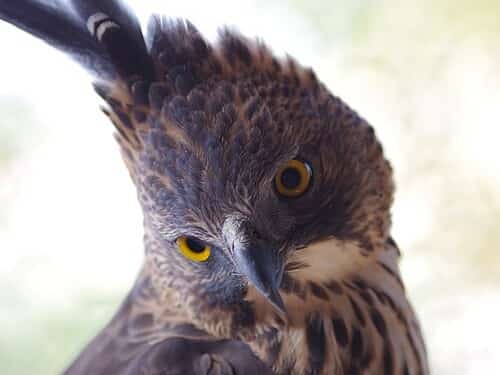
PALO, Leyte—Wildlife conservationists have documented the first active nesting pair of the endangered South Philippine Hawk-Eagle on Leyte Island, offering new hope for the survival of the rare raptor species.
Biologist Tristan Senarillos and a research team from the Philippine Eagle Foundation (PEF) tracked the birds, locally known as lawin, inside Mahagnao Volcano Natural Park.
The milestone marks the first time researchers have recorded the complete nesting cycle of the species — from nest construction and egg incubation to hatching and fledging.
Categorized as endangered on the International Union for Conservation of Nature Red List, the South Philippine Hawk-Eagle (Nisaetus pinskeri) faces ongoing population declines driven by deforestation, agricultural expansion, hunting, and poaching for the illegal pet trade.
Fieldwork began in November 2025 when the PEF team spotted a hawk-eagle calling from a native tiga tree in the Burauen forest. Researchers observed the pair carefully building a nest out of fresh twigs but temporarily withdrew to avoid disturbing the sensitive raptors.
Returning in January 2026, researchers found the female incubating a single egg inside a camouflaged blind.
After 41 days of incubation, during which the male regularly provided food, the egg hatched on 2 March 2026. The chick successfully fledged and took its first flight on 17 May.
The 76-day observation provided critical data on the species’ breeding biology, territorial behavior and nesting requirements, according to the PEF.
The discovery has triggered immediate policy responses to safeguard the species.
The Protected Area Management Board of Mahagnao Volcano Natural Park approved four protective resolutions targeting the nest site, while the municipal government of Burauen is drafting an ordinance to designate the South Philippine Hawk-Eagle as a local flagship conservation species.
PEF researchers are preparing scientific papers to publish their findings and outline evidence-based strategies for regional forest protection.