
Visayas power deficit triggers 22nd red alert

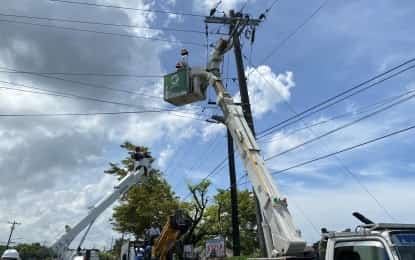
The Visayas grid was placed under red alert for the 22nd time this year on Wednesday as available power supply fell short of projected peak demand amid prolonged plant outages and limited imports from Mindanao.
The National Grid Corp. of the Philippines (NGCP) said Wednesday that the red alert will be in effect from 3 p.m. to 9 p.m., while a yellow alert—the 87th raised in the Visayas this year—will cover 2 p.m. to 3 p.m. and 9 p.m. to 10 p.m.
Available capacity in the Visayas stood at 2,324 megawatts (MW), below the projected peak demand of 2,550 MW, leaving a 226-MW gap between available supply and peak demand.
The latest alerts highlight continued pressure on the Visayas power system, with 901 MW of capacity currently unavailable to the grid due to plant outages and deratings.
To ease recurring supply alerts, Department of Energy (DOE) Assistant Secretary Mario Marasigan said the agency is looking to immediately tap available battery energy storage systems (BESS) across the region.
“So what is the immediate solution that we have identified? We could immediately address and reduce the yellow and red alerts by installing battery energy storage systems,” Marasigan said.
The DOE has directed NGCP to directly negotiate for about 253 MW of available BESS capacity located in Leyte, Cebu, Panay and Negros.
If supply conditions remain tight, Marasigan said the government is also studying the deployment of liquid fuel facilities that can be quickly brought online.
One option involves transferring a power barge from Navotas in Metro Manila to the Visayas. The initial plan was to connect the barge in Panay, but Marasigan said the final configuration would instead have it connected in Cebu near the Naga power facilities.
NGCP, meanwhile, said eight plants are on forced outage this August, while one has been offline since July, three since June, seven since May, and one since March.
Some outages have persisted for years, with three plants unavailable since 2025, two since 2024, two since 2023, and one since 2021. Another 14 plants are operating at derated capacities.
NGCP attributed the red and yellow alerts partly to the unavailability of large coal plants Therma Visayas, Inc. (TVI) 1, TVI 2, and Kepco SPC 1.
The Visayas grid is also receiving limited power imports from Mindanao due to the region’s high demand forecast and the planned outage of Therma South, Inc. 1.