
Three beers and 29 years later, Nick Joaquin’s Ramon Bagatsing story comes home
Nearly three decades after its completion, a biography of Manila’s longest-serving mayor emerges from the family vault, preserving the National Artist’s portrait of a poor provincial boy, war survivor and public servant who bore his Indian ancestry proudly while living fully as a Filipino.


For almost three decades, a manuscript by National Artist for Literature Nick Joaquin lay unpublished in the Bagatsing family vault. It contained the life of Ramon D. Bagatsing: the barefoot schoolboy from Negros Occidental who survived the Bataan Death March, became a lawyer and congressman, lost a leg after the Plaza Miranda bombing, and went on to become Manila’s longest-serving mayor. It was the story of a man affectionately — and sometimes derisively — called “Bombay” because of his Indian ancestry, yet whose life became inseparable from the history of the capital and the country he served.
On 19 August, Bagatsing’s 110th birth anniversary, the manuscript finally emerged as Bombay: A True-Blue Filipino. Published by independent publisher Milflores Publishing, the biography was launched at the Bulwagang Antonio Villegas of Manila City Hall, where Bagatsing once presided over the affairs of the capital. Elected in 1971, he assumed office on 1 January 1972, and remained mayor until February 1986 — an unmatched tenure of more than 14 years.
Four generations of the Bagatsing family gathered at the hall, welcomed by live music from the Manila City Band. The launch was hosted by Bagatsing’s grandchildren, Cristal Bagatsing and former Congressman Ramon “Don” Bagatsing Jr.
Among the guests were Manila Mayor Francisco “Isko Moreno” Domagoso; Indian Ambassador to the Philippines Harsh Kumar Jain; Federation of Indian Chambers of Commerce Inc. president Vishal Hathiramani and former President Vishnu Hathiramani; Filipino Indian Commerce and Welfare Society Inc. founder and president James Kumar; Federation of Filipino-Chinese Chambers of Commerce and Industry Inc. past president Cecilio Pedro; Peter Sy Gaisano, former director and assistant treasurer of the Philippine Red Cross Manila Chapter; and Junior Chamber International (Jaycees) Manila president Edison Ke.
Former Manila councilor and city administrator Felix Espiritu, who worked with Bagatsing for many years, shared personal memories of the former mayor.
But the presences most deeply felt at the launch belonged to two men who were no longer there: Ramon Bagatsing, who died in 2006, and Joaquin, who died in 2004.
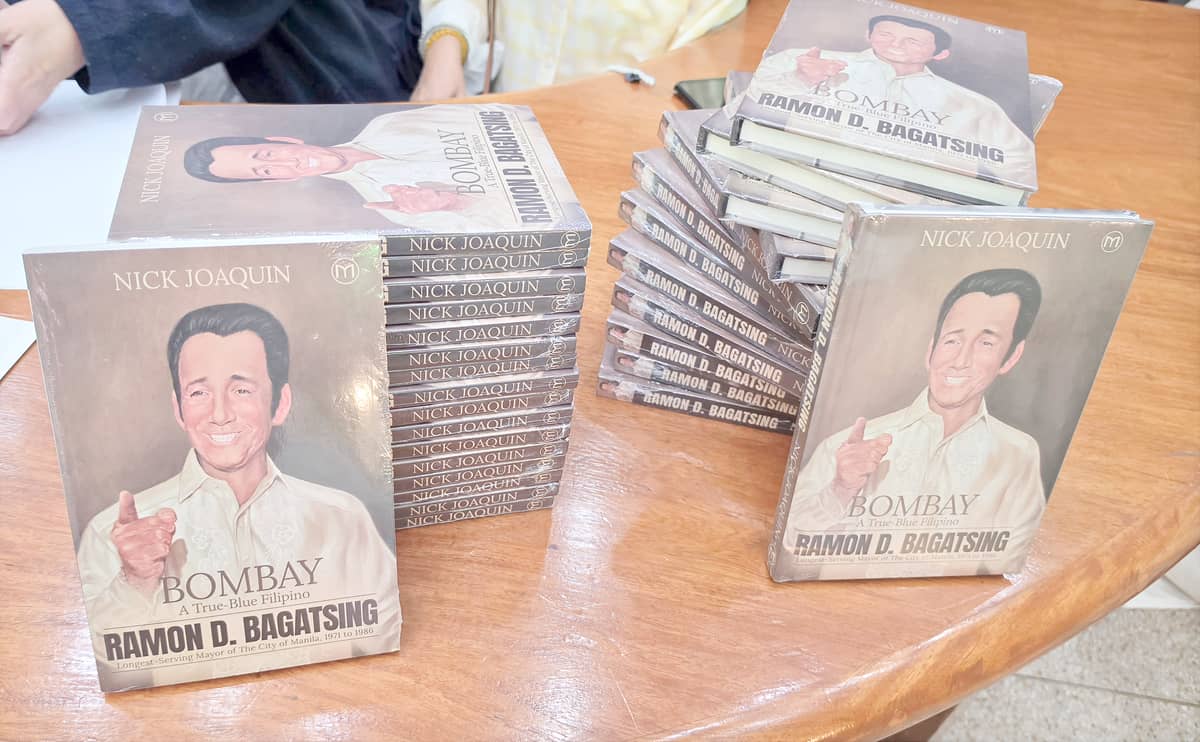
Copies of Nick Joaquin’s long-unpublished biography of former Manila Mayor Ramon D. Bagatsing.
PhotographS by Roel Hoang Manipon for DAILY TRIBUNE
Nick Joaquin and his subject
The journey of the book began in the 1990s, after Bagatsing had retired from public office. His family persuaded Joaquin — one of the country’s greatest writers and its most celebrated chronicler of Manila — to undertake his biography.
“When my father retired in the 1990s, he had all the time in the world,” recalled his son Ramon “Dondon” Sevilla Bagatsing Jr., a former congressman and Philippine ambassador to India and Nepal. “So we were able to convince Nick Joaquin, as you know, a National Artist in the field of literature, to write this biography.”
The interviews and writing took place from 1995 to 1997. In Bagatsing, Joaquin found a subject whose life crossed some of the most decisive episodes of the Philippine 20th century. Yet their encounters were apparently as memorable for the differences between the two men as for the stories that passed between them. Joaquin had his own working ritual.
“Nick Joaquin, when he started the interview in the morning at 10 o’clock, he would order three bottles of San Miguel beer,” Dondon related. “And my father was not a drinker. But Nick Joaquin did it that way. He finishes the beer by the time he finishes the interview. So that was some dynamics between the two of them.”
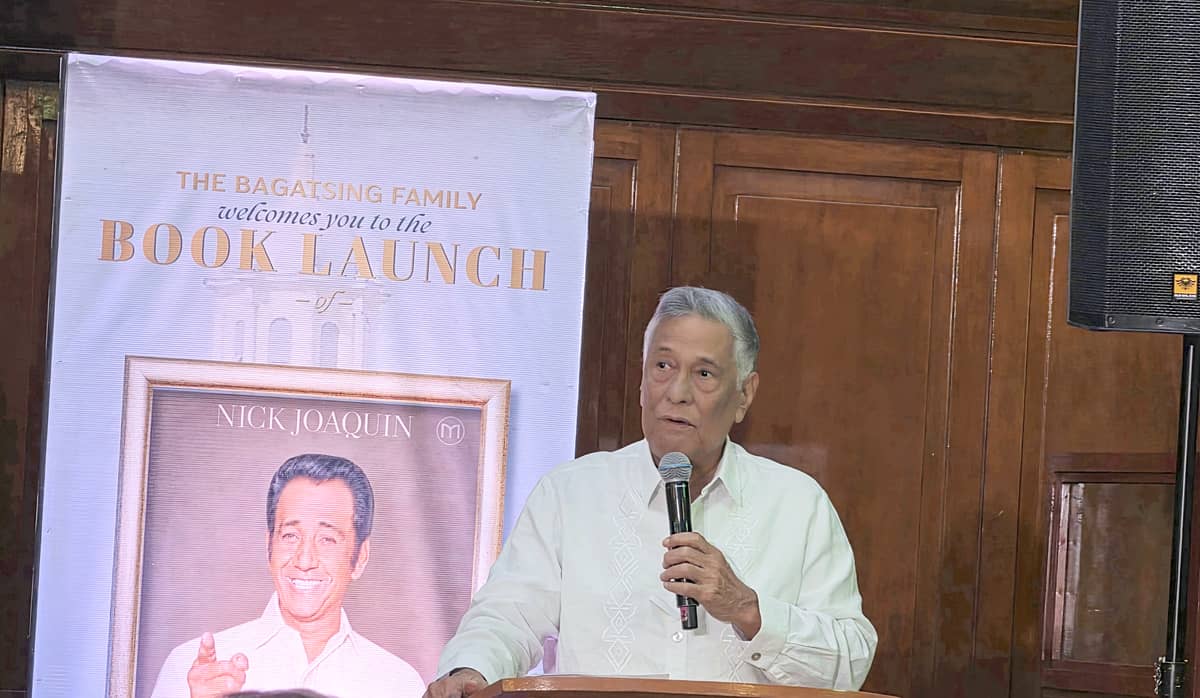
Ramon ‘Dondon’ Bagatsing Jr. recalls how Nick Joaquin wrote his father’s biography and why it took 29 years to reach print.
The book’s introduction, written by Bagatsing’s granddaughter Aym Bagatsing, wonders whether the former mayor was put off by the “ubiquitous bottle of San Miguel Pale Pilsen” in Joaquin’s hand. More seriously, she suggests that Bagatsing’s reserve may have come from a lifetime of being made conscious of his appearance and ancestry. Although he grew up Filipino and spent most of his life serving the country, political opponents could still exploit his Indian roots to portray him as foreign.
Joaquin completed the manuscript in 1997, but it seems nothing came of it.
“It took us to finally come up with this book 29 years,” Dondon said. “Why? We were not happy with the contents of the book. We thought it needed more depth, more substance, but we could not touch the book because Nick Joaquin is Nick Joaquin.”
The family considered what else might be added, but the manuscript had become an artifact in its own right: Joaquin’s rendering of Bagatsing, shaped by conversations between two different men.
“And maybe we will come up with a version later on, Volume 2, Volume 3,” Dondon said. “But we have to owe it to Nick Joaquin and my father for having the patience in dealing with each other.”
The family eventually decided to publish the manuscript as written, preserving the voice and work of the National Artist. In the acknowledgment, Dondon described the weight of bringing his father’s story into print.
“Nick Joaquin’s manuscript of Ramon Bagatsing’s biography has been in the family vault for decades,” he wrote. “The weight of responsibility of getting my father’s story out has been weighing on my shoulders for a while now, and I am glad that circumstances have aligned to finally see this book in print.”
The barefoot boy and the lion of Punjab
Joaquin begins the story with “Lion Out of the Punjab,” an apt preface to the life of a man born on 19 August 1916, in Sagay, Negros Occidental. Bagatsing was the son of Dionisia Delaraga, a Hiligaynon Filipina, and Amado Bagatsing, a Punjabi Sikh immigrant.
Much about Amado’s departure from India remains obscured by family lore. He rarely spoke about Punjab or his earlier life. After settling in Negros, he converted to Catholicism and married Dionisia. According to the family account, the name Bhagat Singh was eventually Filipinized into Bagatsing by removing the letter “h” and joining the two names.
Ramon inherited his father’s height and prominent features, but his formative identity was rooted in the Philippine countryside. He was proud not of being mestizo but of having been a poor probinsyano. Even after rising to power, he continued speaking Hiligaynon, eating simply and identifying with the shoeless boy he had once been.
The chapters of Bombay trace that unlikely ascent through titles bearing Joaquin’s wit and dramatic rhythm: “Simple Annals of the Poor,” “Boy Scout Without Shoes,” “Big-Town Blues and Busses,” “Armageddon and After,” “The Postwar Reinvention,” “Plaza Miranda,” “Happiness Is Hail City Hall” and “Hizzoner on Wheels.” Together, they depict a life repeatedly overtaken by history.
Bagatsing went to Manila and worked as a policeman. During the Second World War, he enlisted in the United States Army Forces in the Far East and fought in Bataan. Taken prisoner, he endured the Bataan Death March before escaping with two companions. A vegetable-truck driver named Ignedio Tuason helped save him — a kindness Bagatsing never forgot. According to the family, after the war he sent rice and fruit to Tuason’s family every year, a practice later continued by his children.
He joined the guerrilla resistance, resumed his education after the war, studied law, and entered public service. He was elected to Congress and later headed the Presidential Agency on Reforms and Government Operations, an anti-corruption body created in 1966. His work against graft helped earn him the sobriquet “The Incorruptible.”
His political life changed irrevocably on 21 August 1971, when grenades exploded during a Liberal Party rally at Plaza Miranda. Bagatsing sustained grave wounds, and his left leg was later amputated. His wife, Annie, was also injured.
Confined to a wheelchair and reliant on his sons to move around, he nevertheless continued his campaign for mayor. Public sympathy, the momentum of the Liberal Party, and his formidable resolve carried him to victory. His body had been altered, but not his mandate.
During his long tenure, Bagatsing became known as “The Mayor for the Poor.” Among the initiatives credited to his administration in the biography and family records were the establishment of the first Manila Barangay Bureau, which helped institutionalize the barangay as a basic unit for delivering local services; the creation of the Manila Youth Bureau and the city’s first tourism office; and the construction or expansion of schools, medical facilities, libraries, sports complexes and public plazas.
A Filipino face
At the launch, Ambassador Jain said the occasion celebrated far more than the publication of a long-awaited volume.
“A book launch is usually an occasion to celebrate a book,” he said. “But today, I believe we are celebrating something much larger. We are celebrating a remarkable life, a remarkable Filipino, and a remarkable story of the bonds between India and the Philippines.”
Bagatsing, Jain said, was “in many ways, a bridge between our two countries.” Born of an Indian father and a Filipino mother, he inherited two traditions without living uneasily between them.
“What makes his story so remarkable is that he did not live between two identities,” Jain said. “He lived fully as a Filipino, while carrying his Indian heritage with dignity and honor.”
The title performs a quiet act of reclamation. “Bombay,” or its Filipino rendering “Bumbay,” became a general name for people of Indian origin in the Philippines. The word could be affectionate, but it could also carry mockery and stereotype. In Bagatsing’s life, it acquired a different resonance.
“His life gave it a face, a Filipino face,” Jain said, “a face of courage, resilience, integrity, and public service.”
The subtitle, A True-Blue Filipino, does not deny Bagatsing’s Indian roots. Instead, it affirms that ancestry and national belonging need not contradict each other.
“The life of Ramon Bagatsing reminds us that heritage is not a boundary,” Jain said. “It is an additional thread in the larger fabric of national life. He was proud of his Indian ancestry, but he was unmistakably and proudly a Filipino.”
The publication of Bombay closes one journey while opening another. A manuscript that passed from Joaquin’s hands into the family vault has now returned to the city whose streets, institutions and people shaped both its author and its subject.
It is fitting that Joaquin should have written this life. He understood Manila as a gathering of histories — native and foreign, sacred and worldly, ruined and rebuilt. Bagatsing, the Bumbay who came from Negros and became the capital’s longest-serving mayor, belonged to that city of convergences.
The book now invites another generation to encounter him not merely as a monument or a name from political history but as the barefoot boy, soldier, survivor, mayor in a wheelchair and aging father sitting across from Nick Joaquin as three morning bottles of San Miguel beer slowly emptied between them.
After 29 years in the dark, the story of the “Bombay” has come home to Manila. From the pages of Joaquin’s long-hidden manuscript rises the salute with which the family closes its introduction: “Mabuhay ang Bumbay!”