
EDCOM2 urges review of remote learning as class suspensions widen learning gaps
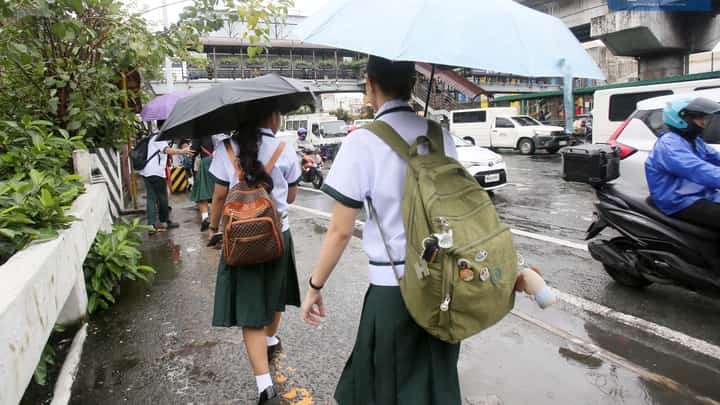
(JULY 3, 2025) Students of Ramon Magsaysay High School in Cubao, Quezon City seen headed home after the Quezon City LGU announce the suspension of classes in the afternoon due to the bad weather, PAGASA said A Low Pressure area LPA inside the Philippine Area of Responsibility (PAR) has a "MEDIUM" potential to develop into a tropical depression within the next 24 hours. on Thursday July 3 2025. Photo/Analy Labor
The Second Congressional Commission on Education (EDCOM2) is calling for a review of asynchronous learning models used during weather-related class suspensions, saying students may be losing weeks of instruction without evidence that remote lessons are closing the gap.
EDCOM2 Executive Director Dr. Karol Mark Yee said schools had lost as many as 30 to 50 days of instruction in some of the past two years, out of a 180-day school year.
“Nakita natin sa nakaraang dalawang taon, minsan 30, 40, 50 days ang nawawala sa isang school year. Paano mo matutunan 'yung lahat ng leksyon sa isang buong quarter? Kahit habulin natin 'yun, hindi natin kayang habulin 'yun nang bigla-bigla,” Yee said in a radio interview on Sunday.
Yee said the Department of Education (DepEd) should monitor and assess asynchronous learning programs to determine which are effective, discontinue those that are not and expand those that work.
“Dapat may monitoring and evaluation ang DepEd kung anong mga asynchronous models ang gumagana o hindi, para 'yung mga hindi, itigil 'yun at 'yung mga gumagana, 'yun 'yung palawakin,” he said.
Students should also undergo assessments when they return to school to identify lessons they failed to learn during suspensions, allowing teachers to provide catch-up instruction.
“Pagbalik dapat ng mga estudyante sa paaralan, dapat may assessment … alin 'yung mga leksyon na natutunan, alin 'yung hindi para 'yung mga hindi, ihahabol pa rin ng mga teachers,” Yee said.
Persistent rains brought by the southwest monsoon and recent tropical cyclones have forced schools in several parts of the Philippines to suspend face-to-face classes or shift to asynchronous learning.
Yee said face-to-face classes remained the most effective way for children to learn, particularly younger students developing basic literacy skills. But he noted authorities should avoid blanket suspensions where possible and instead tailor decisions to local conditions.
“While the safety of the children is extremely important and is paramount, we need to save learning days kung kaya natin,” Yee said.
“Kung puwedeng granular 'yung suspension… baka puwedeng tumuloy sila sa pag-aaral. Hindi 'yung blanket lagi 'yung suspension natin,” he added.
Schools as evacuation centers
Yee also urged authorities to enforce rules requiring schools to be used as evacuation centers only as a last resort, warning that prolonged occupation of schools can further disrupt learning.
“The law says schools should be used as the last resort,” Yee said, calling on local governments to identify alternative evacuation sites.
He also urged the Department of Education and the Department of the Interior and Local Government to monitor compliance.
Some schools remain occupied after the immediate emergency as displaced families repair or rebuild their homes, extending the disruption to classes.
DepEd is developing a standardized system that would automatically suspend and resume in-person classes and on-site work during emergencies based on hazard thresholds set by government agencies. The proposal is expected to be submitted to the presidential office through a draft executive order.