
Marcos silent heist partner
Marcos did not have to invent the leadership fund, but he failed to stop it, and such inaction in a system built on impunity is its own kind of authorship.

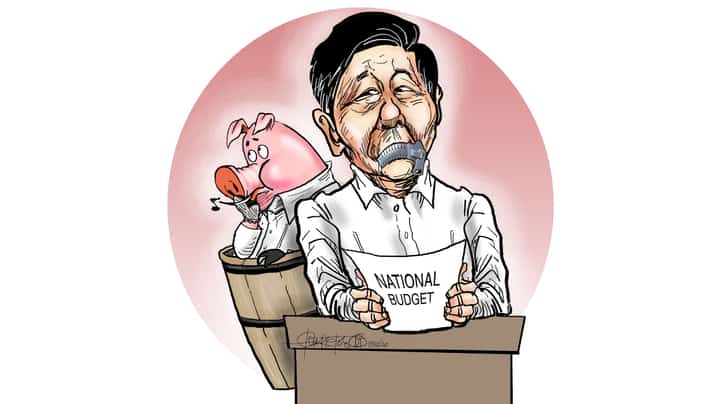
The number surfaced almost by accident. At the Sandiganbayan, former Department of Public Works and Highways (DPWH) Secretary Emmanuel Bonoan testified that in 2024, each senator received at least P500 million from his department’s budget, while committee heads got more, up to P1 billion.
The Palace denied that President Ferdinand Marcos Jr. knew of the fund, but budget watchdogs said it is yet another resurrection of the pork barrel, which, based on Bonoan’s affidavit, was an inferred directive from the President.
The President signs the annual General Appropriations Act, while economic managers draft the National Expenditure Program that is later sent to Congress to bargain over. Marcos also holds item-by-item veto power and the authority to realign funds that fail the public interest.
If P500 million per senator survived three budget cycles inside DPWH, Malacañang allowed it to survive.
Marcos did not have to invent the leadership fund, but he failed to stop it, and such inaction in a system built on impunity is its own kind of authorship.
Over the last three years, 22 percent of DPWH’s budget went to flood control. Forty-three percent went to what insiders call “aid to reelection”: multipurpose buildings, local roads, or small, visible, vote-buying projects.
Together, that is 65 percent of a trillion-peso agency, spent not based on national development priorities but on political survival.
Two senators now face consequences from the flood control scandal that grew out of this arrangement: one jailed and the other released on bail, accused of pocketing part of what should have built seawalls and drainage.
A senator who scrutinizes the DPWH budget line by line should not also receive a fixed allocation from that same budget; the legislator who signs off on the department’s spending plan has no business owning a piece of it.
Then, let’s review the value of the dodge by mouthpiece Claire Castro in saying that Marcos is completely clueless about the Senate arrangement.
A single year of legislative maneuvering might be explained by executive naivete, but three years mean approval or complicity, or both. And the trail leads, inevitably, to the man who delivers the yearly budget, particularly in a heated political rivalry against his vice president.
The deteriorating fiscal numbers, driven by the abuses the yearly budget has been subjected to, are appalling.
The 2027 national budget will exceed P7.2 trillion. Of that, debt service, interest and principal together eat up P2.7 trillion, or 37.5 percent. Next year’s infrastructure program is P3.3 trillion, and 48 percent of it goes to paying down old debt.
The Filipino taxpayer is thus financing irregularities, then borrowing again to cover what corruption stole the first time: two losses, one bill.
In 2013, the Supreme Court struck down the Priority Development Assistance Fund and, a year later, the Disbursement Acceleration Program on the same constitutional ground: legislators have no business exercising post-enactment control over how appropriated funds are spent.
A Senate Leadership Fund tucked inside a line department’s budget is the same violation, relabeled. It was a mutation of pork barrel into a stealth version because it never had to pass through a paper trail that investigators could later trace.
Filipinos are already paying for their elected officials’ last flood-control heist with money borrowed in their name.
Like in the Philippine Health Insurance Corp. mess, they are now being asked to reimburse the government, likely through more loans, for what was lost.