
Bypass operation
The CA’s confirmation power is the principal check on who runs the departments. That check disappears whenever a secretary serves only in an acting capacity.

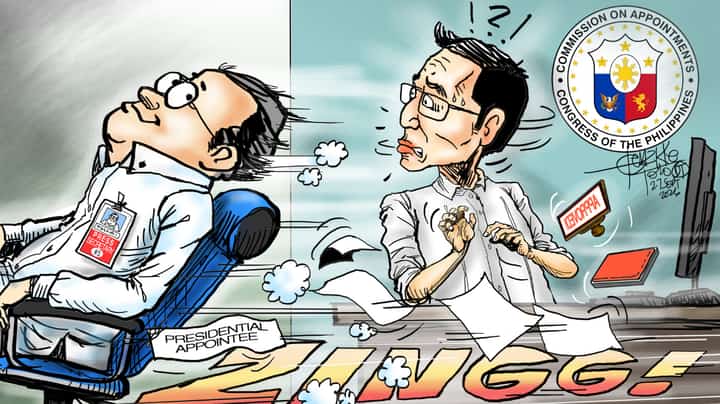
Installing acting and ad interim secretaries across the Cabinet may be legal, but it can corrode the very government they are meant to serve. This is the core argument advanced in a thesis by a College of Law dean submitted exclusively to the DAILY TRIBUNE.
The analysis comes amid concerns about the composition of the current Cabinet, with 40 percent of its members holding temporary appointments, some supposedly exceeding the one-year limit for their designations.
Again, this reflects the leadership’s patented habit of bending the law. The issue, therefore, is not simply whether temporary appointments are legally permissible, but whether continually resorting to them undermines institutional independence, accountability and effective governance.
The law gives acting secretaries the full powers of the office and their acts bind the government just like those of a confirmed secretary. The institutional effect, however, is immense when many Cabinet members serve in an acting capacity.
The Bicameral Commission on Appointments is bypassed at scale. CA confirmation imposes accountability on an official. Article VII, Section 16 of the Constitution obliges the President to nominate department heads “with the consent of the Commission on Appointments.”
The Administrative Code of 1987 allows the President to designate an officer temporarily when the regular head cannot serve or a vacancy exists, provided the designation does not exceed one year.
During President Gloria Arroyo’s term, the Senate challenged her practice of naming eight acting secretaries while Congress was in session, arguing that this circumvented CA confirmation.
The Supreme Court upheld the practice, reasoning that the power to appoint includes making temporary designations, and that department secretaries, as the President’s alter egos, may be chosen on personal confidence rather than legislative vetting.
Since ad interim appointments bypass the CA, they may be made whether Congress is in session or in recess, but the Supreme Court had anchored the practice to the one-year cap in the Administrative Code and warned against using acting appointments to defeat confirmation altogether.
On the question of validity, a 1939 case established the doctrine of qualified political agency. That case gave rise to the doctrine that a secretary’s acts are presumptively the President’s own, since a secretary functions as an extension of presidential authority.
The Constitution’s one-year limit is an absolute prohibition captured in the phrase “in no case” can it be breached. Designations that extend beyond that period could therefore expose the appointments to quo warranto challenges.
A quo warranto proceeding is a legal action questioning a person’s authority or legal right to hold public office or exercise a public function.
Transportation Secretary Giovanni Lopez has been serving under a designation that has surpassed the one-year mark, while Justice Secretary Fredderick Vida’s temporary appointment is approaching the same limit.
The institutional cost is what matters most. The CA’s confirmation power is the principal check on who runs the departments. That check disappears whenever a secretary serves only in an acting capacity.
Temporary officials continue to control budgets worth billions of pesos and approve major infrastructure projects without undergoing confirmation, even though the Constitution provides for that process.
The result is a concentration of power in the presidency. An acting secretary depends on the President’s designation and has no independent institutional mandate from Congress.
Leadership becomes more cautious, as provisional Cabinet members are less inclined to pursue long-term reforms when their tenure ultimately depends on presidential discretion.
Acting designations were intended to ensure continuity after resignations and give a President time to assess an official before making a permanent appointment.
But when temporary postings become the norm rather than the exception, the practice can become a governing strategy to bypass the Commission on Appointments.
Acting and ad interim Cabinet secretaries, in turn, become dependent on presidential favor.