
Why not? Russell Westbrook walks away as one of NBA’s most relentless stars

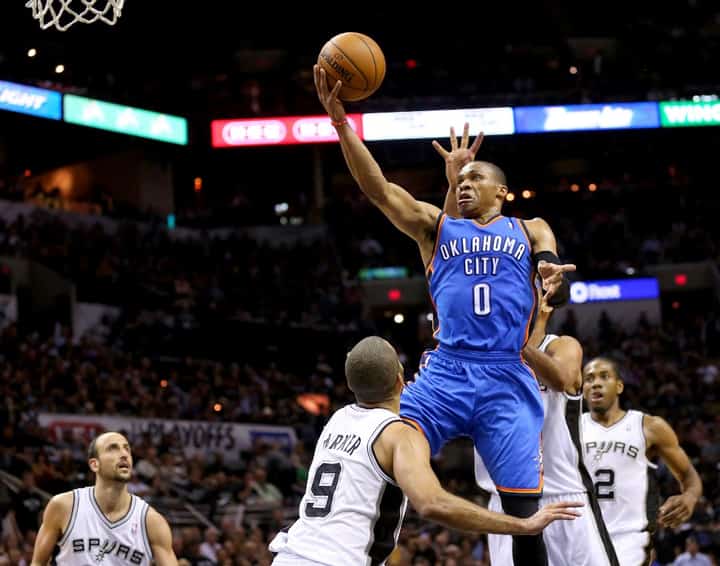
SAN ANTONIO, TX - MAY 19: Russell Westbrook #0 of the Oklahoma City Thunder goes for a shot against Tony Parker #9 of the San Antonio Spurs in the third quarter in Game One of the Western Conference Finals during the 2014 NBA Playoffs at AT&T Center on May 19, 2014 in San Antonio, Texas. NOTE TO USER: User expressly acknowledges and agrees that, by downloading and or using this photograph, User is consenting to the terms and conditions of the Getty Images License Agreement. (Photo by Ronald Martinez/Getty Images) RONALD MARTINEZ / Getty Images Sport Classic / Getty Images via AFP
Russell Westbrook never played basketball quietly.
For 18 seasons, every possession seemed personal. Every rebound was there to be ripped away. Every opening in the defense was an invitation to attack the rim.
Now, at 37, the former NBA Most Valuable Player is walking away.
Westbrook announced his retirement Wednesday, ending a career that transformed the triple-double from a statistical rarity into something almost expected whenever No. 0 stepped on the floor. He retires as the NBA’s career leader with 209 triple-doubles.
There were flaws. There were turnovers, questionable shots, playoff disappointments and, particularly late in his career, endless debates about whether his uncompromising style could fit alongside other stars.
But Westbrook was never afraid of failure.
His career numbers tell part of the story: 27,176 points and 10,351 assists, good for 14th and fifth, respectively, on the NBA’s all-time lists at the time of his retirement. He was a nine-time All-Star, nine-time All-NBA selection, two-time scoring champion, three-time assists leader and member of the NBA’s 75th Anniversary Team.
He also won Olympic gold with the United States in 2012.
But if one season defines Russell Westbrook, it will always be 2016-17.
The season that made ‘Why not?’ real
Kevin Durant had left Oklahoma City for Golden State.
The Thunder suddenly belonged to Westbrook.
What followed was one of the most audacious individual seasons in NBA history.
Westbrook averaged 31.6 points, 10.7 rebounds and 10.4 assists, becoming the first player since Oscar Robertson in 1961-62 to average a triple-double over an entire season. He also won the scoring title.
Then came the record.
Westbrook recorded 42 triple-doubles, breaking Robertson’s 55-year-old single-season mark of 41. Oklahoma City went 33-9 in those games.
Fittingly, he broke the record against Denver on 9 April 2017 in ridiculous Westbrook fashion: 50 points, 16 rebounds and 10 assists, capped by a 36-foot game-winning three-pointer that eliminated the Nuggets from playoff contention.
The Thunder won 106-105.
Westbrook won MVP.
And he wasn't finished with triple-doubles. Westbrook eventually averaged one for an entire season four times, something that once seemed almost impossible.
Westbrook reached the 2012 NBA Finals with Durant, James Harden and the young Thunder before losing to LeBron James and the Miami Heat.
A championship would ultimately elude him.
After 11 seasons with the Thunder, Westbrook's career became nomadic. He played for Houston, Washington, the Los Angeles Lakers, LA Clippers, Denver and finally Sacramento.
His role changed. His athleticism inevitably diminished. Eventually, one of the league's biggest superstars had to learn how to come off the bench.
The intensity rarely changed.
That may ultimately be Westbrook's legacy.
He wasn't the greatest shooter. He wasn't always the easiest superstar to build around. He never won the championship that would have quieted his critics.
But for nearly two decades, Russell Westbrook played basketball as if conserving energy were an insult.
He made triple-doubles ordinary by doing something extraordinary over and over again.
The numbers are now permanent.
209 triple-doubles. Nine All-Star selections. Nine All-NBA selections. Two scoring titles. Three assists titles. Four seasons averaging a triple-double. One MVP.