
Teodoro says stronger military ties with allies key to regional deterrence

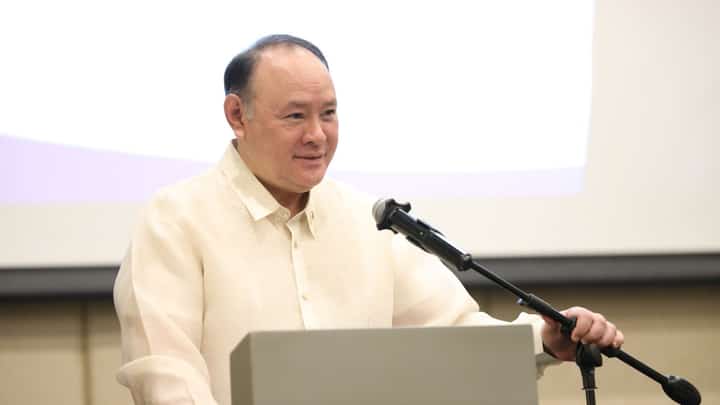
Defense Secretary Gilberto Teodoro Jr. on Wednesday said enhancing interoperability with allied countries, including members of the Association of Southeast Asian Nations (ASEAN) and partners in the Pacific region, is part of a broader deterrence strategy.
Speaking at the 37th United States Pacific Command (USPACOM) Annual International Military Law and Operations Strategic Engagement (MILOPS), Teodoro joined Malaysian Minister of Defense Dato' Seri Mohamed Khaled Nordin and ASEAN Secretary-General Dr. Kao Kim Hourn in delivering keynote remarks on "Philippine Perspectives on Regional Security Threats."
Rather than focusing solely on the threats, Teodoro presented how these challenges affect regional peace and security and, more importantly, ASEAN centrality.
Teodoro said the Philippines' geographic position gives ASEAN a strategic link to the Pacific, making the country's territorial integrity and maritime entitlements important to the regional bloc.
He noted that the Philippines is both an ASEAN member and a Pacific nation, and the only ASEAN country with a maritime area in the Pacific, including Benham Rise, which he said is larger than the West Philippine Sea.
He added that ASEAN benefits from having a maritime presence in the Pacific through the Philippines, which serves as a gateway between Southeast Asia and the Pacific, ensuring resilience, connectivity, and convergence.
"The Philippines is the only ASEAN member state that straddles both the South China Sea and the Pacific Ocean. No other ASEAN country, I repeat, has that," Teodoro said.
According to Teodoro, ASEAN's interest in maintaining unimpeded access to the Pacific under the framework of international law should include support for the Philippines' maritime rights.
"Therefore, it follows that if ASEAN wants unimpeded access to the Pacific under a regime of UNCLOS and our trust and confidence, it follows that ensuring Philippine entitlements as a whole under UNCLOS and the Arbitral Award is in ASEAN's interest," he said.
Teodoro added that, inspired in part by its ASEAN neighbors, the Philippines pursued peaceful dispute settlement through international tribunals established under relevant treaties.
He noted that several ASEAN member states have resolved disputes through international arbitration and accepted the outcomes because the process is fair, independent, and based on established legal norms.
Likewise, the Philippines brought its maritime dispute with China before an independent arbitral tribunal. China, however, refused to participate. Teodoro said this demonstrates the Philippines' commitment to international law in advancing its maritime claims and resolving international disputes.
He also underscored the government's transparency policy, saying it strengthens the credibility of the country's legal position while rejecting non-transparent approaches to conflict resolution.
Teodoro further pointed to China's increasingly assertive and aggressive actions against the Philippines, which, he said, have been documented through the country's transparency initiative and adherence to its international obligations.
He stressed that all Philippine defensive operations, activities, and external defense policies are firmly anchored on international law, including the United Nations Convention on the Law of the Sea (UNCLOS), which serves as a common foundation for like-minded nations.