
DOST, SM Prime launch sustainability expo featuring green innovations

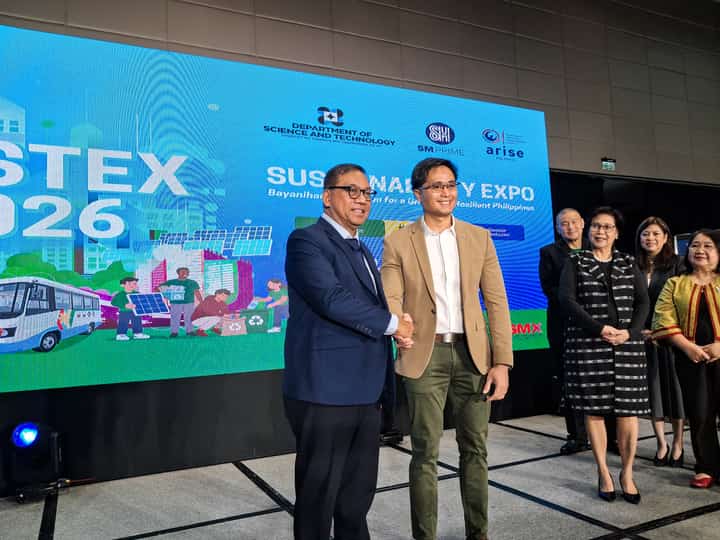
Department of Science and Technology (DOST) Secretary Renato Solidum Jr. (left) and SM Supermalls Vice President for Operations Engr. Junias Eusebio (right) lead the opening of the Sustainability Expo (SUSTEX) 2026 at the SMX Convention Center in Taguig City on 5 August 2026.
Photograph by Sean Magbanua for DAILY TRIBUNE
In partnership with SM Prime Holdings and ARISE Philippines, the Department of Science and Technology (DOST) on Wednesday opened the Sustainability Expo (SUSTEX) 2026 at the SMX Convention Center in Taguig City.
The expo showcased innovations in the circular economy, sustainable energy, and disaster risk reduction aimed at helping the country address pressing environmental challenges while contributing to national economic development.
"At the Department of Science and Technology, we are advancing what we call Bayanihan Innovation. This is a way of thinking and a way of working," DOST Secretary Renato Solidum Jr. said in his keynote address.
"It recognizes that innovation happens when the government provides direction and enabling policies; when researchers generate knowledge and evidence; when our universities nurture talent and discovery; when industry invests in and scales new technologies; when communities contribute local knowledge and lived experience; and when our young people bring creativity, energy, and fresh ideas," he added.
Meanwhile, SM Prime highlighted its sustainability journey, including initiatives on waste management, water conservation, energy efficiency, air quality improvement, and disaster resilience.
Among the company's featured sustainability initiatives were Trash to Cash, Plastic and Electronic Waste Collection, the Rainwater Treatment Facility, its first Solar Photovoltaic (PV) System, and the country's first free in-mall Electric Vehicle (EV) Charging Stations.
DOST also featured several homegrown technologies, including a compact and energy-efficient electric tricycle, the all-electric tourist tram E-Tranvia, Charging in Minutes (CharM) technology, the Textile Revitalization (TexRev) program, and the localized Weather, Environment, and Hydromet Monitoring (WEHLO) System.
The DOST, SM Prime, and their partners from government, industry, academia, and the scientific community reaffirmed their commitment to advancing the United Nations Sustainable Development Goals (UN SDGs) through science-based solutions, innovation, and collaborative action.