
ERC orders loss inventory: Meralco pushes back
Even the removal of the non-technical portion of the charges, which is from pilferage, would be difficult for utility firms.
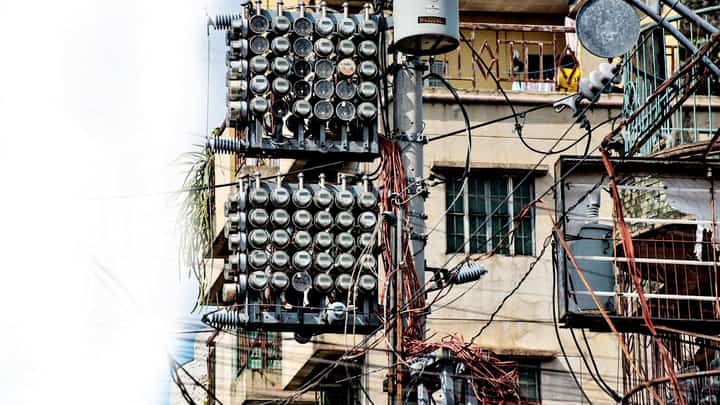
ENERGY consumption is measured by electric meters such these seen in Sta. Mesa, Manila. Energy officials estimate the complete removal of system loss charges may take up to a year, targeting full execution by 2027. The policy requires legal amendments to the EPIRA law, extensive infrastructure planning and regulatory adjustments by the Energy Regulatory Commission before implementation.
PHOTOGRAPH BY Zedrich Xylak madrid FOR DAILY TRIBUNE
Power distributors were ordered to lay bare one of the most contentious charges on consumers’ electricity bills, with the Energy Regulatory Commission (ERC) demanding five years’ worth of system loss records as pressure builds to scrap or overhaul the decades-old levy.
In an advisory issued over the weekend, the ERC directed all distribution utilities (DU) to submit detailed system loss data covering 2021 to 2025, following President Ferdinand R. Marcos Jr.‘s call during his State of the Nation Address (SoNA) to remove the longstanding charge and amid lawmakers’ push to amend the Electric Power Industry Reform Act (EPIRA).
System loss is the difference between the electricity generated or entering a distribution network and the actual amount of the power measured and ultimately billed to consumers.
It includes technical losses that occur naturally as electricity flows through transmission and distribution facilities, as well as non-technical losses caused by electricity theft, illegal connections and meter tampering.
Marcos’s demand to erase the charge in the monthly electricity bills was immediately opposed by Meralco and other electricity distributors, who claimed that it would mean a huge financial loss that may affect the efficiency of their services.
Meralco SVP and head of regulatory management Jose Ronald Valles said even the removal of the non-technical portion of the charge, which is from pilferage, would be difficult for utility firms.
“That means additional personnel going around to check and make sure there are no illegal jumpers, etc. Are you going to pass that on to consumers?” he asked.
Distribution firms are allowed, under EPIRA, to catch those who tamper with or pilfer the electricity supply.
The EPIRA, which restructured and privatized the Philippine power sector in 2001, allows distribution utilities to recover a portion of those losses from consumers through a system loss charge reflected in the monthly electricity bills, subject to caps set by the ERC.
Any losses beyond the regulator’s prescribed cap cannot be passed on to customers.
“We don’t even want the system loss to rise because under the current regulations, if that increases, it will hurt the distribution utility; it will hurt consumers because there is a certain level of system loss that is passed through,” he explained.
Yet, with Meralco having 8.3-million customers, Valles said the entire manpower of the company “is not sufficient to regularly inspect every house and determine whether someone is stealing electricity. There are many cases where electricity is stolen at night so they won’t get caught.”
“How are we going to go there and monitor that? So we have to do it 24/7. So for us to be able to do that, the distribution utility will need enormous resources,” he added.
Valles warned, “If the system loss becomes zero and we are not allowed to recover that cost, how are we going to catch those stealing electricity? We will lose a huge amount.”
“The ERC also has a mandate to allow distribution utilities to operate viably. Otherwise, at the end of the day, consumers will be the ones to suffer,” Valles pointed out.
He said that if distribution utilities were no longer viable, how could they continue to operate properly and efficiently?
“At the end of the day, whatever solution is agreed upon, after considering all the inputs from the stakeholders, we will comply with whatever laws will finally be enacted by Congress,” Valles said.
Meralco chairperson Manuel V. Pangilinan earlier warned that totally removing the system loss charge will raise the inevitable question of who will shoulder the cost.
Gov’t sues for transparency
The ERC said the directive is seen to strengthen transparency, accountability, and consumer protection as policymakers revisit whether consumers should continue paying the charge in its current form.
“Pursuant to the mandate of the ERC under Republic Act 9136, otherwise known as EPIRA, and in furtherance of transparency, accountability and consumer protection in the collection and imposition of the system loss charge, the ERC issued Resolution 10, Series of 2018, requiring all DUs to submit their system loss data on or before 31 May of every year,” the commission said.
While utilities are already required to file annual system loss reports, the ERC said it is requiring a fresh submission covering the past five years in light of the renewed scrutiny over the charge.
“In view of the ongoing deliberations of various proposed legislative measures seeking to amend the EPIRA, as well as the President’s directive in his recent SoNA concerning system loss, among others, all DUs are hereby directed to submit their respective system loss data covering the period 2021 to 2025,” the ERC said.
The commission is requiring utilities to disclose the generation purchased cost, transmission cost, energy input, energy output delivered to consumers and for utility use, sub-transmission and substation consumption, feeder technical losses, non-technical losses, and the kilowatt-hours absorbed by the utility beyond the allowable feeder loss cap, if any.
The information must be submitted through the ERC’s online portal on or before Monday, 3 August.
For Meralco, the country’s largest power distributor, the system loss charge accounts for about five percent of a typical monthly electricity bill.
The utility’s 12-month moving average system loss stood at 5.72 percent in the first quarter, improving from 5.85 percent a year earlier.
An energy sector source said a system loss is normal even among industrialized nations.
According to benchmarks from the World Bank and the International Energy Agency, power grids generally fall under three performance tiers based on transmission and distribution (T&D) losses.
Countries such as Singapore, China, Japan and South Korea typically maintain T&D losses of three to five percent. These systems benefit from modern grid infrastructure, extensive high-voltage networks, and advanced grid management.
Large economies like the United States, Spain and Australia average losses between six and nine percent. The slightly higher numbers are primarily a result of geographic distance, requiring long distance bulk power transmission that naturally suffers greater thermal resistance.
Several emerging economies experience extreme system constraints. Countries like Iraq, Niger, Togo and the Republic of the Congo report grid losses ranging from 39 percent to over 62 percent. In these environments, severe underinvestment is compounded by rampant non-technical losses like power theft and unmetered connections.