
Resilience champ paces global crusade
In a High-Level Dialogue on scaling disaster risk reduction financing, he walked through what resilience actually looks like when it is poured into concrete and steel, beyond what is written in a mission statement.

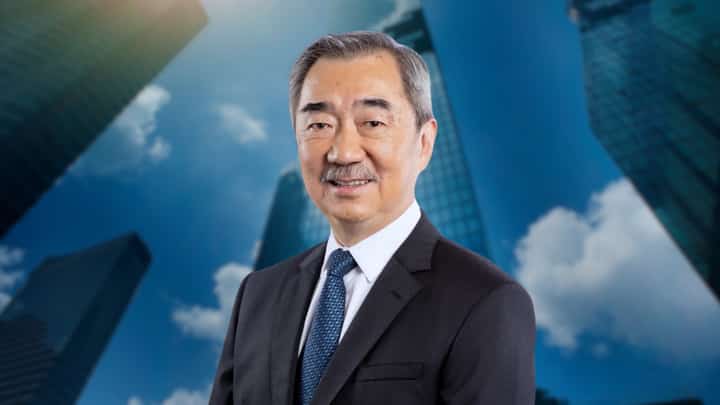
Team approach Resilience investment must be scaled beyond what individual companies choose to do voluntarily, as it will go a long way toward building infrastructure that will shield the economy from the adverse effects of changing weather patterns, SM Prime Holdings Executive Committee chairperson Hans Sy said.
Photographs courtesy of SM Prime
Magnate Hans Sy is increasingly becoming the private sector’s voice in disaster risk reduction, not just in the Philippines, but on the world stage.
From SM Prime’s storm-hardened malls to his advocacy in international fora, Sy has spent years turning resilience into business practice, not charity.
That record carried him to Geneva last year, where he told UN ministers the private sector is ready to do more, if governments meet it with the right incentives.
During the 8th Session of the Global Platform for Disaster Risk Reduction, Sy made a plain argument: business is not a bystander in the fight against disaster. It is, or it should be, a force multiplier.
At the assembly held in the Swiss capital under the co-chairmanship of the Government of Switzerland and organized by the United Nations Office for Disaster Risk Reduction, the SM Prime Holdings Executive Committee chairperson stood before ministers, disaster officials, and financiers from across the world.
“Resilience strengthens businesses while safeguarding lives and communities,” Sy told the Ministerial Roundtable on “Accelerating Financing and Resilience,” where he represented the Philippine private sector. “We know the government cannot do it alone. The private sector is ready to do more.”
His advocacy for a weather-proof economy was recognized by his peers. Sy was named 2025 Management Person of the Year by the Management Association of the Philippines, cited for environmental stewardship, governance, and his resilience-focused leadership at SM Prime, the same portfolio of work that brought him to the UNDRR Global Platform.
The short sentence carried weight. The Philippines sits on the Pacific Ring of Fire and in the direct path of roughly 20 typhoons a year.
Its private sector, SM Prime chief among them, has learned resilience the hard way, through malls flooded, roads closed, and supply chains snapped by storms that arrive with increasing frequency and force.
Sy’s message in Geneva was that this experience is not merely a cost of doing business in a disaster-prone archipelago. It is a body of practical knowledge the rest of the world can use.
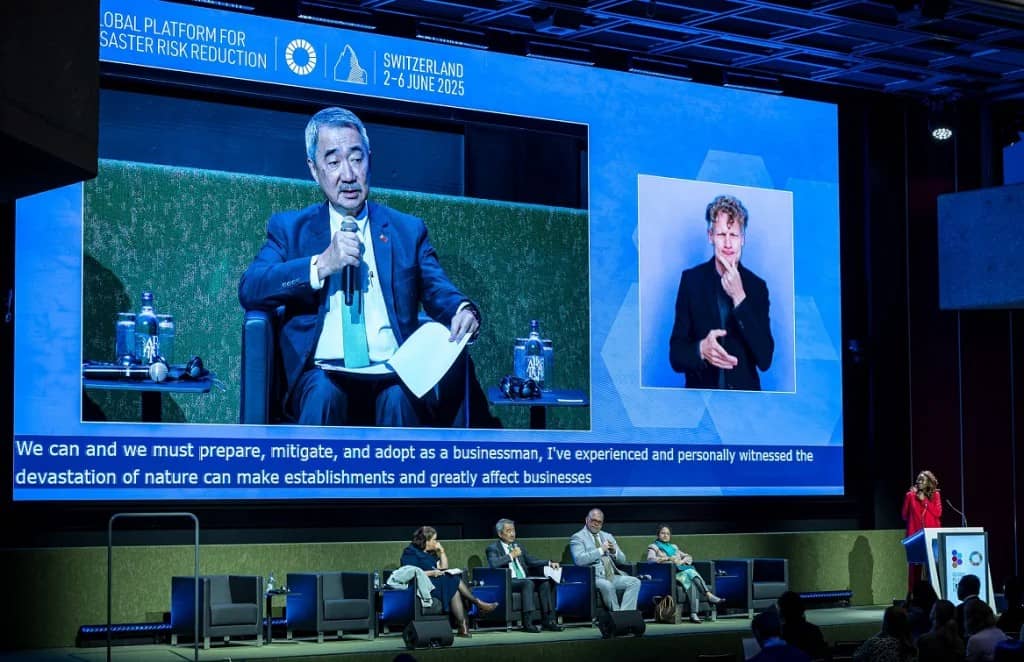
Green and global SM Prime Holdings Inc. Executive Committee chairperson Hans Sy enumerates steps to make the economy weather-proof in the 8th Session of the Global Platform for Disaster Risk Reduction, organized by the UN Office for Disaster Risk Reduction and co-chaired by the Government of Switzerland.
Sy brought a blueprint of resilience in the key meeting.
In a High-Level Dialogue on scaling disaster risk reduction financing, he walked through what resilience actually looks like when it is poured into concrete and steel, beyond what is written in a mission statement.
SM Prime, he said, allocates a significant share of project costs to disaster-resilient infrastructure, guided by science-driven planning frameworks rather than guesswork or convention.
The examples are found in the physical and specific projects of the group. Malls built on elevated platforms, designed to keep operating or to reopen fast after flooding that would shutter a conventional structure.
Rainwater catchment systems built into the architecture itself, turned into a defense rather than an afterthought. Earthquake-resistant designs engineered for a country where the ground itself cannot be trusted to stay still.
The SM Mall of Asia Complex is perhaps the clearest illustration. It sits behind a heightened seawall and an elevated platform meant to hold back rising sea levels. Beneath it run drainage channels wide enough to fit two buses side by side, built to swallow storm surge before it swallows the mall.
“Disasters may be unpredictable,” Sy said, “but their impacts don’t have to be. We can, and must, prepare, mitigate and adapt.”
It is a line that could serve as an engineering philosophy as easily as a corporate one.
Beyond the balance sheet
Sy’s brief to the roundtable extended past SM Prime’s own properties into the partnerships the company has built to spread that weather discipline further.
He pointed to the Adopt-a-City Program, run jointly with the National Resilience Council, which pairs private sector resources with local government units to harden entire cities rather than isolated buildings. He cited joint capacity-building work with ARISE Philippines and the Department of Trade and Industry, aimed at pulling smaller businesses — the ones without SM Prime’s financial strength — into the same resilience thinking.
The through line is that disaster risk reduction, in Sy’s telling, is not a philanthropic gesture bolted onto a company’s operations. It involves infrastructure, planning and partnerships. And all three require money that the public sector, on its own, cannot always supply.
That shortfall was the substance of Sy’s pursuit: Resilience investment must be scaled beyond what individual companies choose to do voluntarily.
He called for a structure of enabling mechanisms, policy support, institutional cooperation, and targeted incentives that would make resilience investment a rational business decision rather than an act of goodwill.
“From the standpoint of the private sector, financial, non-financial and regulatory incentives are among the most effective ways to accelerate investment in resilience,” he said.
The argument beneath it is not complicated. Companies will build resilient infrastructure at scale when the incentives make it sensible to do so.
Perks such as tax treatment, insurance frameworks, and regulatory clarity are required not simply when disaster strikes. Sy’s pitch to the ministers in the room was to build that architecture now, before the next storm makes the case for them.
Benchmark for the future
Sy has nurtured a line meant to summon collective will rather than corporate credit: “Together, we can embed resilience to build a sustainable and secure future for all.”
But the record he brought to Geneva was SM Prime’s own, malls that flood less, seawalls that hold, drainage built for the worst case rather than the average one.
Whether that record becomes a template other companies and other countries adopt, or remains a single company’s competitive advantage, was offered to the participants to ponder.
For now, it stands as one of the more concrete examples of what private capital can do when it treats disaster not as an interruption to business, but as a necessary condition that the whole nation must work hard to adapt to.