
Kuya Charlie sees impeach influencing Pinoy’s future
Serapio explained that senators occupy two roles at once: politicians elected by the people and judges tasked with seeking truth and justice. That dual responsibility makes impeachment impossible to view solely as either a legal proceeding or a political exercise.


Polls, ultimate gauge of people’s will While impeachment demonstrates the constitutional mechanisms for accountability, elections remain the ultimate expression of the people’s sovereign will, according to Carlos ‘Kuya Charlie’ Serapio, the former political consultant for the Office of the Presidential Adviser on Political Affairs and the Office of the Executive Secretary during the administration of President Benigno Aquino III.
Photographs by Yuko Shimomura for DAILY TRIBUNE
By the time Carlos “Kuya Charlie” Serapio weighs in on today’s biggest political controversies, he does so not merely as a lawyer but as someone who has spent decades navigating law, governance and Philippine politics.
Appearing on DAILY TRIBUNE’s Straight Talk, the veteran lawyer and former vice presidential candidate offered more than legal commentary on the impeachment trial of Vice President Sara Duterte. Instead, he painted a picture of how he believes the country’s institutions function, where constitutional principles, political realities and public opinion constantly intersect.
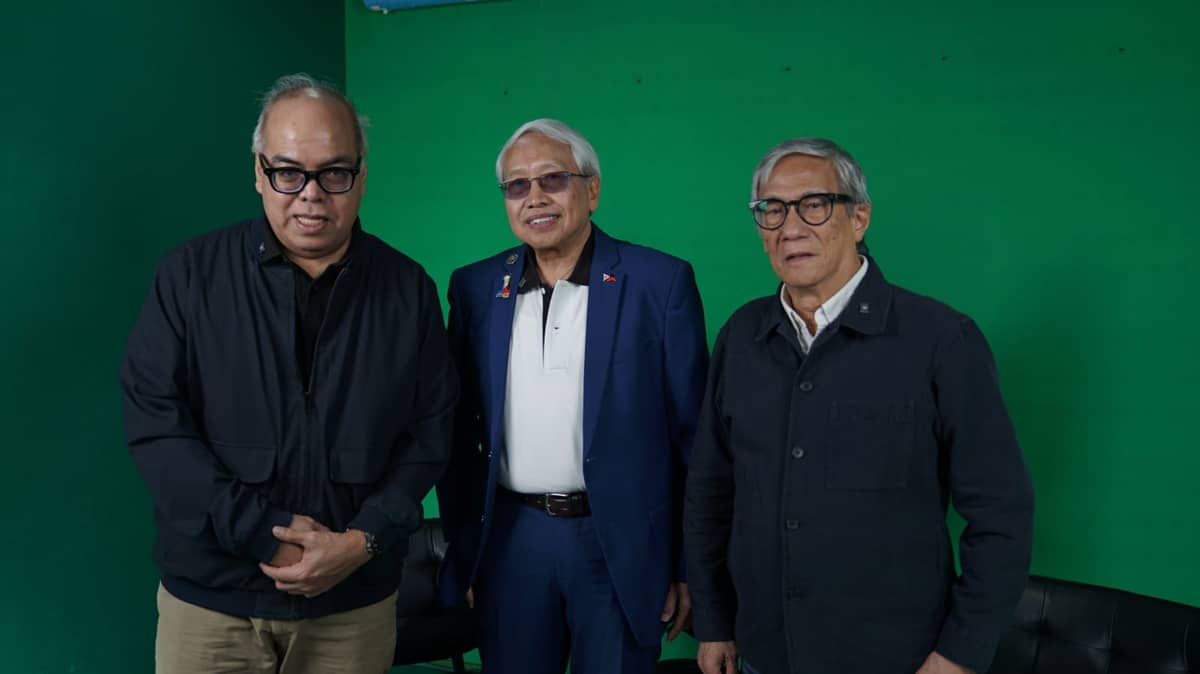
Different take Sociopolitical veteran Carlos ‘Kuya Charlie’ Serapio provides the religious and social dimensions of the milestone trial of Vice President Sara Duterte to Straight Talk hosts Chito Lozada (left) and Teddy Montelibano (right).
Serapio approached the discussion with restraint, saying lawyers must be careful not to undermine judicial institutions.
That caution framed much of his analysis as he examined one of the country’s most consequential political proceedings.
To him, the impeachment court is unlike any other.
Calling it sui generis, Serapio explained that senators occupy two roles at once: politicians elected by the people and judges tasked with seeking truth and justice. That dual responsibility, he said, makes impeachment impossible to view solely as either a legal proceeding or a political exercise.
Instead, it is both.
Procedure matters
That perspective shaped nearly every answer he gave throughout the interview.
While acknowledging the prosecution’s burden to prove its case, Serapio repeatedly emphasized that legal procedure matters just as much as evidence. He pointed out that objections, motions and procedural challenges are not mere courtroom theatrics but tools lawyers are duty-bound to use in defending their clients.
His explanation reflected years of legal practice, where cases are often decided not only by facts but also by how those facts are presented and admitted before the court.
Yet Serapio also recognized that impeachment extends beyond legal arguments.
He described the proceedings as a “numbers game,” noting that conviction ultimately depends on securing the constitutionally required votes in the Senate.
“The audience is the 16 senators that you need in order for her to be convicted,” he said.
For Serapio, that reality underscores the political character of impeachment.
Senators, while acting as judges, remain elected officials who are conscious of their constituents, the national mood, and the broader implications of their decisions.
He also viewed the trial through a longer political lens.
According to Serapio, the impeachment proceedings are inseparable from the country’s political future, particularly the 2028 presidential elections. Whether Vice President Duterte is convicted or acquitted, he said, the outcome will inevitably influence the next presidential race.
Beyond the immediate controversy, Serapio returned to a theme that has long defined his understanding of governance: democracy works through both institutions and the people.
He explained that while impeachment demonstrates the constitutional mechanisms for accountability, elections remain the ultimate expression of the people’s sovereign will. Congress and the Senate, he noted, merely exercise that authority on behalf of the electorate.
Even when discussing courtroom strategy, Serapio resisted reducing lawyers to political actors.
Instead, he defended the legal profession’s obligation to provide every available defense within the bounds of the law. Procedural challenges, he argued, should not automatically be dismissed as delay tactics because they form part of ensuring due process.
The same attention to process was evident in his discussion of evidence.
Using digital evidence presented during the impeachment proceedings as an example, Serapio underscored the importance of preserving its integrity and complying with procedural requirements before it can be relied upon in court.
Throughout the interview, Serapio offered neither sweeping political declarations nor dramatic predictions.
Instead, he returned consistently to the Constitution, legal process and institutional balance.
It is a perspective shaped by decades in public life — one that sees the country’s biggest political battles not simply as clashes between personalities, but as continuing tests of how Philippine democracy, its laws and its institutions are meant to work.