
Paolo Panelo: Law must outlast politics
He became a lawyer in 2011 and almost top the 2010 Philippine Bar Examinations.


WRONG fruit The Anti-Money Laundering Council findings on Vice President Sara Duterte’s finances would be similar to comparing apples to oranges, as lawyer Salvador Paolo Panelo Jr. argued the financial records cannot be directly compared with her Statements of Assets, Liabilities and Net Worth because they measure different things.
Photographs courtesy of Salvador Paolo Panelo Jr./FB
For Salvador Paolo Panelo Jr., the impeachment proceedings against Vice President Sara Duterte are more than a legal contest; they test whether constitutional processes can withstand political pressure.
At 40, Panelo has built a legal career that stretches from corporate boardrooms to some of the country’s most politically charged cases.
Founder and managing partner of Panelo Law Office, he now serves as one of Vice President Sara Duterte’s lead legal counsels in matters involving perjury allegations and issues related to her impeachment.
The son of former Presidential Spokesperson and Chief Presidential Legal Counsel Salvador S. Panelo, the younger Panelo has carved out his own reputation in the legal profession.
He became a lawyer in 2011 and almost top the 2010 Philippine Bar Examinations.
A graduate of Ateneo de Manila University with a degree in Development Studies, where he received the Most Outstanding Thesis award, Panelo began his legal education at the Ateneo School of Law before completing his Bachelor of Laws with Honors at the Arellano University School of Law in 2010.
He began his legal career at the Migallos and Luna Law Offices under veteran litigators Barbara Anne C. Migallos and Troy A. Luna.
In 2016, he divided his time between the law firm, where he served as a senior associate, and Malacañang, where he was a consultant and acting chief of staff to the chief presidential legal counsel.
Two years later, he struck out on his own.
In 2018, Panelo established Panelo Law Office as a one-man practice with just four clients and four active matters. Within a year, fueled largely by client referrals, the firm expanded to eight lawyers handling around 150 matters for 60 clients.
Today, the firm has grown into a full-service practice serving more than 150 clients, including several of the country’s largest corporations.
His practice centers on complex litigation and dispute resolution, spanning corporate, tax and criminal litigation, as well as corporate governance, mergers and acquisitions, securities, labor, taxation, intellectual property and government procurement.
His work has also earned industry recognition. Thomson Reuters’ Asian Legal Business named him a finalist for Dispute Resolution Lawyer of the Year, Managing Partner of the Year and Young Lawyer of the Year in multiple editions of the Philippine Law Awards.
Yet despite his growing profile, Panelo is careful to define his role in the Vice President’s impeachment case.
“I’m counsel for VP Sara on specific matters, but I’m not part of the impeachment defense team,” he clarified during DAILY TRIBUNE’s Straight Talk, stressing that his observations were based on his legal assessment and the information available to him.
Throughout the interview, the lawyer repeatedly returned to one central idea: that impeachment may be governed by law, but it is rarely insulated from politics.
“I hope that they’re treating it as not only a legal battle but also a political battle,” he said, acknowledging what he believes will ultimately influence the Senate’s decision.
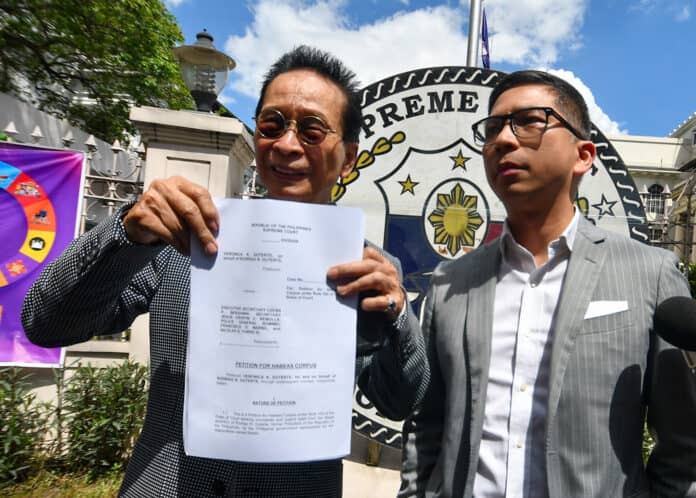
PANELO and son, a family affair Former Presidential Legal Counsel Salvador Panelo (left) and son Salvador Paolo Jr. file a petition before the Supreme Court on 12 March 2025, seeking to compel the government to bring back former President Rodrigo Duterte to the Philippines on behalf of his daughter, Veronica.
That perspective shapes much of Panelo’s reading of the case.
While some legal observers have described the unexplained wealth allegation as the strongest article of impeachment, Panelo disagrees.
He questioned the reliability of the Anti-Money Laundering Council reports cited against Duterte, arguing that the financial records cannot be directly compared with her Statements of Assets, Liabilities and Net Worth because they measure different things.
He also pointed to what he described as a reported banking system error involving a P2-billion transaction and said information available to the defense suggests that not all accounts attributed to the Vice President were hers to declare.
To him, those issues raise questions rather than provide conclusive proof.
The same insistence on context surfaces in his reading of another impeachment article involving Duterte’s alleged threats against President Ferdinand Marcos Jr., First Lady Liza Araneta-Marcos and Speaker Martin Romualdez.
Panelo argued that the Vice President’s remarks cannot be separated from the circumstances in which they were made, noting that she had first spoken about alleged threats to her own life before making the controversial statement.
Even when discussing courtroom strategy, Panelo’s focus extends beyond legal procedure.
Asked whether Duterte should personally appear during the Senate trial, he suggested that public perception is unlikely to drive her decision. Based on his experience working with the Vice President, he described her as someone more concerned with her duties and family than with political optics, saying attendance would ultimately depend on necessity rather than symbolism.
His legal analysis also reaches beyond the impeachment itself.
Panelo questioned proposals that could lower the number of votes needed for conviction in the Senate, warning that such interpretations could create opportunities for political manipulation.
He likewise urged the Supreme Court to rule on issues arising from the Senate leadership dispute despite arguments that portions of the controversy have become moot, saying important constitutional questions deserve judicial guidance.
The conversation even extended beyond domestic politics to the International Criminal Court proceedings involving former President Rodrigo Duterte, where Panelo discussed the expected trial timeline while noting that health considerations could still affect the schedule.
Across every topic, Panelo projected the methodical approach of a lawyer shaped by years of litigation, one who believes legal disputes should be decided not by political momentum but by evidence and constitutional principles.
In a political climate where law and politics often collide, Panelo’s message remained consistent: The law should not simply follow politics, it should be strong enough to withstand it.