
ART ACROSS OLD DIVIDE
As the year reaches its midpoint, the Embassy of Spain in the Philippines — through Instituto Cervantes and its Cultural and Education Offices — concludes its first half of cultural calendar with a series of exhibitions and artistic initiatives staged across various venues in Manila.
Over the past months, the embassy has partnered with local and Spanish artists and institutions to present exhibitions that highlight the rich artistic and historical connections between the two countries, bringing to the fore that modernity validates tradition.
At the Museo San Agustín in Intramuros, the exhibit Buen Camino brings to attention the undeniably enduring religious and cultural influence of Spain in the Philippines as it showcases the different routes, or the St. James' Way, that pilgrims follow on foot leading up to the tomb of St. James in the northern Spanish city of Santiago de Compostela.
A thought-provoking exhibition is simultaneously displayed at the Instituto Cervantes in Intramuros and the UP Vargas Museum in Diliman, Quezon City.
Melodías del pensamiento (Melodies of Thought) is a series of photographs by renowned Spanish artist García de Marina who explores music beyond the realm of sound, transforming instruments, sheet music and musical elements into visual metaphors.
Side by side with the García de Marina exposition at the UP Vargas Museum is another collaboration with a Spanish artist titled “Embracing the wind, Cradling the water” by Cristina Mejías which examines the unseen forces shaping life though works that move and evolve with their surroundings.
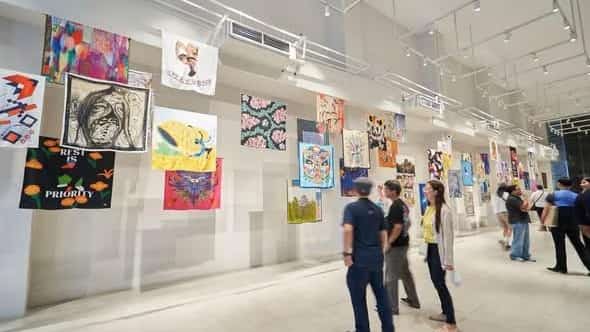
Beckoning the curious is Manila Calling, a traveling exposition displayed at the Centro de Turismo in Intramuros that brings together 70 artists from Spain, the Philippines and Japan, whose work, originally painted on walls in different cities, are printed on silk cloth.
Across Manila Calling on the same floor of the former Jesuit church, one may be captivated by the permanently displayed exhibition Four Centuries of Spanish Engineering Overseas, which will definitely surprise viewers with the amazing legacy of Spanish engineers.
While in Intramuros, visitors may head to Fort Santiago where they may delight in an Instagrammable mural colorfully emblazoned with the word Tagpuan by the Madrid-based street art collective Boa Mistura.
Spain's Instituto de Historia y Cultural Naval as well as the Archivo Histórico de la Armada “Juan Sebastian Elcano” have joined forces to share their resources and help produce the exhibition Returning to Manila: The Galleon Trade in Maps,” tracing the route that would unleash globalization.