
A celebration of endurance
From the old leadership to the current one, I have borne witness, too, to the changes within the newsroom — the expansion into online and digital work, the entry of artificial intelligence.

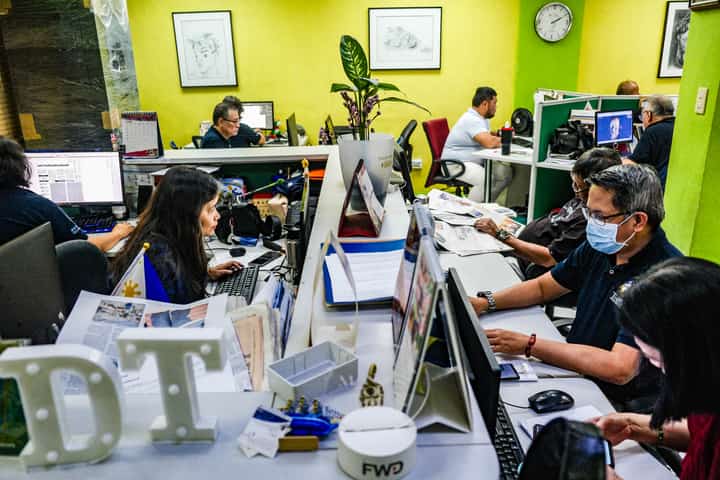
Battle at the newsroom happens every day as Daily Tribune copes with deadline and verification of news articles and online and in print to bring the stories that are credible and timely.
Photograph by Yummie Dingding for the DAILY TRIBUNE
There was a moment in our previous life at a newspaper with its offices on the top floors of the old Plywood Building along TM Kalaw Avenue in Manila when we thought we would not last another anniversary.
I remember how sunlight was pouring in through the wide glass windows, smudged with grime though they were. Inside, a dark shadow attempted to disturb our peace. The Lifestyle desks were, as usual, clack-clacking away with the staff finishing the next day’s articles. Then someone came in and announced: “Print is dying na daw!”
A heartbeat, then clackety-clack went the keyboards again, someone made a crack about the dire pronouncement, and then no one gave it another thought, at least for that day.
In the following years, print journalists saw the transitions taking place. As press conferences became bloated with bloggers, vloggers and so-called KOLs, the newspapers seemed to lose weight. Editions became thinner, salaries stopped growing.
But the staunch journalists did not waver. For much in the way that typewriters gave way to computers, and PCs gave way to mobile phones, the work did not stop. More importantly, the passion did not die.
Newspapers are more than a business, and sometimes we tend to forget the reason for their existence. DAILY TRIBUNE, for the past 26 years, has served to record the nation’s triumphs, failures, and turning points. That is 26 years of bearing witness.
Working in media gives us front row seats to big events in the country, and a first look at many things before they hit the public eye. It is a huge responsibility, yes, and a duty. Being part of the paper puts one in the thick of a living archive of Philippine history.
Since 2000, DAILY TRIBUNE has chronicled everything from political transitions (from the Erap years cut short, to Gloria Arroyo’s two-term dominance, to the present) and natural disasters (the tragedies wrought by Yolanda to Ondoy and all calamities in between), to economic growth and cultural milestones.
Looking back through all the years, with all their ups and downs, I may have found the answer to a question I strove to answer during the DAILY TRIBUNE’s anniversary last year: What makes you stay?
First, this paper has always led with an innovative mindset. It was here that I learned to think out of the box, to approach a matter with an open mind, and to be opinionated as much as to be open-minded. This paper has always challenged standards and norms, coming up with different ways to tell the Filipino story.
From the old leadership to the current one, I have borne witness too to the changes within the newsroom — the expansion into online and digital work, the entry of artificial intelligence. I am sure the landscape will change even more in the coming years. For now, I am grateful to have been part of its longevity.
I have always laughed at the joke that today’s newspaper is tomorrow’s fish wrapper. I honestly don’t mind. Our story as a nation is still being written. As our reach continues to broaden, we remain committed to responsible journalism. It is our duty. It is our calling.