
Red rocks yield coveted minerals
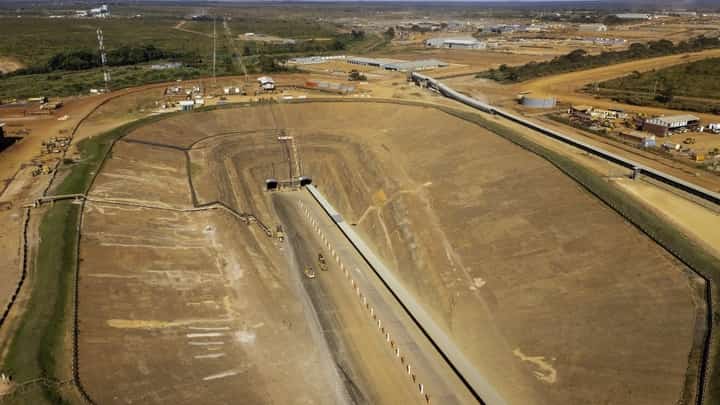
THE entrance to the underground mine operated by Kamoa Copper S.A. in Kolwezi, in the southeastern part of the Democratic Republic of the Congo.
PHOTO courtesy of glody murhabazi/AGENCE FRANCE-PRESSE
vast warehouses at the Kamoa copper mine in the southeastern Democratic Republic of Congo, mountains of reddish rocks pile up as the machines grind away day and night.
The deposit, reputed to be the largest in Africa, is one of the DRC’s hidden treasures — which are at the center of a global race for critical minerals.
In the ultra-modern installations, thousands of workers churn out the red gold — coveted by international markets for its exceptionally high copper content.
China has long been mining it, and now the United States is vying for a share in the country’s mineral wealth, seeking to challenge Beijing’s hold on the strategic resources used to make cars, phones and weapons.
“Kamoa at the moment is one of the largest copper mines in the world” with capacity to produce 300,000 tons a year, its managing director Annebel Oosthuizen told Agence France-Presse.
It is “growing to become the largest copper mine in Africa and probably the fourth largest copper mine in the world”, aiming to churn out half a million tons from 2028, she added — “right up there in terms of world capacity.”
The DRC is one of the poorest countries in the world.
Of its roughly 100 million inhabitants, nearly two in three live below the poverty line, according to official statistics.
Yet the vast central African nation is also one of the world’s biggest sources of critical metals indispensable to global industry.
It is Africa’s top copper producer, with 3.4 million tons in 2025.
The ore mined at Kamoa has a copper content of 2.8 percent, four times the global average.
It is also the world’s leading producer of cobalt, with 68 percent of world supply.
All this puts it at the heart of Chinese and US economic interests and they actively covet it.
Copper and cobalt are essential for the manufacture of smartphones, computers, cars and batteries.
Copper conducts electricity, while cobalt allows that energy to be stored. These minerals are also vital to aeronautics, defense and renewable energy.
According to the United Nations Conference on Trade and Development, global demand for copper is expected to rise by more than 40 percent by 2040.