
PH tarsier spotted in South Cotabato cornfield

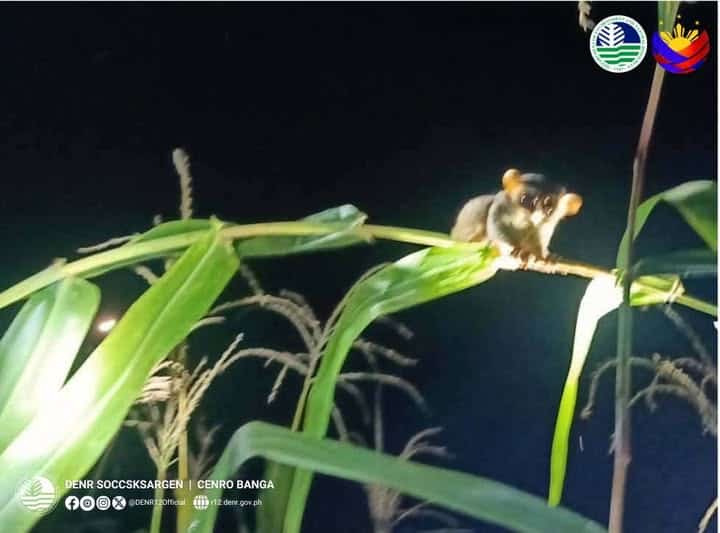
A Philippine tarsier was spotted in a cornfield at T'boli, South Cotabato. (PHOTO COURTESY of DENR-SOCCSKSARGEN - CENRO Banga)
The Department of Environment and Natural Resources (DENR) – SOCCSKSARGEN reported on Monday that a resident recently spotted a Philippine tarsier in a cornfield at Barangay Laconon, T’boli, South Cotabato.
“It was reported to the Department of Environment and Natural Resources (DENR) – Community Environment and Natural Resources Office (CENRO) Banga. Locally known as ‘Mal’, the tarsier is believed by residents to inhabit the surrounding area, although encounters with this tiny primate are rare due to its nocturnal and elusive nature,” the agency said.
According to CENRO Banga, the sighting of the Philippine tarsier indicates that suitable wildlife habitats continue to exist within the community despite increasing human activities in rural landscapes.
“As an insect-eating primate, it plays an important role in maintaining ecological balance by helping control insect populations in both forested and agricultural areas,” the office pointed out.
The CENRO Banga stressed that the Philippine tarsiers are a protected wildlife species, with no disturbance, capture and handling allowed.
“Community members are encouraged to help conserve wildlife habitats and to immediately report wildlife sightings or concerns to the nearest DENR office or local authorities.”
“Protecting species such as the tarsier ensures that future generations can continue to appreciate the rich biodiversity of South Cotabato and the entire SOCCSKSARGEN region,” the DENR Region 12 office stated.