
How Bicutan Exit slows down SLEX
The result is a common urban condition: infrastructure designed for yesterday attempting to accommodate the demands of today.


THE intersection immediately beyond the northbound Bicutan Exit serves as a convergence point for expressway traffic, service roads, local commuters and commercial vehicles.
Screengrab from Google Maps
There are few places in Metro Manila more capable of testing a driver’s patience than the Bicutan Exit. For anyone from the south or who regularly visits it, it’s a portion of SLEX that looks close to Metro Manila on the map but actually takes up a noticeable part of the trip.
Traffic flows smoothly for kilometers as vehicles settle into a steady rhythm. Then, somewhere approaching Bicutan, a sea of brake lights begins to appear up ahead. What had been an expressway suddenly feels like a parking lot.
For many motorists, the delay has become so predictable that it is simply accepted as part of the journey. Entire routines are quietly shaped around the expectation that traffic will inevitably begin near this one particular interchange.
Funnily enough, what makes this situation interesting is that the problem is not necessarily the expressway itself. SLEX is intentionally designed to move large volumes of traffic efficiently over long distances. However, it failed to take into account that the Bicutan Exit is directly connected to a heavily used intersection. The benefits of the expressway’s mobility are undermined when thousands of vehicles are funneled into a single location where regional traffic, local traffic, commercial activity and residential access all compete at one intersection.
In many ways, Bicutan illustrates a broader principle of urban systems. A city is only as efficient as its weakest connection. We can build a hundred kilometers of road, but if a few hundred meters are at a standstill, it defeats the transportation network’s primary goal of mobility.
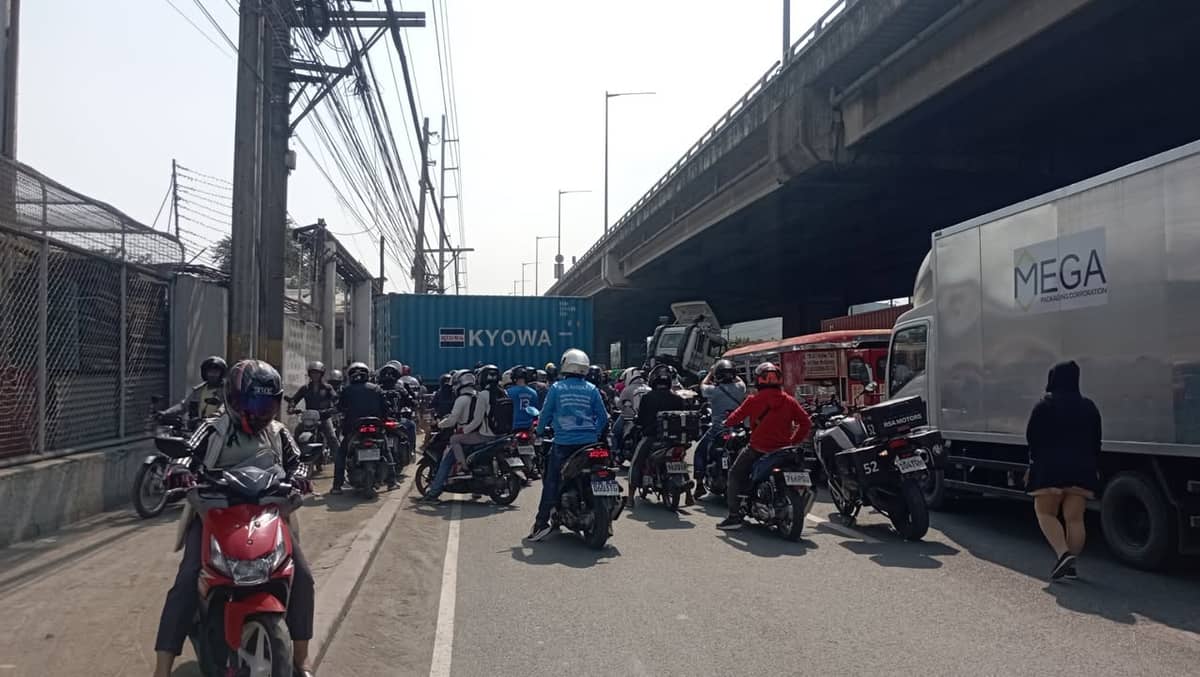
FOR thousands of motorists, the Bicutan area has become synonymous with delay.
Photograph by Alexus Josuelle Gonzales for DAILY TRIBUNE
This is particularly true in rapidly growing metropolitan areas. When many of our roads and interchanges were originally planned, they served a very different urban environment. The surrounding population was smaller, vehicle ownership was lower and commercial activity was less intense.
Over time, it is only natural for subdivisions to expand, businesses to multiply and employment centers to grow as a city thrives. However, many of the connections between these places have remained largely unchanged because the properties surrounding them have already been developed.
The result is a common urban condition: infrastructure designed for yesterday attempting to accommodate the demands of today.
What is remarkable is how much influence a single interchange can exert over an entire corridor. A delay of only a few minutes for one vehicle may seem insignificant. Multiplied across thousands of commuters, delivery trucks, public utility vehicles, and service fleets, the collective impact becomes substantial. The loss of time and the consumption of fuel accumulate into a loss of productivity and potential spending for everyday users. This frustration becomes part of the daily routine, especially for those who live in the south.
The Bicutan Exit is not unique. Every major city has its own version of it: a junction, intersection, or interchange whose influence extends far beyond its physical dimensions. The solution may ultimately involve new flyovers, better signal systems, additional road connections, or improved public transportation.
This can serve as a useful case study that clearly illustrates the way cities function. Urban systems are interconnected, and their performance is often determined by their smallest constraints rather than their grandest ambitions.
Perhaps that is the real lesson hidden behind the familiar sea of brake lights.