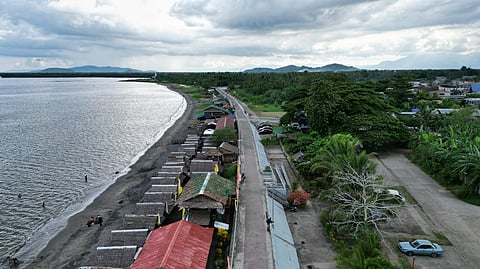


TACLOBAN CITY — The Bureau of Fisheries and Aquatic Resources (BFAR) is looking at the long coastline of Eastern Visayas as a key area in the revival of the country’s struggling salt industry.
Former BFAR Eastern Visayas regional director Dr. Hannibal M. Chavez, who now heads the National Salt Program Management Office, said developing a local salt industry could empower coastal communities, many of which rely on marginal fishing as their main source of livelihood.
Chavez, who referred to salt as “white gold,” said salt production represents opportunity, livelihood and hope for poor coastal communities.
Eastern Visayas, composed of numerous islands and island municipalities, has an estimated coastline of around 1,600 to 2,000 kilometers. Of its 136 municipalities, 117 are coastal.
Despite being an archipelagic country, the Philippines produces only about 114,623.29 metric tons of salt annually, or 16.78 percent of national demand. More than half of local production (57.43 percent) comes from Occidental Mindoro, although output has been declining due to land-use conversion, market competition, and strict food safety and quality standards.
President Ferdinand Marcos Jr. signed Republic Act 11985, or the Philippine Salt Industry Development Act, on 11 March 2025, aiming to revitalize and modernize the local salt industry.
The law seeks to reduce import dependence by boosting domestic production, supporting salt farmers, and positioning the Philippines as a net salt exporter while maintaining the national salt iodization program.
Under the law, the government established the Philippine Salt Industry Development Roadmap 2025–2040, a 15-year plan to build a productive, self-sufficient, and globally competitive salt industry.
It also created the Salt Industry Development Competitiveness Enhancement Fund, sourced from tariffs on imported salt. Under the law, 50 percent of the fund will go to mechanization, 40 percent to post-harvest facilities, 5 percent to research and development, and 5 percent to extension services.
Chavez gathered fisherfolk associations, salt producers, traders, local stakeholders and partner agencies across Eastern Visayas for a regional orientation and consultation on the Development of Salt Industry Project.
During the orientation, stakeholders were introduced to sustainable and climate-adaptive salt production technologies, including solar crystallization modules, improved post-harvest handling practices, quality enhancement measures, and salt convergence mapping strategies aimed at improving productivity and competitiveness.
Participants expressed optimism that salt production could open new livelihood opportunities for small island and coastal communities across the region.

