
A reunion of Holy Crosses in Batangas: Pagtatagpo ng Magkapatid na Krus ng Alitagtag at Bauan


As dawn unfolded on 2 May in the town of Alitagtag in the predominantly Tagalog province of Batangas, about a hundred kilometers south of Manila, the Invencion de la Santa Cruz Parish Church stirred to the sound of a recorded hymn. Inside the church, parishioners prepared to bring out their most venerated image and relic: the Poong Santa Cruz, or the Holy Cross.
The cross has already been placed before the altar, its wooden body sheathed in polished silver-toned metal and resting on a globular base. At its intersection gleamed a gold-toned, radiant sun, while stylized rays extended from its back. Draped over the image was richly embroidered velvet, its floral and vine patterns embellished with beadwork and metallic trim. Beside it stood its standard, likewise adorned with elaborate designs.
The evening before, the image underwent the pagpapaligo, or ritual bathing. In the neighboring town of Bauan, its own Holy Cross image had been bathed on 22 April. Both parishes also held the pagsisiyam or novena, the nine days of preparatory prayers, Masses, and rituals leading to the Pagtatagpo ng Magkapatid na Krus, an annual extra-liturgical Catholic tradition shared by the two towns.
By six in the morning, the Holy Cross of Alitagtag was carried out of the church and placed on a pickup truck bound for the barangay of Concordia, at the boundary between Alitagtag and Bauan. There, devotees approached the cross, touching it with reverence, whispering prayers, and waiting for the arrival of its counterpart from Bauan.

THE Holy Crosses of Alitagtag and Bauan meet at the border of the two towns in the barangay of Concordia.
PHOTOGRAPHS by Roel Hoang Manipon for DAILY TRIBUNE
After nearly an hour, the Bauan cross arrived. The two crosses — known as the Magkapatid na Krus, literally “sibling crosses” — were placed side by side, their reunion renewing a bond shaped by faith, local history, and stories passed down through generations.
According to local lore, the Holy Crosses of Bauan and Alitagtag came from one large cross made of anubing wood, believed by devotees to have protected the towns from bad spirits, harm, and calamities, including the eruption of Taal Volcano. When Alitagtag became a separate town from Bauan in 1910, the Holy Cross was divided into two, giving rise to the Magkapatid na Krus: one for Bauan and one for Alitagtag.

THE motorcade bearing the two Holy Crosses passes by the Invencion de la Santa Cruz Parish Church in Alitagtag.
PHOTOGRAPHS by Roel Hoang Manipon for DAILY TRIBUNE
Every year, the two crosses are brought together again on 2 May, traditionally observed as the bisperas, or eve, of the Dakilang Kapistahan ng Mahal na Poong Santa Krus, the Feast of the Holy Cross, on 3 May. The date was associated with the discovery of the True Cross by Saint Helena, mother of Emperor Constantine, in the fourth century. However, in 1960, the universal Catholic Church transferred the celebration to 14 September, now observed as the Feast of the Exaltation of the Holy Cross. Yet in many Philippine communities, devotions tied to the old 3 May observance remain alive, among them the Santacruzan, a procession reenacting the finding of the True Cross, and the Pagtatagpo ng Magkapatid na Krus, also called the Salubong.
In Concordia, the meeting of the two crosses was marked by a short program that opened with a luwa, a prayer-poem traditionally performed during religious observances in Batangas. A young student, dressed in a barong Tagalog, recited a luwa written by Dr. Salome Atienza. In her message, Alitagtag Mayor Jo-Ann Brucal Ponggos said the Pagtatagpo tradition continues to bind the two towns, keeping alive a relationship older than their present boundaries.
After the program, the motorcade proceeded to sitio of Binukalan. In the barangay of Tadlac, residents welcomed the motorcade before it continued toward the church, now accompanied by the Sublian sa Karsada, a parade of students performing a modern “street version” of the subli, the traditional folk dance deeply associated with devotional life in Batangas. This part of the event was introduced in 2005 by Dr. Roger Quitain with Nona Cruzat.
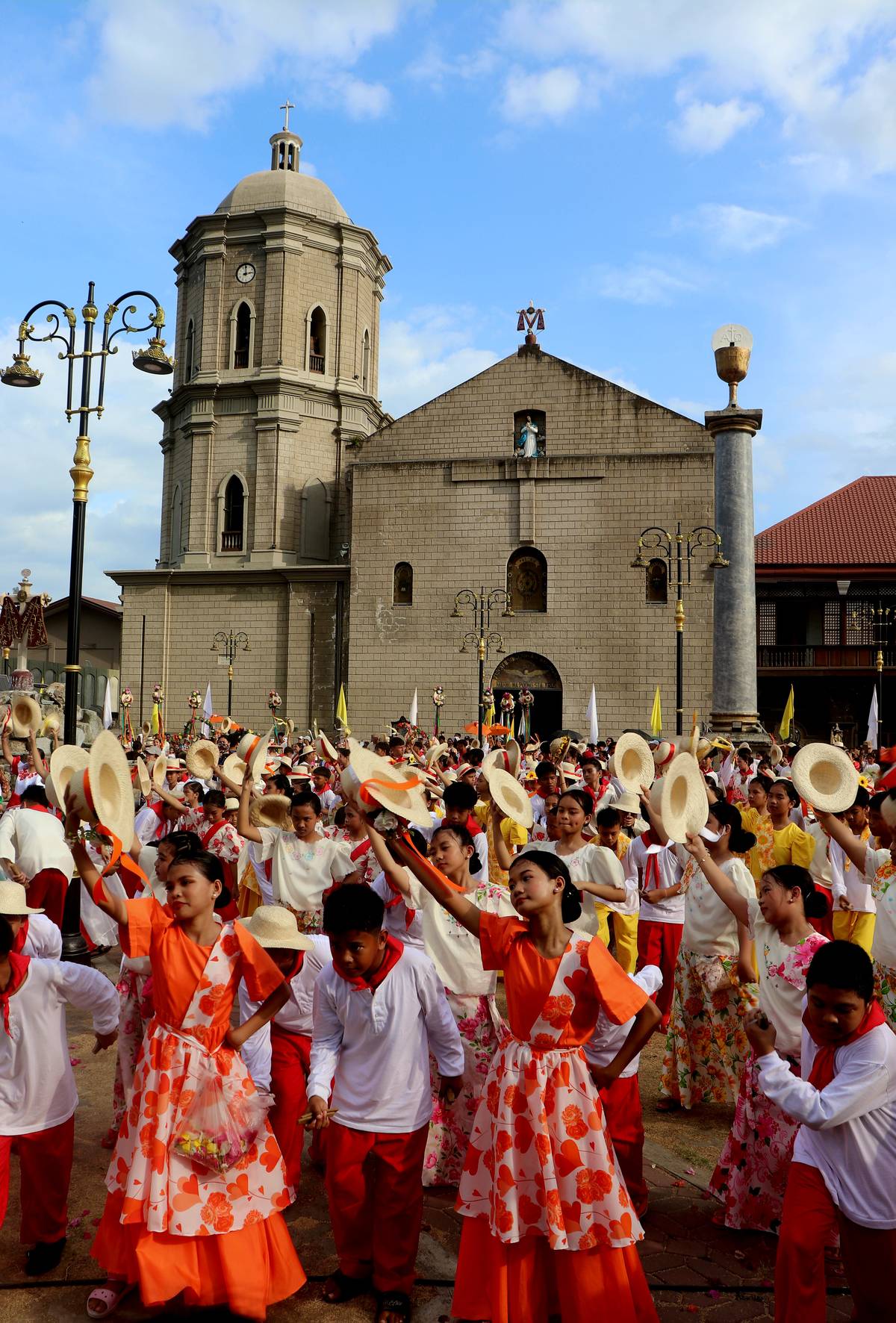
SUBLI dance greets the Holy Crosses as it arrives at the Immaculate Conception Parish Church.
PHOTOGRAPHS by Roel Hoang Manipon for DAILY TRIBUNE
I met Quitain as the parade made its way to Alitagtag Church. He explained that the subli was not originally part of the Pagtatagpo, which used to be marked mainly by a simple motorcade. He thought of incorporating the dance because subli itself is part of the lore of the Magkapatid na Krus.
The contingent stopped in front of the parish church, where another luwa was recited. From there, the procession continued on foot to the Binukalan Shrine in the barangay of Poblacion West, with the two crosses borne on the shoulders of devotees.
Dingin, in Binukalan, is regarded as the original home of the Holy Cross, which stood eight feet tall. According to legend, there were repeated attempts to uproot and move the cross, but all failed. Each time, the sky reportedly darkened, as though a storm were about to break. But when the people of Bauan wished to bring the cross to their church, the image finally yielded.
Before the cross was uprooted, children were said to have played before it, moving in a strange manner —a combination of subsob (fall forward) and bali (broken), which later became subli, the dance. After the priest said a prayer, the cross was uprooted. Binukalan continues to observe the old 3 May date of the Feast of the Holy Cross.
At the Binukalan Shrine, another program unfolded, featuring a luwa and performances of the subli. One was described as “ceremonial,” referring to its older ritual form, and was performed by students of Alitagtag Senior High School. Another, described as “festival,” presented a more modernized version used largely for public performance and entertainment, and was performed by students of Saint Bridget College.
The subli is believed to have precolonial roots as a ritual dance, performed as an act of devotion, thanksgiving, and supplication. Today, it is practiced in Alitagtag, Bauan, Agoncillo, Batangas City, San Pascual, and Santa Teresita in Batangas, often as devotion to patron saints. Some versions are accompanied by sung verses and musical instruments, especially wooden or bamboo clappers. Other, less explicitly religious versions have evolved into courtship dances.

THE ritual dance subli performed by students at the Binukalan Shrine in Alitagtag.
PHOTOGRAPHS by Roel Hoang Manipon for DAILY TRIBUNE
The program also included the ceremonial washing of the feet of the crosses by a girl portraying Juana, a woman in a local story associated with a miracle of the Holy Cross. This was followed by a concelebrated Mass and the pagtatanod, or vigil.
By one in the afternoon, the two Holy Crosses began their journey to the Immaculate Conception Parish Church in Bauan, about 10 kilometers away. As they entered the Bauan town proper, the crosses were welcomed by locals with another luwa. The delegation then proceeded on foot in a procession accompanied by dancers and marching bands.
At the church, the arrival of the Holy Crosses was greeted by a subli performance by about a hundred students at the church patio. The Pagtatagpo culminated with a Mass, closing a day of prayers, processions, dances and devotion — an enduring ritual through which two neighboring towns renew connections and return, year after year, to a shared source of faith and memory.