
Phl Chairship turns regional diplomacy into economic momentum
President Ferdinand R. Marcos Jr. earlier underscored this direction, stressing that ASEAN must prioritize policy stability, lower costs, and radical digitalization to return as a formidable force in the global economy.


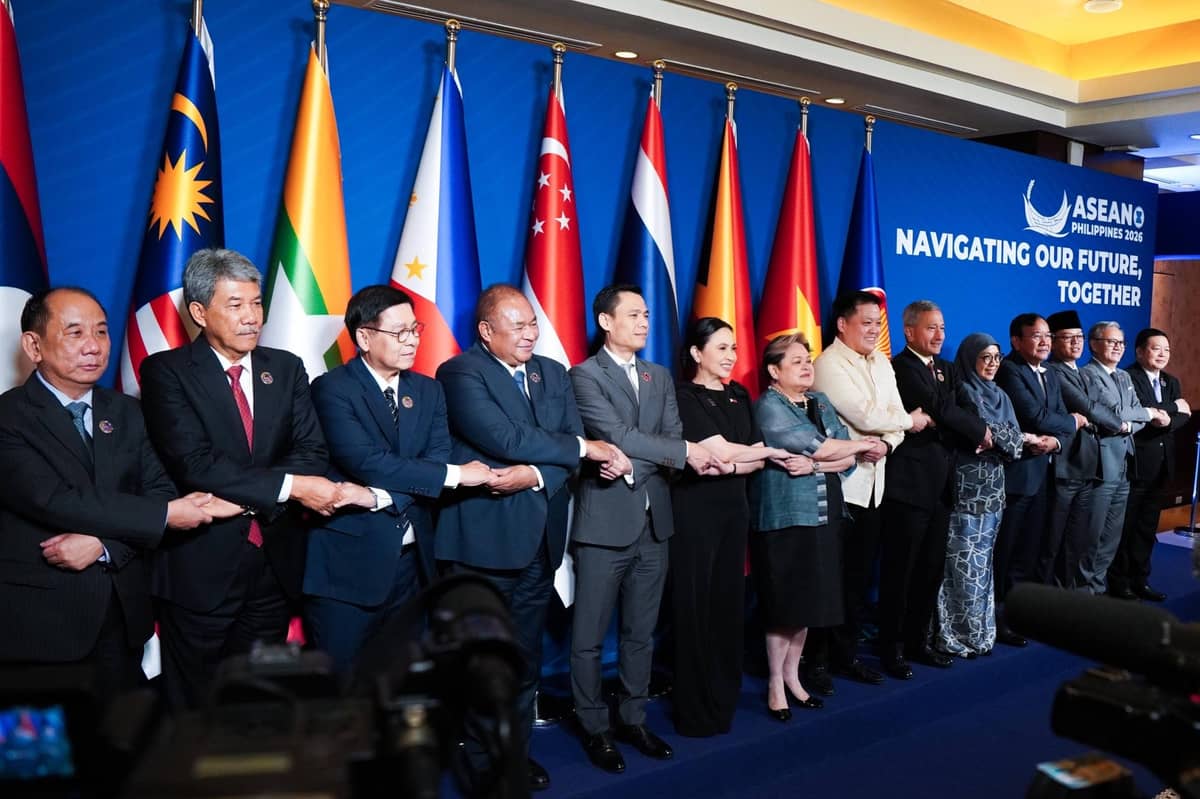
TRADE Secretary Cristina Roque (third from left) is joined by fellow Cabinet secretaries and other ASEAN ministers, during the ASEAN Ministers Meeting as part of the recently concluded 48th ASEAN Summit and Related Meetings held in Mactan, Cebu last week.
Photo courtesy of DTI
The Philippines is turning its ASEAN Chairship into a platform for investment generation, business confidence and digital economic transformation, with six business and investment promotion events already completed under the country’s 2026 ASEAN slate.
Through the Department of Trade and Industry (DTI)-led Committee on Business and Investment Promotion (CBIP), the Philippines has convened government leaders, investors, business groups, media executives, and development partners to advance ASEAN’s competitiveness, investment readiness and transition into a more connected digital economy.
To date, the Philippines has completed six CBIP-led and CBIP-endorsed engagements: the ASEAN Editors and Economic Opinion Leaders Forum on February 24, done in partnership with Ayala Corporation and the Economic Research Institute for ASEAN and East Asia (ERIA); the ASEAN Business Environment Forum, done in partnership with the Asian Development Bank (ADB) on March 11; the 32nd ASEAN Economic Ministers’ Retreat Welcome Dinner on March 12; the ASEAN Business Media Exchange, held in Cebu with the Presidential Communications Office from 6 to 7 May; the ASEAN Economic Community Council Welcome Dinner on 6 May; and the ASEAN-EU Sustainability Summit, a CBIP-endorsed event, on 7 May.
Early outcomes from these engagements show that the Philippine Chairship is already helping convert regional dialogue into concrete economic interest. During the ASEAN Economic Community (AEC) Council Welcome Dinner, CBIP networking engagements generated around P3.7 billion in investment leads, particularly in tourism and food/agriculture infrastructure. Thai officials also noted rising interest among Thai companies in investing in the Philippines, especially in renewable energy, agribusiness, importation, and retail.
These early gains reflect the Philippine Chairship’s focus on practical outcomes that can translate into opportunities for businesses, workers, and communities. By bringing together government and private sector leaders across the region, the CBIP platform has helped create space for investment leads, business partnerships, and stronger confidence in ASEAN’s growth prospects.
Beyond investment leads, the Philippine Chairship has also placed the digital economy at the center of ASEAN’s growth agenda, particularly through the ASEAN Digital Economy Framework Agreement or DEFA. In her Manila Tech Summit speech, Secretary Roque described DEFA as one of the Philippines’ strongest initiatives under its ASEAN Chairship, citing that it has the potential to transform the region’s digital economy.
PRESIDENT Ferdinand Marcos Jr., alongside his Cabinet secretaries, called on ASEAN leaders to strengthen collective action and regional preparedness amid evolving geopolitical challenges during the 48th ASEAN Summit Retreat in Mactan, Cebu, last week. The President emphasized that economic resilience, resource security and regional stability now require foresight, coordination and concrete cooperation across ASEAN.
Photo courtesy of President Ferdinand Marcos Jr./FB
ASEAN’s digital economy is currently valued at around USD 300 billion and is projected to reach USD 1 trillion by 2030. With DEFA fully implemented, this could grow further to as much as USD 2 trillion. She also noted that negotiations are moving fast and that the Philippines is optimistic DEFA will be signed during the 49th ASEAN Leaders’ Summit in November.
This digital push complements the broader competitiveness agenda raised across the ASEAN Editors and Economic Opinion Leaders Forum and the ASEAN Business Environment Forum, where discussions emphasized the need for policy stability, lower business costs, faster digitalization, regulatory coherence, and stronger public-private collaboration.
President Ferdinand R. Marcos Jr. earlier underscored this direction, stressing that ASEAN must prioritize policy stability, lower costs, and radical digitalization to return as a formidable force in the global economy.
The CBIP framework also reflects the Philippines’ effort to widen participation in the ASEAN economic agenda. Under its event guidelines, CBIP-led events are directly planned and executed by the committee, while CBIP-endorsed events are private sector-driven initiatives recognized for their alignment with ASEAN 2026 priorities and the Philippines’ Priority Economic Deliverables.
As the Chairship progresses, the Philippines will continue to use its ASEAN leadership to promote practical cooperation that strengthens regional supply chains, supports digital transformation, and improves the business environment across Southeast Asia.
Through these efforts, the Philippines aims to help position ASEAN as a more resilient, competitive, digitally connected, and opportunity-driven region.