
New book highlights Filipina scientists, urges better STEM education
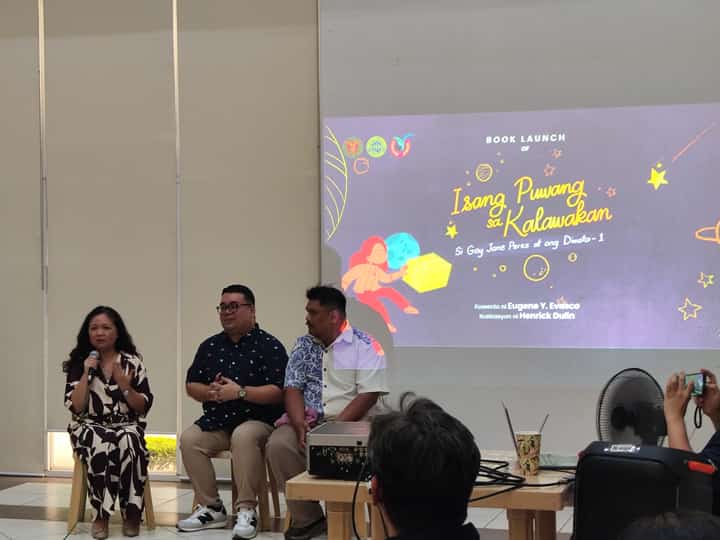
(From left to right) Dr. Gay Jane Perez, writer Eugene Y. Evasco, and illustrator Henrick Dulin at the book launch event of "Isang Puwang sa Kalawakan: Si Gay Jane Perez at ang Diwata-1" at the UP Diliman College of Science, Quezon City Friday.
Photo by Theo Cabantac
A new children’s book highlighting the journey of Gay Jane Perez was launched Friday at the University of the Philippines Diliman in a bid to encourage more young girls to pursue careers in science, technology, engineering and mathematics (STEM).
Titled Isang Puwang sa Kalawakan: Si Gay Jane Perez at ang Diwata-1, the book was authored by Eugene Y. Evasco and illustrated by Henrick Dulin. It chronicles Perez’s journey in helping develop Diwata-1, the country’s first satellite, and her rise to becoming ad interim director general of the Philippine Space Agency.
Speaking during the launch at the UP Diliman College of Science, Perez recalled how the lack of relatable role models influenced her early perception of scientists.
“I didn’t dream of becoming a scientist because I didn’t know one,” Perez said in Filipino, adding that scientists were often portrayed in films as eccentric figures.
The event highlighted continuing gender disparities in STEM education despite women now accounting for 55 percent of the country’s researchers.
Citing a 2025 report by the World Economic Forum, organizers noted that only 14 percent of STEM graduates in the Philippines are women, compared with 35 percent who are men.
Giovanni Tapang, dean of the UP Diliman College of Science, praised Perez's achievement in advancing to a doctorate in physics. However, he noted that challenges in foundational instruction in high school mathematics and physics can discourage young girls.
"If we just let it be, there won't be many girls in the provinces who will take up physics. There won't be many women who will take up physics," Tapang said.
"Because in high school, they are not taught properly... their teachers also don't know how to teach math and physics. So in the end, many dislike it."
He emphasized the need for intervention to support future innovators.
"The problem is, how many Gay Perezes are we cutting off?" Tapang asked. "When there's a Gay Perez in her thirties, there should be thousands of women, thousands of scientists in line so that we don't have a problem when we need people looking at things from space to warn us of a drought."
Evasco, a Palanca Hall of Fame awardee, said localizing science communication helps normalize the idea of a Filipina scientist.
"I wanted to show the youth a real Filipino woman who reaches such great heights," Evasco said.
He noted that historically, naming a Filipino space scientist was like a "suntok sa buwan" (punch to the moon) — a local idiom for an impossible dream. But through Perez's story, he hopes he could inspire the Filipino children to pursue their dreams in STEM, sparking the next generation of scientists that will carry Filipino science and research from the Philippines and beyond.