
Steering SM Investments through challenges
SMIC’s journey under leaders like Gomez mirrors the country’s own economic maturity. Listed in 2005 with modest beginnings of 19 malls, 55 retail stores, 361 bank branches, and P169 billion in assets, the group has scaled dramatically.


Competitive advantage A deliberate ecosystem in which retail, banking and property coexist and reinforce one another sets the SM group apart, according to SM Investments Corp. executive vice president for finance and corporate information officer Franklin Chan Gomez.
Photographs courtesy of SMIC
In the high-stakes world of conglomerates, where family empires meet modern capital markets, Franklin Chan Gomez becomes a reliable pillar, operating with the precision of a seasoned financier and the discipline of a long-term steward.
As executive vice president for Finance and corporate information officer at SM Investments Corp. (SMIC), Gomez oversees the financial architecture of one of Southeast Asia’s most formidable diversified groups.
At the company’s 2025 annual stockholders’ meeting, the numbers he helped deliver told a story of resilience: consolidated earnings up 10 percent to P90.5billion, revenues climbing 4 percent to P682 billion, and a conservative net debt-to-equity ratio of 30:70 amid a P1.8-trillion asset base.
These figures represent more than quarterly beats for Gomez as they validate a philosophy honed over years in the role, one that prioritizes synergies, balance-sheet strength, and compounding value in a market prone to external shocks.
“We’re staying the course,” Gomez has emphasized in briefings, underscoring a commitment to tried-and-tested strategies rather than reactive pivots.
A De La Salle University alumnus, Gomez brings a blend of corporate rigor and emerging-market insight to SMIC. His background includes stints that exposed him to global operations, including time at Unilever, before he rose through the ranks at the Sy family-led conglomerate.
Appointed EVP-Finance in recent years, he now plays a central role in shaping capital allocation, investor communications, and the group’s overall financial narrative.
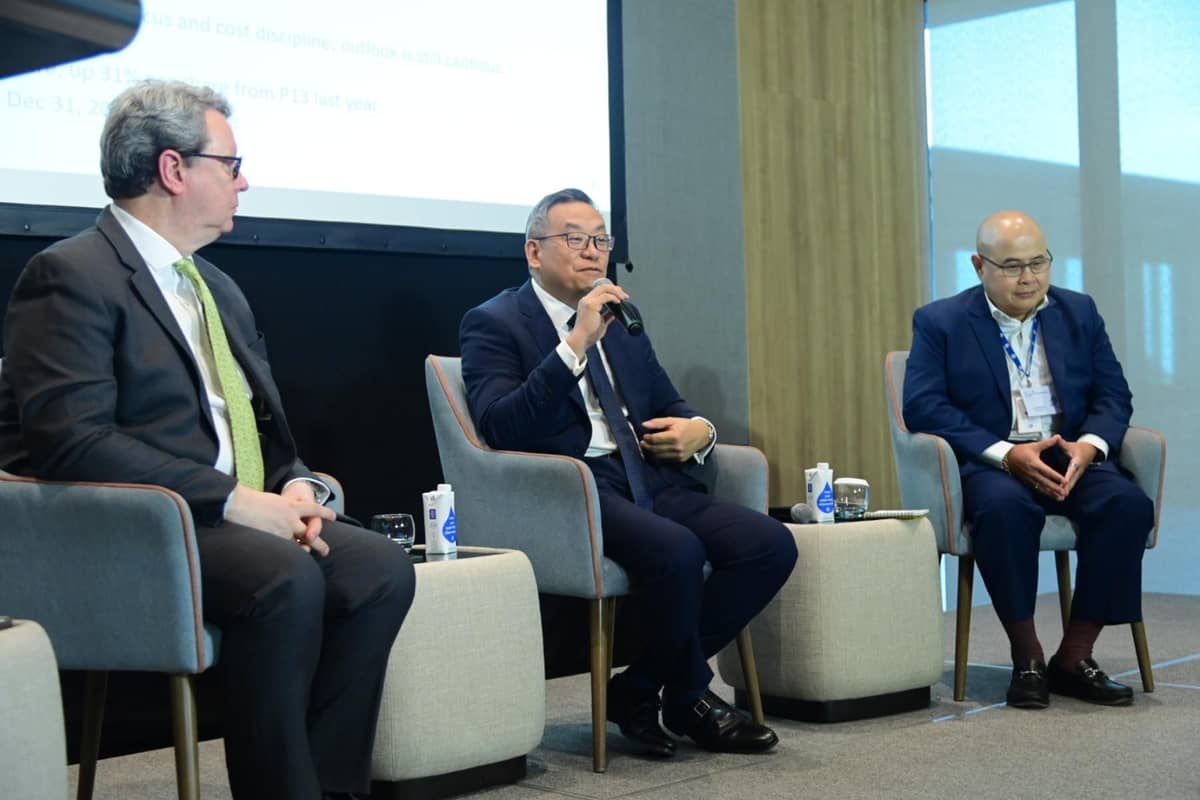
SM at a glance Providing shareholders with a window into the health of the SM Group during the annual meeting are some of its key stewards (from left, seated) Timothy Daniels, consultant and head of investor relations and sustainability at SM Investments; Franklin Gomez, EVP for Finance at SM Investments; and Jonathan Ng, president of SM Retail.
Growth dynamo
SMIC’s journey under leaders like Gomez mirrors the country’s own economic maturity. Listed in 2005 with modest beginnings of 19 malls, 55 retail stores, 361 bank branches, and P169 billion in assets, the group has scaled dramatically.
By the end of 2025, it boasted 89 Philippine malls and 9 in China, over 4,800 SM-owned stores, more than 2,500 bank branches, and assets of P1.8 trillion. Total dividends to shareholders since listing reached P149 billion.
Gomez’s fingerprints are evident in the group’s conservative yet opportunistic approach. Banking contributed 49 percent of 2025 earnings; property, 27 percent; retail, 18 percent; and portfolio investments, 6 percent.
The diversified mix, coupled with strong recurring income streams that represent around 90 percent of group earnings, provides ballast against volatility from trade tensions, political noise, or adverse weather.
Power of synergies
What sets SM apart, and what Gomez helps optimize, is its deliberate environment. Retail, banking, and property coexist and reinforce one another.
Malls house retail outlets, ensuring high occupancy and low capital intensity for stores. Banks finance tenants and suppliers. Gomez has highlighted how this model creates entrenched advantages and diversified cash flows.
The conglomerate’s social projects also revolve around its malls scattered across the country. Thus, health clinics, for instance, are stocked and periodically checked by mall personnel.
In 2025, SM Prime expanded with new malls in Laoag and La Union, as well as SM City Xiamen Haicang in China.
SM Retail added 490 stores, including 280 Alfamart outlets, pushing its network to 4,831. Banking saw BDO outpace the industry in loan growth and successfully tap international markets with oversubscribed bond offerings. Portfolio plays like 2GO and geothermal exploration added momentum.
As the group’s finance chief, Gomez champions the parent company’s unique proposition. SMIC offers investors exposure to the massive unlisted SM Retail business, serving millions across price points and categories, alongside listed gems like SM Prime, BDO and Chinabank.
Parent-level revenues jumped 22 percent to nearly P43 billion last year, while dividends grew at a compound rate exceeding 32 percent annually over five years, from P5 billion in 2021 to P16 billion in 2025. This cash-generation engine allows disciplined reinvestment. “Our investments in China have been largely opportunistic,” Gomez noted in interviews, pointing to SM Prime’s malls in lower-tier cities with solid occupancy.
Gomez indicated that his tenure aligns with SMIC’s five core strengths: synergies, a resilient balance sheet, high governance and sustainability standards, long-term compounding, and deep commitment to the Philippines.
The group’s majority-independent board, early adoption of IFRS Sustainability Standards, carbon reduction efforts, and community initiatives (870 new scholarships, new schools, and health centers) reflect this.
International recognition underscores the approach. Gomez and colleagues have been honored with Asia’s Best CFO awards, affirming financial stewardship.
In a young, consumption-driven economy where retail spending accounts for over two-thirds of gross domestic product (GDP), SMIC’s underpenetrated market position offers a long runway.
Gomez said he views favorable demographics, rising incomes, and financial inclusion as tailwinds. The strategy: nurture core businesses, expand selectively into high-potential areas like logistics and renewables, maintain cost discipline, and deliver both near-term dividends and long-term value creation.
As SMIC marks two decades as a public company, Gomez embodies the transition from founder Henry Sy Sr.’s entrepreneurial vision to institutionalized, professional execution.
The group plans to expand its provincial reach and capitalize on major projects while staying entrepreneurial and collaborative across units.
Challenges persist, macro headwinds, geopolitical nuances, and climate impacts, but SMIC’s model has proven durable.
Gomez’s focus remains on execution using tight capital management, prudent investments, and leveraging the ecosystem for sustainable growth.
Gomez represents the quiet competence behind one of Asia’s standout conglomerates: a financier who understands that true value compounds not through flashy moves, but through consistent, synergistic delivery. In the Philippines’ dynamic economy, that steady hand may prove the ultimate competitive edge.