
SM Foundation spreads infrastructures of care
Facilities spread across Luzon, Visayas and Mindanao. Yet both consistently redirect attention away from numbers and toward collaboration.


SM Foundation senior project manager Albert Uy (left) and project supervisor Roma Carbonell explained to Daily Tribune’s weekly online program Straight Talk, the interlocking programs of medical missions and wellness centers that have benefited communities through a coordinated offensive with great help from the SM malls spread throughout the nation.
Photograph courtesy of Albert Uy
They arrive not as public figures, but as practitioners of a system that moves quietly behind the country’s most visible structures.
On an episode of DAILY TRIBUNE’s Straight Talk, SM Foundation’s leading figures, Albert Uy and Roma Carbonell, sit across from the program’s hosts, with the ease of people used to explaining work that is logistical, repetitive, and often unseen.
The conversation never drifts far from structure. Both speak from within the SM Foundation, an institution that defines its purpose in terms of systems — access, continuity and scale.
Carbonell frames it early and plainly, “Our goal, or our mission, is to uplift the lives of underserved communities.”
It is a statement that anchors everything that follows, grounding the discussion not in ambition but in need.
What emerges is less a story of individual initiative than of sustained infrastructure.
Their work rests on two interlocking programs: medical missions and wellness centers.
The missions, which began in 2001, are described by Uy in a way that resists the idea of charity as temporary.
“When we see the medical mission, we think it’s just one time… But for SM Foundation, we do it comprehensively,” he says, reframing what might otherwise be understood as episodic outreach into something continuous and layered.
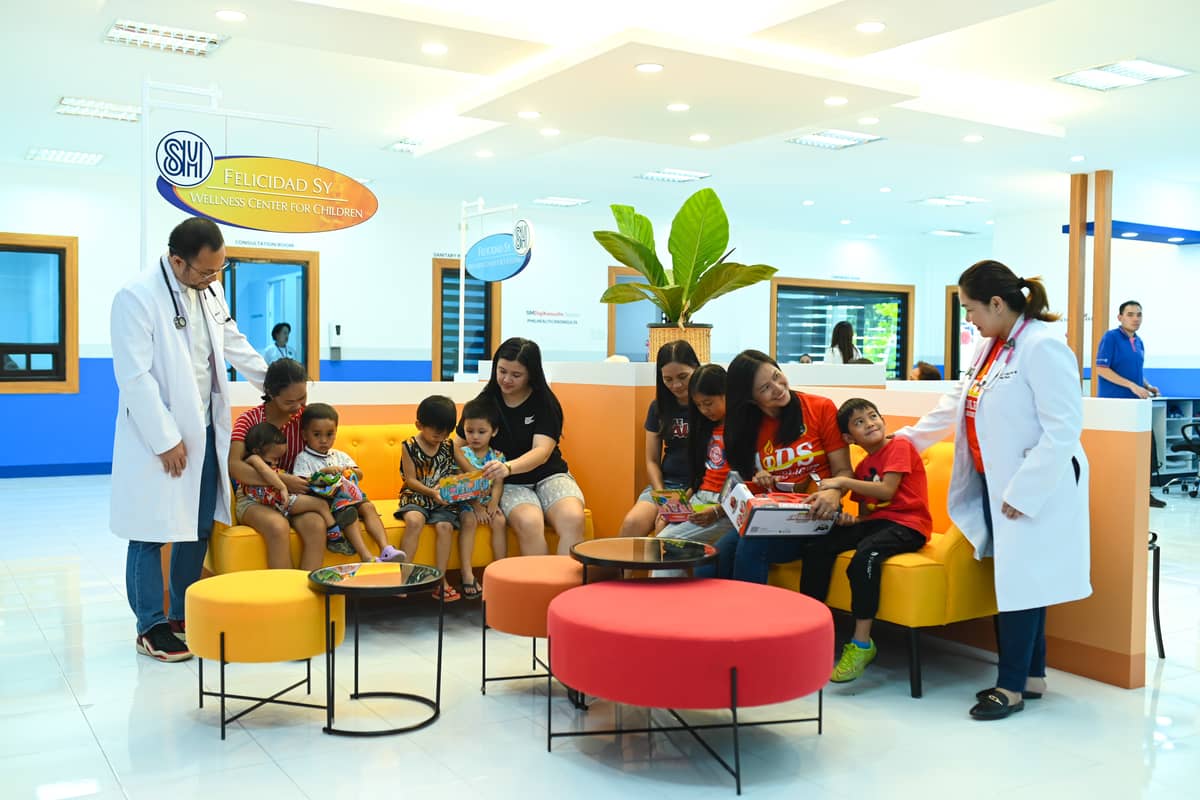
HEALTHCARE closer to home SM Foundation’s Health and Wellness project has transformed the Polomolok East Community Clinic in Barangay Cannery, Polomolok, South Cotabato, into a modern beacon of care. In partnership with Mahintana Foundation and the local government unit, the renovated facility now serves nearly 50,000 residents — especially those in geographically isolated and disadvantaged areas and indigenous communities. The upgraded clinic features specialized zones for animal bite treatment, TB-DOTS, nebulization, counseling and family planning, plus an enhanced dental clinic, breastfeeding room, play areas for children, Felicidad T. Sy spaces for the elderly and eco-friendly rainwater harvesting.
Photograph courtesy of SM Foundation
Tailor-fit programs
That insistence on continuity carries through to the wellness centers, established a year later.
These are not new constructions but rehabilitations, existing health facilities assessed, renovated and aligned with national standards.
Uy describes a process that adapts to each community rather than imposing a uniform design: “We tailor-fit our program to their needs in the community.”
The work begins with requests, extends through site visits, and culminates in facilities designed to function long after turnover.
Carbonell’s role sharpens the picture by focusing on what happens after that handover.
If Uy builds systems, Roma maintains them.
Foundation’s one-two punch
“The challenge that we see is the maintenance,” she admits, pointing to the slow, less visible work of revisiting centers, assessing wear, and restoring what time and use inevitably erode. Their model depends not just on delivery, but on return.
Across the conversation, scale surfaces in fragments. Around 80 medical missions a year. Mobile clinics equipped for diagnostics.
Facilities spread across Luzon, Visayas and Mindanao. Yet both consistently redirect attention away from numbers and toward collaboration.
The work, they stress, is shared with local government units, volunteer doctors, and partner organizations, which form the backbone of implementation.
Carbonell distilled the philosophy that underlies everything they have described.
“We also wanted people to feel that healthcare is not a privilege… It is essential for everyone.”
It is less a conclusion than a quiet assertion of purpose — one that reflects the steady, system-driven approach both she and Albert have outlined throughout the conversation.
What remains is a portrait not of personalities, but of persistence, two figures working within a structure designed to extend beyond them, where impact is measured not by singular moments, but by whether care continues to reach the places that need it most.