
Mangrove memos spawn conservation challenge
DILG Memorandum Circular 2025-066 tasks local government units to lead the rehabilitation and reforestation of degraded mangrove sites.

A long-delayed greenbelt zone law and new challenges posed by memorandum circulars from two government agencies greeted conservationists at the Philippine Mangrove Conference 2026 (PMC).
Global Mangrove Alliance-Philippines (GMAP), which groups mangrove stakeholders in the country, and the Biodiversity Management Bureau (BMB) of the Department of Environment and Natural Resources (DENR), held the PMC with the theme “Ensuring Accountable Pathways for Resilient Communities” on 24 to 26 March at Microtel Wyndham in Quezon City to revitalize concerted efforts to conserve, rehabilitate and protect greenbelt zones in the country.
Participants, including mayors, pledged support to the Philippine Biodiversity Strategy and Action Plan and National Blue Carbon Roadmap, as the Philippines NBCAP Blue Carbon Ecosystems Explorer — an interactive platform for key blue carbon datasets, including mangroves, seagrass, tidal marshes, and restoration areas — was launched on the last day.
GMAP officers also pledged to intensify lobbying for the passage of stalled greenbelt zone bills in Congress to protect more than 300,000 hectares of mangrove areas nationwide. Four related bills are currently filed in the House of Representatives and awaiting deliberation in the committee level, according to the Zoological Society of London-Philippines (ZSL), one of the non-government organizations composing the alliance.
On the second day of the conference, ZSL speaker Jurgenne Primavera, a marine biologist leading efforts to bring back mangroves in the Philippines, revealed that an online petition on change.org for the recall of DENR memorandum circular dated 8 October 2025, titled “Interim Operational Guidance and Conditions on the Earth-Balling and Relocation of Mangroves in Exceptional Circumstances,” had garnered more than 8,000 signatures.
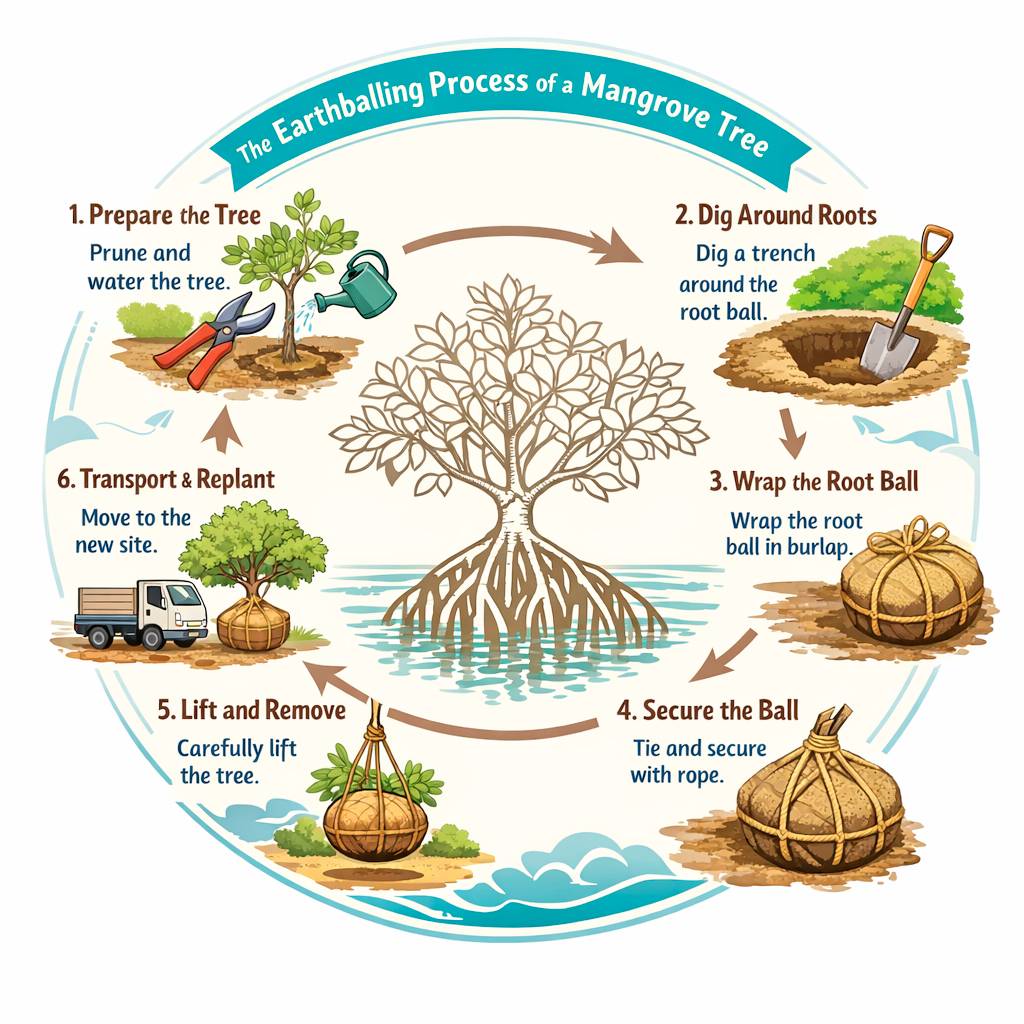
MANGROVE conservationists are opposing the DENR interim memo on earth-balling.
ILLUSTRATION BY COPILOT
ZSL is demanding the withdrawal of the memo allowing the earth-balling and relocation of mangroves for infrastructure “flagship projects” endorsed by government authorities, once proponents claim that all other mitigation measures have been exhausted.
“Allowing exemptions for infrastructure projects creates a clear pathway for mangrove removal across the country, particularly in ecologically sensitive coastal areas,” the petition warned. “If left unchallenged, this interim guidance risks becoming standard operating procedure across DENR regional offices, effectively rolling back decades of mangrove protection policy in the Philippines.”
On the first day of the PMC, BMB assistant director Mariglo Laririt said in a press conference that a study is being conducted by the Ecosystems Research and Development Bureau, the research arm of DENR, focusing on what to do if projects already have been designed, contracted and started.
“Once the studies conclude, we will need to either revise that memo or — ideally — elevate it to an administrative order to make it more binding,” she said.
Meanwhile, Engr. Jeff Miranda, from the Department of the Interior and Local Government’s Bureau of Local Government Supervision, presented, on Day 2 of the PMC, the DILG Memorandum Circular 2025-066, which tasks local government units (LGUs) to lead the rehabilitation and reforestation of degraded mangrove sites, and enforce environmental safeguards such as bans on mangrove cutting, shoreline encroachment, and destructive fishing practices.
The circular also enjoins LGUs to enact ordinances declaring greenbelt zones as protected areas or local conservation areas, and to integrate a coastal greenbelt management and action plan into their comprehensive land use plans, local climate change action plans, and Disaster Risk Reduction and Management Plans.
“Planting just anywhere is not allowed. It should be targeted and evidence-based,” Miranda said, referring to one of the rationales of the memo.
Mayor Melchor Mergal of Salcedo, Eastern Samar said the intention of the DILG memo is good but expressed reservations over how resource-lacking town can comply with it.
“We don’t have the technical capability to, for example, to delineate municipal waters,” Mergal said. “It’s not easy to implement it on the ground without supporting mechanisms,” he added.
Prieto Diaz, Sorsogon board member Benito Doma advised local executives to use the resources that they have and tap people’s organizations that economically benefits from mangroves in implementing the DILG memo.
Doma said he did it when he was mayor, Prieto Diaz, an effort that earned the Best Mangrove Award in the Bicol region from the DENR in 2020.
PMC underscored a national commitment to protect the country’s mangrove ecosystems — safeguarding coastal livelihoods, shielding communities from climate risks, and strengthening resilience for generations of Filipinos.