
How Rain Vortex at Singapore’s Jewel Changi Airport elevates indoor landscape


DAILY TRIBUNE recently published a travel story about a recent visit to Singapore, characterizing the landing at Changi Airport as a clear confirmation of the country’s global renown.
According to the newspaper, the long-held assertion that Singapore is incredibly clean and has stunning architecture turned out to be totally true.
The airport was described as immaculate, extremely well-organized, and visually arresting — a setting that quickly distinguishes it from other airports.
It was marketed as a contemporary architectural landmark that exemplifies Singapore’s dedication to excellence in both architecture and public infrastructure, rather than merely serving as a transit hub.
Singapore’s Changi Airport is widely regarded as one of the best airports in the world, not only for its efficiency but also for its groundbreaking architecture and passenger experience. Consistently ranked at the top of global airport awards, it has earned this reputation by redefining what an airport can be: not just a transport hub, but a destination in itself.
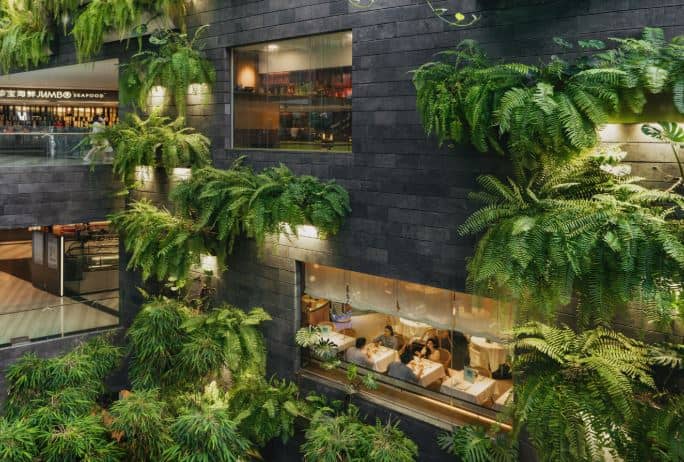
IMMERSE yourself in this garden wonderland and meet Singapore, the City in Nature.
Changi Airport’s flawless fusion of comfort and functionality is one of the key factors contributing to its widespread praise. With thousands of weekly flights connecting Singapore to about 170 cities, the airport is one of Asia’s most significant aviation hubs. Simultaneously, it places a high priority on the passenger experience with effective services, entertainment, and leisure areas. What is usually a difficult ride is made delightful by features like gardens, art installations and recreational activities.
Step out of the airport right into a lush green sanctuary, a tranquil retreat in the core of the world’s best transport hub. Immerse yourself in this garden wonderland and meet Singapore, the “City in Nature.”
But what really makes Changi unique is its innovative architecture, especially the famous Jewel Changi Airport, which was created by famed architect Moshe Safdie. Jewel is a groundbreaking area that unites infrastructure, retail and the natural world into a seamless whole. It is more than just an extension of the airport.
Jewel’s eye-catching glass-and-steel dome, formed like a torus (a doughnut-like form), is the focal point of its design. This construction maintains a controlled environment for both humans and plants while letting in an abundance of natural light. In order to prevent aircraft noises from disturbing the peaceful interior ambiance, the dome is designed to minimize outside noise.
Rain Vortex, the tallest indoor waterfall in the world at almost 40 meters, is the focal point of this architectural wonder. A spectacular visual and sensual experience is produced when water flows down through several levels from the oculus at the roof. In addition to being aesthetically pleasing, the waterfall is sustainable because rainwater is collected and recycled, demonstrating Singapore’s dedication to environmentally friendly architecture.
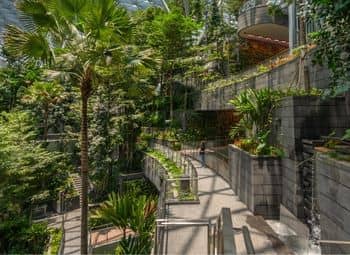
WALKING trails.
Forest Valley, a multi-story indoor garden with hundreds of plant species, encircles the Rain Vortex. This lush setting is more than just ornamental; it embodies the idea of biophilic design, which incorporates natural into constructed spaces to enhance wellbeing. The effect is a serene, almost rainforest-like ambiance that stands in stark contrast to the usual airport sterility.
Jewel also houses more than 2,000 trees and palms, and over 100,000 shrubs covering a total area of more than 21,000sqm. There are some 120 species, originating from countries all around the globe, such as Australia, Spain, Thailand and the United States.
Serving as a connection in architecture, Jewel’s circular shape connects several airport terminals, facilitating seamless transitions between areas while preserving visual coherence. This combination of public space and infrastructure shows how architecture can improve experience and usefulness.
The way Changi reimagines the airport as a social and cultural arena is another important facet of its greatness. Jewel draws both locals and tourists with its hundreds of stores, eateries and attractions. This change turns the airport from a strictly utilitarian transit zone into a thriving urban hub.
Singapore’s Changi Airport’s success ultimately stems from its all-encompassing strategy. It blends human-centered architecture, sustainable design and state-of-the-art engineering to produce an environment that is effective, lovely and emotionally compelling. By fusing infrastructure, technology and nature, it establishes a new standard for airports worldwide.