
The steering wheel may disappear
The steering wheel has defined the automobile for more than a century. Drivers sit behind it and use it to guide the vehicle along the road.


If you are around my age, you might remember Johnny Cab, the robotaxi from Arnold Schwarzenegger’s film Total Recall. The vehicle carried passengers without a human driver and relied on an onboard robotic system to handle the trip. At the time it looked like a piece of science fiction.
What stood out in that scene was not only the absence of a human driver but the possibility that the steering wheel might no longer be necessary.
The steering wheel has defined the automobile for more than a century. Drivers sit behind it and use it to guide the vehicle along the road.
That familiar object may not remain part of future vehicles.
Several companies now experiment with vehicles that do not include a steering wheel. These vehicles rely on autonomous systems that control direction and speed without human input.
Tesla presented a concept vehicle called the Cybercab that removes both the wheel and the pedals. The vehicle is intended for a robotaxi service. Passengers choose a destination and allow the system to complete the trip.
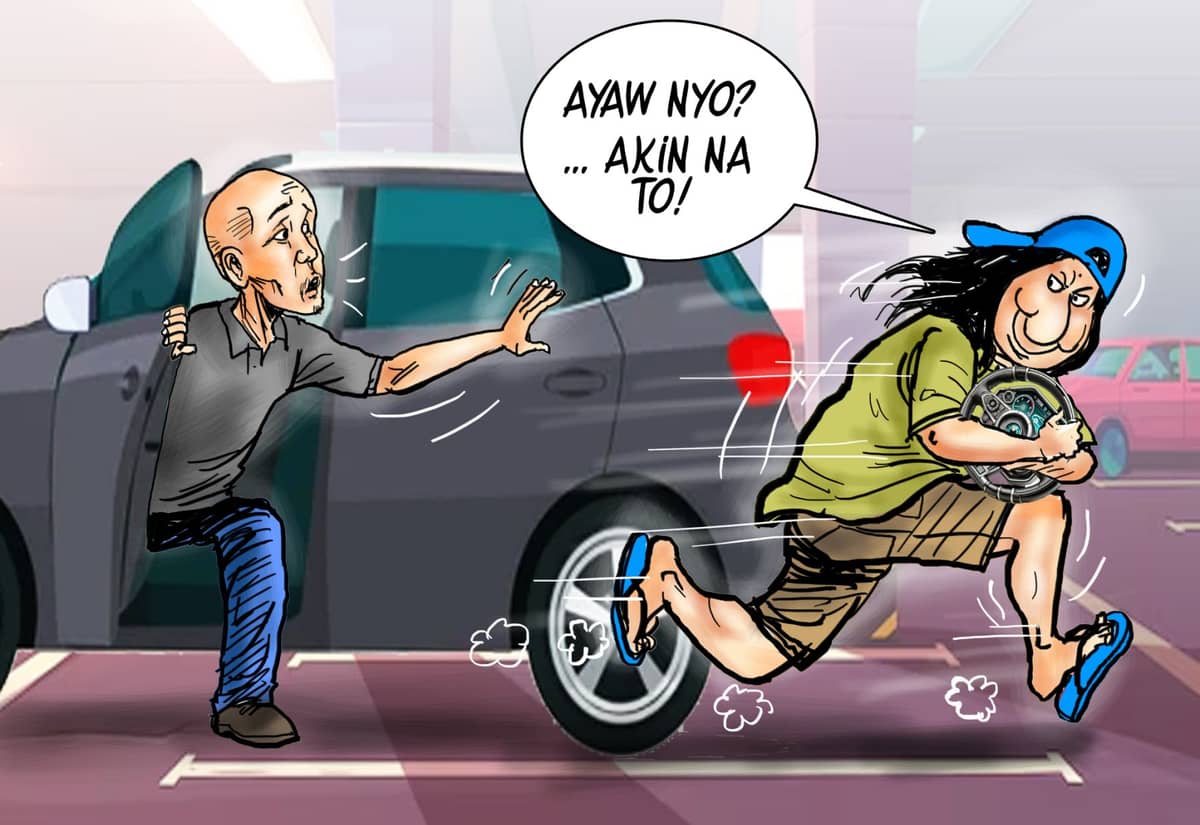
Illustration BY GLENZKIE TOLO
Waymo has tested autonomous ride services in several American cities where passengers sit inside while the vehicle travels through traffic without a human driver.
When engineers remove the steering wheel, they must reconsider how the interior of a car works. That arrangement changes once a vehicle no longer requires someone to drive it.
Design changes represent only one part of the challenge. Traffic laws assume that a person operates the vehicle.
Police officers, or in our case, Metropolitan Manila Development Authority (MMDA) personnel and traffic enforcers, expect a driver who can answer questions during an incident. Insurance policies assign responsibility to the person behind the wheel.
A vehicle that drives itself complicates those expectations.
Autonomous systems depend on sensors and computing power to understand the road. Cameras and radar monitor the surroundings, and software evaluates that information to determine how the vehicle should respond.
Supporters believe automation could reduce accidents linked to human behavior. Many crashes involve distraction or fatigue. Technology does not experience those conditions.
Critics remain cautious because real streets present situations that engineers cannot fully predict. A motorcycle may appear beside the car. A pedestrian may step into the lane without warning.
Human drivers rely on judgment shaped by experience. Autonomous vehicles depend on programming and large volumes of data.
The steering wheel, therefore, represents more than a mechanical control. For generations, it symbolized the driver’s authority over the machine.
A vehicle that drives itself changes the relationship between people and cars. The system performs the driving task while the person inside no longer controls the vehicle.
That scenario raises an amusing question for motorists in Manila. When a car has no driver, who does the MMDA or traffic officer wave over?
Some drivers might immediately think of the intersection near Pureza and Ramon Magsaysay Boulevard, where enforcers sometimes stand behind the flyover posts and step out at the last second to flag a vehicle.
A robotaxi with no steering wheel might leave them with nobody to pull aside and no driver’s license to examine.
That transition will take time. Governments must write new rules while engineers work to demonstrate reliability, and the public gradually gains confidence in the technology.
Discussions about driverless vehicles already take place across the industry.
One day, the steering wheel may appear as outdated as other tools from earlier automotive history. It may survive only as a memory of how drivers once guided their cars.
The steering wheel remains in front of every driver for now but engineers and designers already imagine vehicles that no longer need it.