




Toyota Hilux enters electric shift

Text size
Bangkok, Thailand — Toyota has pulled the covers off the all-new ninth-generation Hilux in Bangkok, giving its iconic pickup more power, more tech, and, for the first time, a full battery electric version.
The current Hilux has been around for about a decade, and rivals have been rolling out newer pickups with more safety and electrified options.
The new model is Toyota’s answer to that pressure, and it comes with a message that the Hilux will move toward cleaner power without losing its tough-truck image.
Under Toyota’s multi-pathway approach, the new Hilux family will eventually include several powertrains. Thailand gets an improved 2.8-liter turbo diesel as the mainstay, while other markets will also see a 48V mild-hybrid version and a 2.7-liter gasoline engine.
A hydrogen fuel cell Hilux is also in the pipeline, with production aimed for 2028 in selected markets.
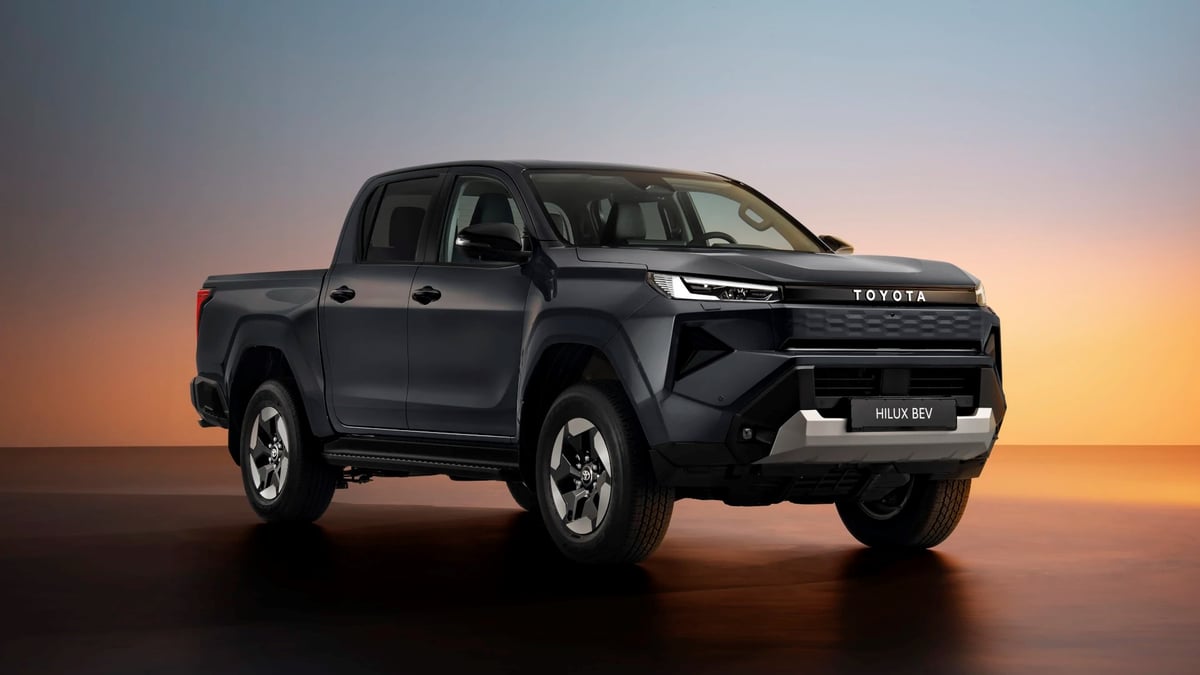
The star of the launch is the Hilux BEV, known in Thailand as the Hilux Travo-e. It uses a 59.2 kWh lithium-ion battery and dual eAxles for permanent all-wheel drive. Output is pegged at around 193 hp, with strong torque from the front and rear motors.
Toyota is targeting a driving range of more than 300 km, with 10 kW AC charging and up to 125 kW DC fast charging to cut downtime for owners who use their trucks for work.
The BEV can wade through 700 mm of water, carry about 715 kg, and tow up to 1,600 kg. The battery is mounted within the ladder frame and protected by what Toyota calls a Diamond Guard system to keep it safe during serious off-road use.
Visually, the new Hilux takes a bigger step away from the conservative look of the outgoing model. The front end is boxier and more upright, with slim headlamps framing a broad panel that carries a bold “TOYOTA” script in place of the usual logo.
The cabin is available in Double Cab form, which shows global demand for pickup trucks that double as family vehicles. The dashboard is dominated by two 12.3-inch screens, one for the driver and one for infotainment.
Physical buttons for the climate controls remain, a small but important win for users who prefer quick, no-nonsense adjustments while driving.
The BEV variant gets a different shift selector similar to Toyota’s other electric models, plus an electronic parking brake with auto hold. Depending on variant and market, there are USB-C ports for front and rear passengers, wireless charging, and dual-zone climate control with rear vents. Storage spaces are tucked neatly into the dash and console.
On the tech and safety side, the Hilux now offers connected services through the MyToyota app, which can be useful for both private owners and fleet operators. Toyota T-Mate driver assist features are available, including an updated Toyota Safety Sense package.
Systems such as low-speed acceleration suppression, proactive driving assist, blind spot monitoring, safe exit assist, emergency driving stop, and a driver monitor camera are part of the suite, with some functions future-proofed for over-the-air updates.
Electric power steering, four-wheel disc brakes, and a retuned suspension aim to give the truck better comfort and control on the road, while a Multi-Terrain Select system helps manage grip in mud, sand, and other challenging surfaces.
Production of the new Hilux will be based in Thailand, which has long been a major hub for the nameplate. Prices for the ninth-generation Hilux start at 789,000 baht (about P1.43 million) and go up to 1,366,000 baht (around P2.48 million). The Hilux EV is priced at 1,491,000 baht (roughly P2.71 million).
Toyota Motor Philippines has yet to make any official announcement on timing or powertrain mix, or if it will reach the Philippine market at all.
Three decades after the Marcopper mining disaster devastated Marinduque’s waterways, the province is again pressing the…
Housing is probably the biggest issue affecting people the world over.
Malacañang on Monday called for a more thorough investigation into the questioned flood control projects in Taguig…
The defense on Monday backed the move by senator-judges to exclude a prosecution witness who testified on the firearms…
