
U.S., India launch powerful Earth-monitoring satellite
Data will also be used to help guide agricultural policy by mapping crop growth, tracking plant health, and monitoring soil moisture.
Text size
Data will also be used to help guide agricultural policy by mapping crop growth, tracking plant health, and monitoring soil moisture.
A formidable new radar satellite jointly developed by the United States and India launched Wednesday, designed to track subtle changes in Earth’s land and ice surfaces and help predict both natural and human-caused hazards.
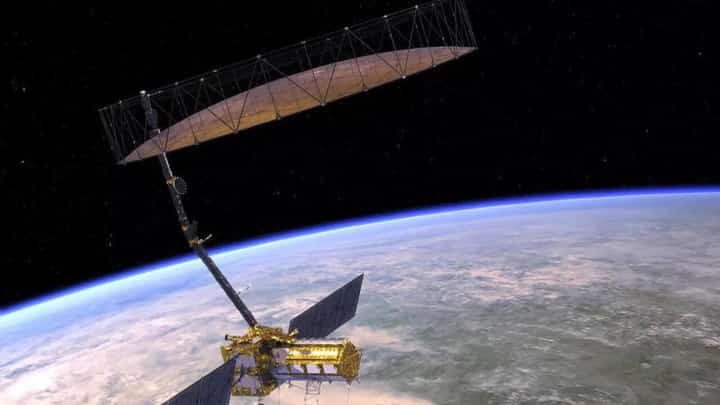
Dubbed NISAR (NASA-ISRO Synthetic Aperture Radar), the pickup truck-sized spacecraft blasted off around 5:40 p.m. (1210 GMT) from the Satish Dhawan Space Center on India’s southeastern coast, riding an ISRO Geosynchronous Satellite Launch Vehicle rocket.
Livestream of the event showed excited schoolchildren brought to watch the launch and mission teams erupting in cheers and hugging.
Highly anticipated by scientists, the mission has also been hailed by US President Donald Trump and Indian Prime Minister Narendra Modi as a milestone in growing cooperation between the two countries.
“Congratulations India!” Dr Jitendra Singh, India’s science and technology minister wrote on X, calling the mission a “game changer.”
“Our planet surface undergoes constant and meaningful change,” Karen St Germain, director of NASA’s Earth Science division, told reporters ahead of launch.
“Some change happens slowly. Some happens abruptly. Some changes are large, while some are subtle.”
By picking up on tiny shifts in the vertical movement of the Earth’s surface — as little as one centimeter (0.4 inches) — scientists will be able to detect the precursors for natural and human-caused disasters, from earthquakes, landsides and volcanoes to aging infrastructure like dams and bridges.
“We’ll see land substance and swelling, movement, deformation and melting of mountain glaciers and ice sheets covering both Greenland and Antarctica, and of course, we’ll see wildfires,” added St Germain, calling NISAR “the most sophisticated radar we’ve ever built.”
India in particular is interested in studying its coastal and nearby ocean areas by tracking yearly changes in the shape of the sea floor near river deltas and how shorelines are growing or shrinking.
Data will also be used to help guide agricultural policy by mapping crop growth, tracking plant health, and monitoring soil moisture.
In the coming weeks, the spacecraft will begin an approximately 90-day commissioning phase during which it will unfurl its 39-foot (12-meter) radar antenna reflector.
Once operational, NISAR will record nearly all of Earth’s land and ice twice every 12 days from an altitude of 464 miles (747 kilometers), circling the planet near the poles rather than around the equator.
Microwave frequencies
As it orbits, the satellite will continuously transmit microwaves and receive echoes from the surface.
Early-stage cancer can be more easily treated than in the later stages. That is why doctors recommend regular cancer…
‘As far as I recall and based on the record, there is no showing.’
President Ferdinand Marcos Jr. is flying to Singapore for a five-day working visit upon the invitation of Singaporean…


