
Cosmic sparks: Mysterious flares dance around Milky Way’s black hole
Astronomers uncover an unpredictable ‘light show’ near Sagittarius A, challenging our understanding of black holes.
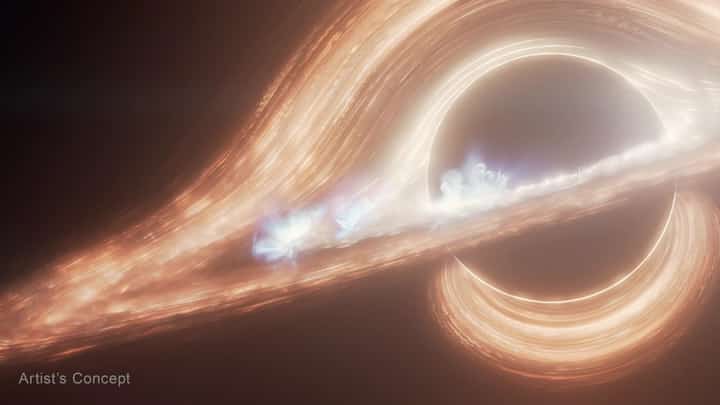
This artist's concept shows Sagittarius A*, a supermassive black hole at the center of the Milky Way galaxy, surrounded by a swirling accretion disk of hot gas. Flaring hot spots that resemble solar flares are seen in the disk.
NASA, ESA, CSA, Ralf Crawford (STScI)
For decades, black holes have remained one of the universe’s most enigmatic phenomena. But recent observations from NASA’s James Webb Space Telescope (JWST) have revealed a dazzling new spectacle at the heart of our galaxy: erratic bursts of light flickering near Sagittarius A*, the supermassive black hole anchoring the Milky Way.
A team of astrophysicists from Northwestern University monitored Sagittarius A* for 48 hours over a year, capturing an unprecedented display of flares. These bursts—some lasting mere seconds, others glowing for hours—suggest chaotic and unpredictable activity within the black hole’s accretion disk, the swirling flow of gas and plasma orbiting its event horizon.
The Science Behind the Show
Sagittarius A* is no stranger to flare activity, but what sets these observations apart is their irregularity. Lead researcher Farhad Yusef-Zadeh explains that while flares are expected in such environments, the ones recorded here vary wildly in intensity and duration, making it impossible to establish a steady pattern.
Scientists suspect that two primary mechanisms drive this phenomenon. Some flares may stem from turbulent fluctuations within the disk, where hot plasma compresses and releases energy. Others could be the result of magnetic reconnection events—a process akin to solar flares, where tangled magnetic fields snap and unleash bursts of radiation moving near the speed of light.
Why It Matters
These observations not only deepen our understanding of black holes but also hold broader implications for astrophysics. By studying how matter interacts with extreme gravity, astronomers can refine theories about space-time, test Einstein’s general relativity, and gain insights into galaxy formation.
Moreover, Sagittarius A* provides a unique laboratory for studying accretion disk behavior. Unlike more active black holes in other galaxies, our own central giant offers a relatively quiet—but still dynamic—environment for long-term observation.
What’s Next?
While this “cosmic fireworks” show has been thrilling to witness, astronomers are eager for a longer, uninterrupted look—perhaps a full 24-hour observation. Such data could help determine if these flares follow any hidden periodic patterns or if they are purely random.
As telescopes like JWST continue to push the boundaries of deep-space exploration, the mysteries of black holes may not remain mysteries forever. But for now, Sagittarius A* remains a celestial enigma—one that dazzles, confounds, and keeps astronomers watching in awe.
(Sources: NASA; CNN Science; Chandelis Duster, NPR Org; Ty Roush, Forbes)