




Abandon 9-dash lies
“Beijing can’t blame the Philippines for the grudgingly slow pace of the CoC negotiations since it is the one throwing roadblocks to its realization.

Text size
“Beijing can’t blame the Philippines for the grudgingly slow pace of the CoC negotiations since it is the one throwing roadblocks to its realization.
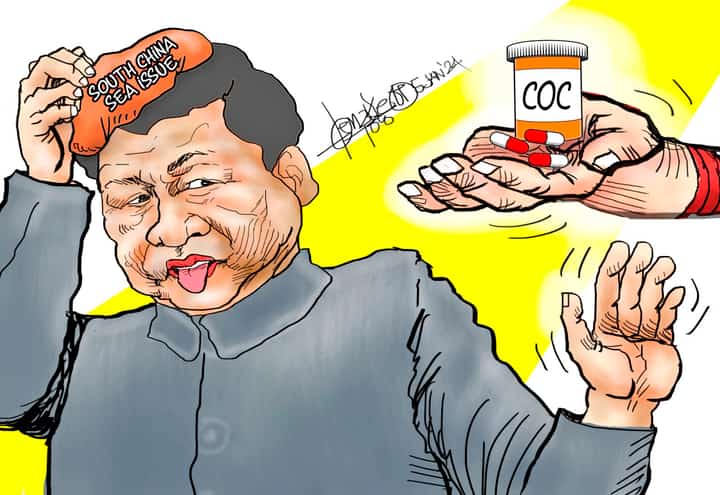
China is now the one prodding the Association of Southeast Asian Nations, or ASEAN, to get on with the Code of Conduct, or CoC, which has been stuck in limbo for more than 20 years due to its impossible demands.
In his recent trip to the United States, President Ferdinand "Bongbong" Marcos Jr. laid on the table the possibility of ASEAN creating its own CoC without the Asian giant, a statement that jolted the Chinese communist party leadership.
In Honolulu, Marcos said, "We are now negotiating our code of conduct, for example, with Vietnam because we are still waiting for the code of conduct between China and ASEAN, and progress has been rather slow, unfortunately."
To counter the proposal, China uses its economic leverage on Malaysia and Vietnam to dissuade those countries from participating in the Marcos formula.
The CoC, unlike the consensual Declaration on the Conduct of Parties in the South China Sea, or DoC, is an agreement that will bind all the signatories. But China has tried to impose the condition of setting aside third-party involvement, which would mean shelving the 2016 arbitral award invalidating its nine-dash line claim over the entire South China Sea.
China has been brandishing the DoC in its complaint against the Philippines regarding its allegations of incursions in Ayungin Shoal, a sea feature that falls within the Philippines' exclusive economic zone as defined in the United Nations Convention on the Law of the Sea, or UNCLOS.
China said Marcos had mistakenly believed that Malaysia and Vietnam would go along with his suggestion.
One of its mouthpieces said, "Despite Vietnam's collaboration with the Philippines on the South China Sea arbitration, it has not yet formally filed its case with the Hague Tribunal."
The question is why Vietnam should do that since the tribunal's ruling clearly delineated entitlements in the disputed waterway. Another case would be redundant unless China agrees to participate in it this time.
Beijing can't blame the Philippines for the grudgingly slow pace of the CoC negotiations since it is the one throwing roadblocks to its realization.
Looking at it from a distance, the CoC without China is feasible since it will create a formidable negotiating body to negotiate a fair agreement on sea disputes.
Beijing accused Marcos of threatening China by talking with the ASEAN members to draft a separate agreement to settle the territorial disputes.
China must step down from its ivory tower to allow an equal discussion on the overlapping areas.
It has refused to give up a historical claim that nobody recognizes.
The friction could simmer down with Beijing's action. Also, it should refrain from resorting to the deception that it is the Philippines instigating a flare-up in hostilities because Filipino forces are merely exercising their obligation to their people.
Regarding the naval exercises, China does not have the right to interfere with the treaty partners exercising what is contained in the agreement that binds both the Philippines and the United States.
Similar to what it demands, China, as a third party, should not be involved in acts between the two strategic allies.
China's first move if it wants to show its sincerity in de-escalating tensions in the WPS should be to acknowledge the Permanent Court of Arbitration ruling and abandon its historical nine-dash line claim.
Early-stage cancer can be more easily treated than in the later stages. That is why doctors recommend regular cancer…
‘As far as I recall and based on the record, there is no showing.’
President Ferdinand Marcos Jr. is flying to Singapore for a five-day working visit upon the invitation of Singaporean…
