




Geopolitics and shock-prone world
That scenario would have oil prices skyrocketing to $150 a barrel and global growth dropping to 1.7 percent.
Text size
That scenario would have oil prices skyrocketing to $150 a barrel and global growth dropping to 1.7 percent.
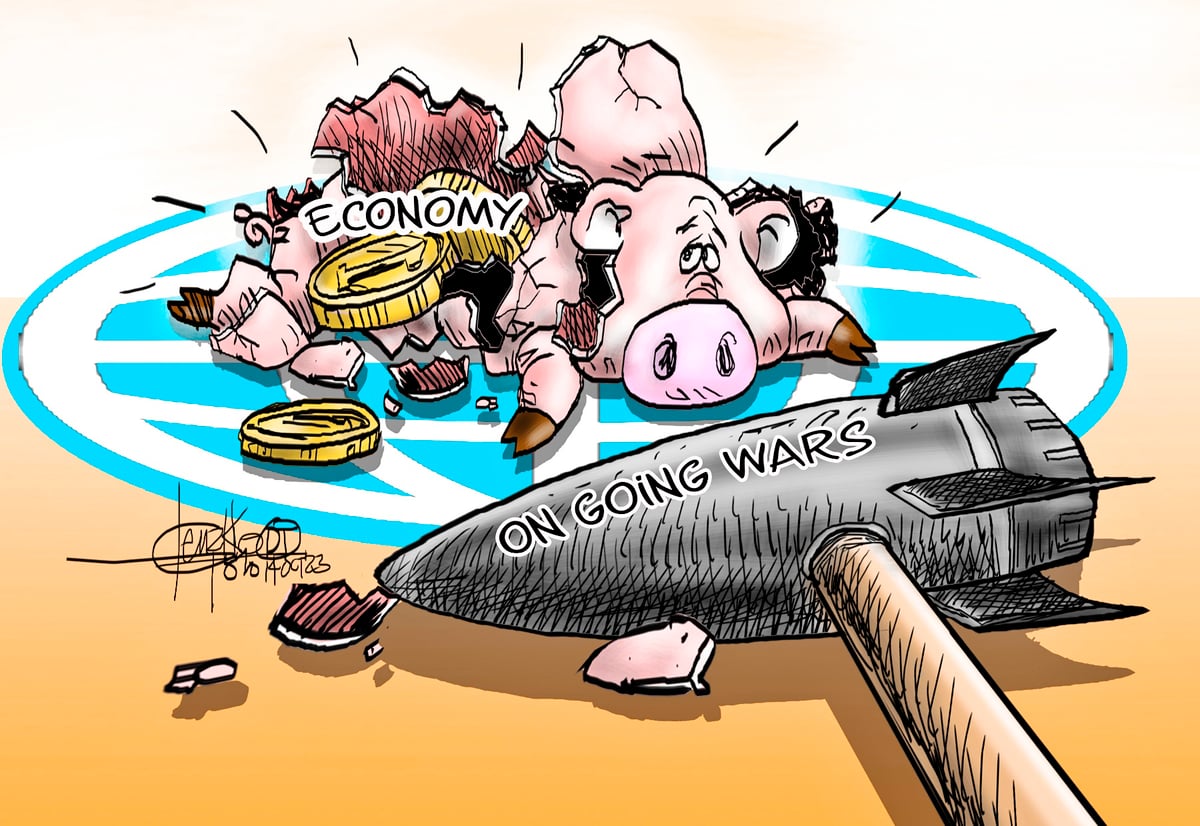
How much more battering can the world economy withstand before the whole floor caves in, sucking us all, rich and poor countries alike, down the pits of war and a global depression?
The world economy was already slowing down as a result of the Russian assault on Ukraine, and then comes this ferocious unleashing of hate and violence between Hamas and Israel, provoked by the former's launching of a multi-front assault on Israel and the killing of over a thousand Israelites, including children and babies.
The swiftness and brutal ferocity of the strike by Hamas militants who swept across the border into Israel, launching an unprecedented wave of bloody attacks on villages near the Gaza Strip, killing over a thousand, and taking away hundreds of hostages, stunned Israel and the world.
What was even more shocking was to realize that the ultra-sophisticated defense system put up by what is arguably the most powerful military in the Middle East proved inutile against Hamas.
The latter eluded Israel's Iron Wall, the $1.1-billion 40-mile-long security barrier separating Gaza from Israel. Finished in 2021, it includes a sensor-equipped 20-foot tall fence with hundreds of cameras and automated machine gun fire when sensors are tripped. There is, too, Israel's $1.5-billion air defense system, the Iron Dome, built in 2011 to protect Israelites from rocket attacks launched from Gaza.
Bristling with anger and wounded pride, Israeli Prime Minister Benjamin Netanyahu vowed the virtual total decimation of Hamas. On Wednesday, he declared, alongside US Secretary of State Anthony J. Blinken: "Every Hamas member is marked by death; Hamas is ISIS, and just as ISIS was crushed, so too will Hamas be crushed."
A critical dilemma is how long this will take — the total destruction of the militant organization that hates Israel with a vengeance, and how exactly this will be undertaken.
Invading Gaza, one of the most densely populated areas in the world with 2.3 million inhabitants crammed within a territory 41 kilometers long and 10 kilometers wide, is a daunting proposition, particularly since Hamas, the militant Islamist group that has controlled the Strip for 17 years, is well acquainted with the terrain, operating in a complex network of tunnels, with concealed weapons propped amid the populace, using non-combatants as human shields.
Then there is the fear that any long-drawn-out operation to secure Israel's objectives against Hamas would become a protracted bloody affair, resulting in the death of many innocent Palestinians (not to mention Israelite combatants ), and draw Israel's enemies, particularly Iran, and militants in Lebanon and Syria that support Hamas, into the fray.
That scenario would have oil prices skyrocketing to $150 a barrel and global growth dropping to 1.7 percent. This recession would strip off world output by some $1 trillion, per Bloomberg Economics analysis.
Not surprisingly, world economic and finance ministers are more than jittery about the consequences and further outcomes of the bloody Israel-versus-Hamas mess, faced as they are with a terribly vulnerable world economy that has hardly recovered from crippling inflation exacerbated by the war waged by Russia in Ukraine.
Tension in that part of the world is what preoccupies the fiscal and central banking elite currently congregating at the International Monetary Fund's annual meeting in Marrakech, Morocco.
IMF Managing Director Kristalina Georgieva said, "We are closely monitoring how the situation will evolve, in terms of economic impact, how it is particularly affecting oil markets."
She added that the world's governments and policymakers will have to get used to the fact that geopolitical risks will not soon disappear. "We are in a shock-prone world; I do not know when the next shock is going to be, I just know that it will come."
The "shock" that Georgieva fears could be an escalation of a regional war in the Middle East and how it will affect the global economy, seeing how a significant percentage of the oil supply comes from that part of the world.
The big loss of Israeli lives and Israel's top leaders' determination to scorch the earth occupied by Hamas — whose raison d'etre, in turn, is to see the total extinction of Israel — are dimming hopes for a more stable Middle East.
A new conflagration, other than the Russian assault on Ukraine, the US-China trade war, and heating tension over Taiwan, and now, the likelihood of an escalated regional war in the Middle East, indicates that geopolitics is the driver of markets' behavior and the world economy.
An oil shock resulting from a long-drawn-out regional war in the Middle East would derail efforts to rein in oil prices, and unless a resolution to the conflict between Israel and Hamas could be worked out, somehow, in the speediest possible time, who knows what kind of world we would wake up to, and where we'd all be at this time, next year?
Housing is probably the biggest issue affecting people the world over.
Malacañang on Monday called for a more thorough investigation into the questioned flood control projects in Taguig…
The defense on Monday backed the move by senator-judges to exclude a prosecution witness who testified on the firearms…
