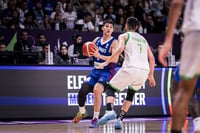
Pumaren on naturalization: ‘We were ahead of our time’



PHNOM PENH – Even before the wave of naturalized players poured in this year in the Southeast Asian Games, Franz Pumaren had seen it as early as four decades ago.
He was a part of the Northern Consolidated Cement team which bankrolled the Philippine men's basketball squad program during the 1980s and played for the team until the EDSA Revolution forced officials from cage governing body to scrap the program.
But that NCC-backed Philippine squad has three naturalized players, who went on to represent the country – Jeff Moore, Dennis Still and Arthur "Chip" Engelland.
Moore and Still reinforced the Philippine squad and helped the team in ruling the Asian Basketball Confederation (now known as FIBA Asia Cup), which was played on from December late December of 1985 to early January of 1986.
Engelland was a key part of the Philippine squad in winning the 1985 Jones Cup and dazzled the opposition when he played in the World Inter-Club tournament.
"We were way, way ahead of our time, even against teams in Europe," said Pumaren, who also played for San Miguel Beer's multiple champion squads, including the grand slam in 1989 and Mobiline before retiring and becoming a multi-titled coach for La Salle in the Universities Athletic Association of the Philippines.
"I think we were the first introduce naturalizing players. During that time, Asia was not ready for that," he added. "But looking back, we started this process."
Now a lawmaker himself, Pumaren is very much particular when it comes to rules and procedures and as long as it is legal to naturalize players regardless of how many they are, then there's no reason for us to complain.
He is not aware though if there's a limit to the number of naturalized players to be allowed to every competing nation in the SEA Games.
"Maybe, that's the policy when you're a host team," said Pumaren, now the Representative of the Third District of Quezon City to the Congress. "You can propose new law. And of course, it's easy for them to get naturalized players, but the only question there is how many naturalized players are allowed?"
"I was watching the warm up of Cambodia women's team and there are a lot of American players. I don't know if there's a limit for naturalized players."